





Building an Edtech Application like AuximTec in India
- What Is AuximTec and Why Does It Stand Out?
- Why Build an Edtech Application in India Now?
- Core Features Required to Build an App Like AuximTec
- Step-by-Step Process for Edtech App Development in India
- Cost to Build an Edtech Application in India
- Factors That Affect Development Cost
- Trending Aspects in Indian Edtech Platforms
- Architecture Framework for Scalable Edtech Platforms
- Monetisation Models for Edtech Platforms in India
- Challenges in Building an Edtech App in India
- Future of Edtech App Development in India
- Choosing the Right Edtech App Development Company in India
- Conclusion
- Why iProgrammer Solutions for Edtech App Development
Most leadership consulting firms face a common problem. They have strong facilitators. Proven frameworks. Engaged clients. Yet the impact was difficult to measure across cohorts.
Assessments were delivered separately. Coaching notes lived in private documents. Training sessions were powerful but not always connected to long-term behavior change. Reporting to client organizations required manual consolidation.
AuximTec, was built to close this gap with structure, visibility, and accountability.
If you are planning to build a platform similar to AuximTec, you are not building a course portal. You are building a leadership transformation system. One part assessments. One part training. One part coaching. All integrated into a measurable journey.
This blog walks through the essential layers required to build such a platform.
At, iProgrammer, we developed a versatile platform for AuximTec to streamline training management and boost engagement. With dynamic surveys, tailored task assignments, and intuitive controls, our solution equips the organization with the flexibility and precision needed to scale their business effectively.
Its model blends three pillars:
- Evidence-based assessments
- Practical leadership training
- Individualized coaching
What differentiates it is not content volume. It is structured integration.
Participants move through defined tracks. Each track can support up to 16 leaders. This ensures depth without losing group dynamics.
The platform supports:
- DISC and Motivators assessments to build self-awareness
- Facilitated training experiences aligned to real workplace challenges
- One-on-one coaching with professional coaches
- Peer community engagement that continues beyond the formal program
Organizations value measurable outcomes. They want to see behavioral growth, leadership alignment, and cultural impact.

India’s digital education ecosystem is mature but still evolving. Several trends shape opportunity:
- Rapid smartphone penetration across tier 2 and tier 3 cities
- Hybrid learning becoming standard in schools and colleges
- NEP 2020 pushing digital transformation
- Growing demand for outcome-based education
- Institutional pressure to show measurable academic performance
The question is no longer whether institutions need digital systems. The real question is whether your product solves real academic pain points. That distinction determines market survival.
Role-Based User Management
Optimized Performance Dashboards
Performance Tracking
Leadership Assessments and Surveys
Coaching and Mentorship Management
Task and Action Management (Persona-Based)
Communication and Engagement Automation
1. Role-Based User Management
Leadership programs involve multiple stakeholders.
Administrators, coaches, facilitators, client HR teams, and participants must have defined access levels.
- Secure login with role-based dashboards
- Permission-based access to assessments, reports, and coaching notes
- Cohort and track management for up to 16 participants per group
- Organization-level visibility for enterprise clients
Clear access control builds trust and protects confidentiality.
2. Optimized Performance Dashboards
Leadership growth must be visible.
Dashboards should provide real-time insights for participants and sponsors.
- Individual progress overview
- Assessment comparison reports
- Coaching milestone tracking
- Engagement metrics across sessions and assignments
- Organization-level summary dashboards
Data must be simple to interpret. Leaders are busy.
3. Performance Tracking
Behavior change requires accountability.
The system should track measurable development indicators.
- Goal setting and alignment tracking
- Habit formation milestones
- Skill progression mapping
- Pre- and post-assessment comparison
- Track completion status
Progress must be documented, not assumed.
4. Leadership Assessments and Surveys
Self-awareness is the foundation of leadership growth.
The platform should integrate:
- DISC assessments
- Motivators assessments
- 360-degree feedback surveys
- Pulse surveys during training cycles
- Custom organizational diagnostics
Assessment results should automatically link to dashboards and coaching plans.
5. Coaching and Mentorship Management
Coaching transforms insight into action.
The platform must support structured coaching workflows.
- Session scheduling and reminders
- Confidential coaching notes
- Action commitments after each session
- Coaching progress visibility (without exposing private details)
- Coach performance tracking
Coaching should feel personal. The system should make it organized.
6. Task and Action Management (Persona-Based)
Learning fades without follow-through.
Each participant should have a personalized action system.
- Post-session assignments
- Reflection prompts
- Behavior-based action tracking
- Manager-aligned accountability tasks
- Deadline reminders and completion logs
Tasks should connect directly to development goals.
7. Communication and Engagement Automation
Sustained engagement drives results.
The platform should automate communication without feeling mechanical.
- Session reminders
- Coaching alerts
- Milestone celebrations
- Survey notifications
- Cohort announcements
Community interaction features can extend learning beyond formal sessions. Engagement should continue even after the structured program ends.
Structured execution defines successful Edtech App Development. Below is a practical roadmap followed by mature product teams.
Step 1: Market and Institution Research
Start with structured institutional interviews and ecosystem analysis. Understand:
- Academic calendar structure and term cycles
- Examination workflows and grading models
- Fee models and collection timelines
- Regulatory and board compliance requirements
- Existing software limitations
- Teacher technology readiness
- Parent communication expectations
- Budget constraints across segments
Conduct competitor benchmarking in parallel. Without this clarity, development becomes assumption-driven and commercially risky.
Step 2: Product Positioning and Revenue Validation
Define the commercial foundation before feature planning. Clarify:
- Target segment such as K-12, coaching, or universities
- Average institutional technology budget
- Subscription tolerance per student
- Decision-making hierarchy
- Sales cycle duration
- Customer acquisition expectations
Decide pricing and positioning strategy early. Revenue clarity ensures sustainable product planning.
Step 3: Product Scope Definition
Control feature expansion from the beginning. Decide whether the MVP will focus on:
- LMS-centric platform
- Full academic ERP
- Coaching management system
- University-level automation
- Multi-tenant SaaS model
Clearly define exclusions for version one. Scope discipline protects timelines and engineering focus.
Step 4: UX Architecture and Workflow Design
Design for operational simplicity and adoption.
Prioritise:
- Role-based dashboards
- Minimal workflow steps
- Clear navigation hierarchy
- Mobile-first interface
- Accessibility across devices
Prototype high-frequency actions early. Validated UX improves adoption and reduces friction.
Step 5: System Architecture Planning
Establish scalability before development begins. Plan for:
- Multi-tenant SaaS scalability
- Load balancing during peak exam periods
- Secure database structure
- API-first integration framework
- Backup and disaster recovery systems
Strong architecture prevents long-term bottlenecks.
Step 6: Technology Stack Selection
Select tools aligned with long-term growth. Include:
- Frontend framework such as React or Angular
- Backend framework such as Node.js or Python
- Secure relational database
- Cloud infrastructure platform
- CDN for content delivery
- Caching layer for performance optimisation
The stack must support video streaming and concurrent users at scale.
Step 7: Compliance and Data Security
Embed security into system design. Ensure compliance with:
- Indian IT regulations
- Secure payment standards
- Data encryption protocols
- User consent management policies
Implement role-based access and audit tracking. Security safeguards institutional credibility.
Step 8: Development Sprint Execution
Follow modular and agile development cycles. Include:
- Sprint-based feature releases
- Internal quality validation
- Security reviews
- Staging deployment checks
- Structured beta feedback collection
Iterative refinement improves stability.
Step 9: Quality Assurance and Performance Testing
Simulate real-world institutional load. Conduct:
- Load testing during peak traffic
- Cross-device compatibility testing
- Payment gateway stress testing
- Data accuracy verification
- Regression testing before release
Strong QA protects reliability.
Step 10: Pilot Deployment and Onboarding
Deploy within controlled institutional environments. Plan:
- Faculty onboarding sessions
- Administrative workflow walkthroughs
- Student account activation
- Legacy data migration
Track adoption and usage metrics. Pilot validation confirms product readiness.
Step 11: Go-to-Market Preparation
Align product strength with distribution readiness. Prepare:
- Pricing tiers
- Demo environments
- Sales collateral
- Onboarding documentation
- Support workflows
- Service-level agreements
Structured distribution accelerates adoption.
Step 12: Scaling and Optimisation
Strengthen infrastructure post-validation. Implement:
- Auto-scaling cloud systems
- Performance optimisation layers
- Advanced analytics dashboards
Introduce AI-driven insights gradually. Scaling must remain measured and data-driven.
Step 13: Post-Launch Maintenance and Evolution
Plan continuous product improvement. Allocate for:
- Security updates
- Feature enhancements
- Infrastructure monitoring
- Customer success engagement
- Performance audits
Long-term evolution sustains competitiveness.
Indicative Cost Table
| Component | Estimated Cost Range (INR) | Description |
|---|---|---|
| Research & Planning | 5–10 Lakhs | Requirement analysis and UX blueprint |
| UI/UX Design | 8–15 Lakhs | Wireframes, dashboards, multi-role flows |
| Core Development | 25–60 Lakhs | LMS, ERP modules, analytics integration |
| Mobile App (Optional) | 15–35 Lakhs | Android and iOS development |
| Cloud Infrastructure | 5–12 Lakhs annually | Hosting, storage, CDN |
| Testing & QA | 6–12 Lakhs | Functional and security testing |
| Maintenance | 15–20% annually | Ongoing updates and support |
A full-scale platform may cost between 70 Lakhs to 1.5 Crore INR. MVP models can be built within 40 to 60 Lakhs INR. Cost should align with long-term scalability.
Several variables shape the total investment. Each decision adds technical depth and long-term responsibility.
- Feature Depth: Advanced analytics, AI engines, and automation layers increase backend complexity and testing effort.
- Customisation Requirements: Institution-specific workflows demand flexible architecture and extended development cycles.
- Integration Complexity: Connecting ERP, CRM, payment gateways, biometrics, or video systems adds API layers and validation effort.
- Security Infrastructure: Encryption, role-based access, audit logs, and compliance controls require structured backend planning.
- Multi-Platform Support: Native Android, iOS, tablet optimisation, and web apps increase build and QA scope.
- Scalability Requirements: Supporting high concurrent users requires load balancing, auto-scaling, and optimised databases.
- Data Migration Needs: Legacy record transfer and validation increase backend logic and onboarding effort.
- Maintenance and Upgrades: Ongoing security patches, regulatory updates, and feature releases require long-term allocation.
Development cost reflects architecture maturity, not just coding hours.
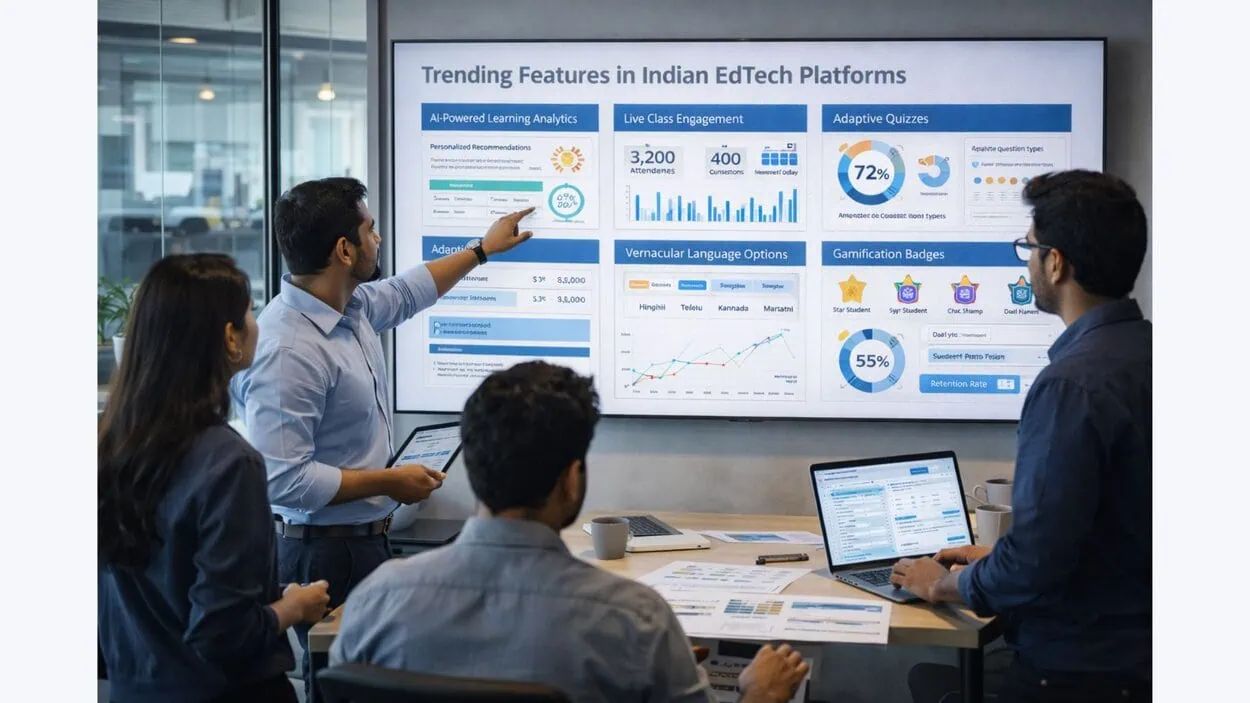
Institutions are already expecting these capabilities in active deployments. Platforms must implement:
- AI-based performance analytics for early risk detection
- Micro-learning modules optimised for mobile engagement
- Gamification systems to improve participation in K-12 segments
- Regional language interfaces for tier 2 and tier 3 expansion
- Hybrid classroom integration with attendance and content sync
- Real-time parent dashboards for academic transparency
- Skill-based tracking modules linked to certifications
- Mobile-first, low-bandwidth optimised application architecture
These are no longer optional enhancements. They are competitive necessities in today’s edtech market.
An edtech platform must be built on layered architecture. Each layer should operate independently but integrate seamlessly.
The goal is scalability, performance stability, and long-term maintainability. A modular SaaS architecture also allows institutions to adopt features gradually without structural disruption.
| Layer | Core Responsibility | Technology Example |
|---|---|---|
| Presentation Layer | Web and mobile user interfaces for students, teachers, parents, and admins | React, Angular, Flutter |
| Application Layer | Business logic, workflows, validation rules, role management | Node.js, Django |
| Data Layer | Structured data storage, content storage, backup systems | PostgreSQL, AWS S3 |
| Integration Layer | APIs for ERP, CRM, payment gateways, video tools, biometric systems | REST APIs, GraphQL |
| Analytics Layer | Performance dashboards, reporting engines, predictive models | Power BI, Custom Analytics Engine |
| Caching Layer | Performance optimisation and faster response time | Redis |
| Cloud Infrastructure Layer | Hosting, load balancing, auto-scaling, CDN support | AWS, Azure |
| Security Layer | Authentication, encryption, role-based access control | OAuth, SSL, JWT |
| DevOps Layer | Continuous integration, deployment pipelines, monitoring | Docker, CI/CD tools |
| Monitoring & Logging Layer | System health tracking, audit logs, error monitoring | CloudWatch, ELK Stack |
| Disaster Recovery Layer | Backup automation, failover systems, uptime continuity | Automated Cloud Backup Systems |
Revenue models must match institutional budgets. Common models include:
| Pricing Model |
|---|
| Subscription per student per year |
| Institutional licensing |
| Freemium with premium analytics |
| Commission on course sales |
| SaaS recurring model |
Recurring subscription provides stable revenue flow.
India’s education ecosystem is structurally complex. Diversity in boards, fee models, language preferences, and infrastructure maturity creates execution friction.
Key challenges include:
- Institutional change resistance driven by legacy administrative habits
- Uneven digital infrastructure affecting bandwidth and device reliability
- High price sensitivity across private, aided, and government institutions
- Frequent regulatory updates across state and central education bodies
- Heightened scrutiny around student data privacy and digital consent norms
- Fragmented decision-making within institutions delaying procurement cycles
- Limited in-house technical capacity for implementation and training
Product design must account for operational realities, not just feature ambition. Adoption in India depends as much on execution simplicity as on technical capability.
- Do not build without pilot validation.
- Invest heavily in UX testing.
- Prioritize data analytics from day one.
- Ensure cloud scalability before large deployments.
- Choose a development partner with institutional domain expertise.
The next phase of Indian edtech will be outcome-driven and regulation-aware. The industry is moving beyond digitisation toward measurable academic intelligence. Institutions will increasingly demand:
- Outcome-linked academic performance measurement
- AI-assisted curriculum structuring aligned with learning gaps
- Employability-focused competency mapping
- Integrated academic-to-career lifecycle tracking
- Real-time regulatory and accreditation readiness systems
- Data-backed decision-making at management level
- Institutional benchmarking across performance metrics
Edtech will no longer function as a content delivery layer. It will operate as institutional intelligence infrastructure. Platforms that combine pedagogy, analytics, and compliance readiness will define the next decade.

Selecting the right partner determines execution quality and long-term stability. A credible edtech app development services provider must demonstrate:
- Deep understanding of Indian academic workflows and compliance structures
- Proven experience in SaaS-based education platforms
- Strong system architecture and multi-tenant scalability expertise
- Secure coding standards and structured data protection practices
- Experience with high concurrent user environments
- Clear sprint management and documentation processes
- Capability for long-term maintenance and structured upgrades
- Dedicated support and customer success framework
- Transparent cost estimation and roadmap planning
A technology partner should not just build features. They should understand institutional impact.
Building an edtech platform in India demands clarity, discipline, and long-term thinking.
This is not a short-term application build. It is institutional infrastructure. It touches academics, finance, communication, and compliance.
Success depends on academic insight, structured product planning, scalable cloud architecture, and uncompromising data security. It also depends on validating features through real institutional feedback.
Rushed development creates fragmented systems that institutions abandon within months. Structured execution creates platforms that integrate into daily academic operations.
At iProgrammer Solutions, we approach every Edtech App Development initiative with product depth and architectural discipline.
- Enterprise-grade SaaS architecture expertise
- Strong understanding of academic and institutional workflows
- Structured research and requirement validation process
- UX-focused interface design for multi-role users
- Scalable cloud-native engineering practices
- Secure development aligned with compliance standards
- Agile sprint execution with transparent milestones
- Long-term maintenance and performance optimisation support
- Experience delivering complex enterprise systems
You can explore how we translate complex requirements into scalable systems in our success stories.
For institutions and founders planning full-scale platforms, our web application development services provide structured architecture, cloud scalability, and long-term engineering support.
If you are planning to build an advanced educational platform in India, connect with our team now!