





Green App Development: A Practical Guide for App Development Companies That Want to Build Responsibly

- What is Green App Development?
- Why Sustainable App Development is Gaining Momentum
- What is a Green Approach in App Development?
- Principles of Green Software
- Key Levers of Green App Development
- Designing for Efficiency: Where Most Apps Fall Short
- Sustainable Architecture Patterns for Modern Apps
- The Role of Cloud in Green App Development
- Sustainable App Development Lifecycle
- Measuring Sustainability in Applications
- Green App Development Tools
- Green Coding Techniques
- Green App Development MetricsAMU
- Challenges in Green App Development
- The Business Case for Green App Development
- How App Development Companies Can Adopt Green Practices
- Real-World Use Cases of Sustainable App Development
- The Future of Green App Development
- Final Thoughts
- Building Sustainable Applications with iProgrammer
If you work in an IT industry, you must have encountered this situation often. A product manager reviews app analytics after a major release. Downloads look healthy. Engagement seems stable. But the app is simply taking too long to respond under real-world conditions. Battery drain is higher than expected. Data usage spikes in the background. Users are just leaving quietly.
Performance, cost, and sustainability are now intertwined. App development was previously concerned with performance and features. However, now the quality of the product is determined by its efficiency in terms of energy, data, and device usage.
This is where Green App Development comes in. It increases the overall efficiency of the code, architecture, and user interface to minimize resource usage.
This new trend in app development has created a challenge and opportunity for app development companies. The challenge is to break away from the old way of thinking. The opportunity is to develop apps that are faster and more efficient. This guide will examine the true meaning of green app development and its principles.
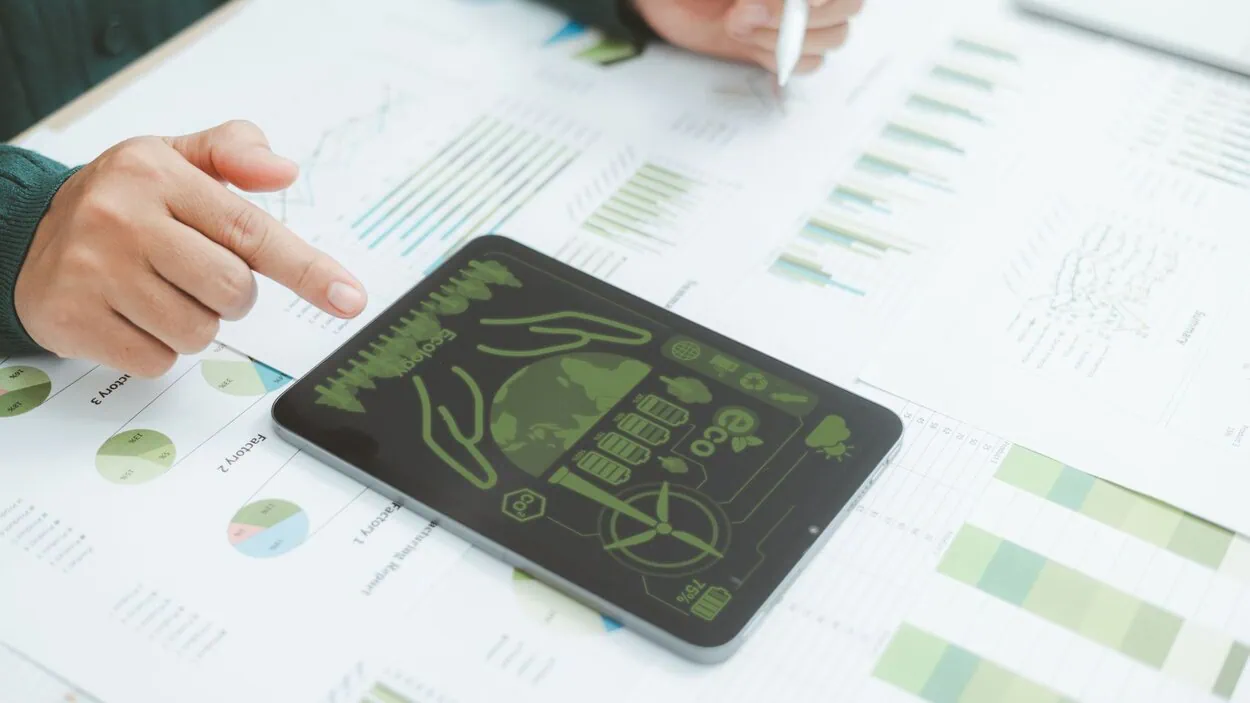
Green app development is the process of creating applications that have the least impact on the environment in all the stages of the app lifecycle, including the development, deployment, usage, and maintenance of the application.
It is more than the mere optimization of server or cloud usage, but the entire environment in which the application runs, including the devices of the users, the network, the backend, and even the development process itself.
Ultimately, it answers the following question: How can an application deliver value using the least possible resources?
This changes the way we think about some of the most common app development decisions, like the following:
This changes the way we think about some of the most common app development decisions. For instance:
- A feature is not only evaluated for usability, but also for its resource cost.
- A backend service is not only assessed for scalability, but also for efficiency.
- A UI animation is not only judged on aesthetics, but also on battery impact.
A green app developer looks at performance metrics and sustainability metrics together. The intention is not to compromise user experience but to do so in a more efficient manner.
Why Sustainable App Development is Gaining Momentum
Sustainable app development is not being driven by one single force. Rather, it is the culmination of several different drivers.
1. Rising Infrastructure Costs
The adoption of cloud computing is increasing in the industry. Inefficient applications require more and more infrastructure to function. This has a direct impact on costs.
Sustainable app development can also lead to cost savings. This is because efficient applications require fewer resources to produce the same result.
2. User Expectations Are Evolving
Users do not necessarily ask for sustainable applications. Users react to the way that applications make them feel. Faster response time, battery life, and data usage make for a better user experience.
Improvements in sustainability tend to follow these expectations.
3. Regulatory and ESG Pressures
Organizations are becoming increasingly answerable for their environmental footprint. This includes digital products.
Organizations are beginning to monitor and measure their emissions associated with their software systems. This includes applications.
4. Device and Network Constraints
Not all users operate on high-end devices or high-speed networks. Efficient applications perform better across diverse environments.
This makes sustainability a necessary consideration, not just a moral imperative.
What is a Green Approach in App Development?
A green approach to app development is all about minimizing resource consumption without affecting user experience.
It requires consideration at several levels:
Code Efficiency
Efficient code can be run faster and uses fewer resources. This includes:
- Reducing unnecessary computations
- Avoiding redundant API calls
- Using optimized algorithms
Data Management
Data transfer consumes energy. A green approach minimizes data usage through:
- Efficient data formats
- Smart caching strategies
- Reducing background sync frequency
UI and UX Design
Design decisions affect resource usage. For example:
- Limiting heavy animations
- Using dark mode where applicable
- Reducing unnecessary rendering
Backend Optimization
Servers consume significant energy. Optimization includes:
- Efficient database queries
- Auto-scaling infrastructure
- Serverless architectures where suitable
Lifecycle Thinking
The lifecycle of the app is taken into consideration by a green approach. It includes updates, maintenance, and finally shutting down the app.
It is not a one-time process, but a continuous process.
Principles of Green Software
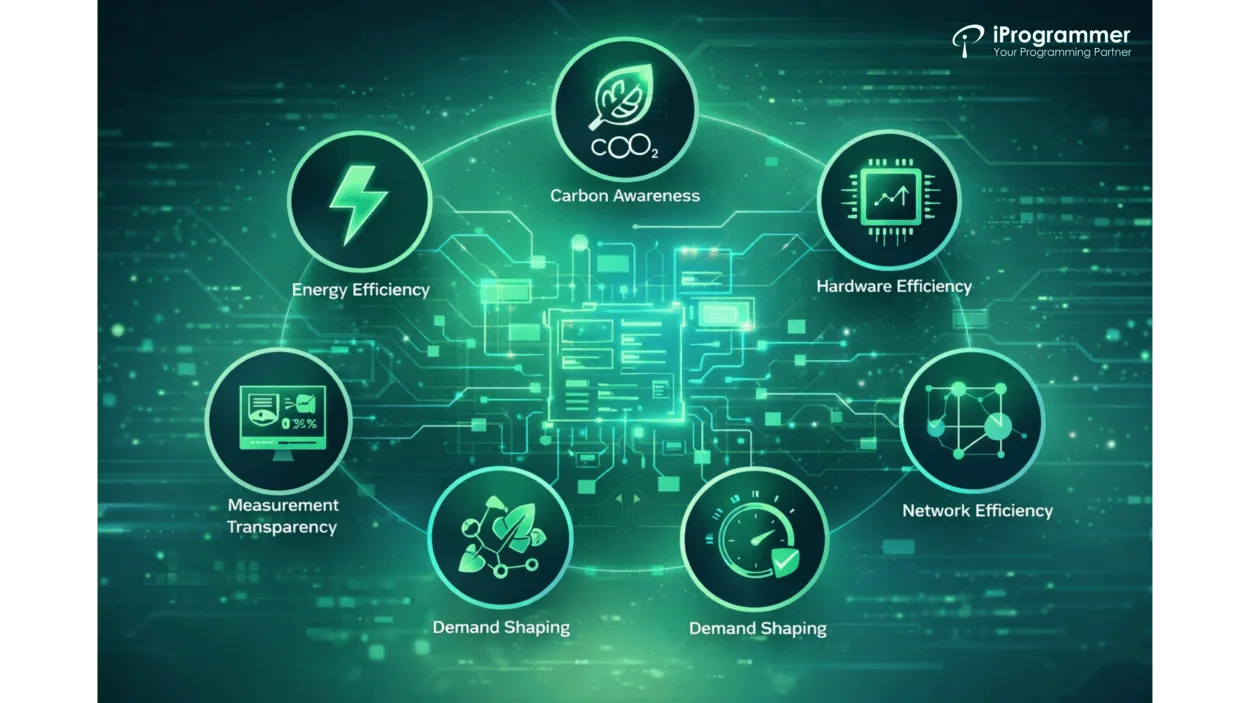
The green app development process is based on a set of principles that shape the decision-making process.
1. Energy Efficiency
The application should be able to use the least energy needed to perform the task. This requires efficient algorithms, optimized code, and smart resource usage.
2. Carbon Awareness
Software should adapt to reduce carbon impact where possible. The tasks should be scheduled during the time of day or season when the amount of available renewable energy is high.
3. Hardware Efficiency
Applications should make optimal use of hardware resources. This includes CPU, memory, and storage.
Poorly optimized apps often waste these resources.
4. Network Efficiency
Data transfer has an environmental cost. Reducing payload sizes and optimizing communication protocols helps lower this impact.
5. Demand Shaping
Applications can influence user behavior. For example, encouraging offline usage or batching updates reduces resource consumption.
6. Measurement and Transparency
If you can’t measure something, you can’t improve it. Tracking energy usage and emissions helps teams make informed decisions.
Key Levers of Green App Development
| Layer | Traditional Approach | Green Approach | Impact |
|---|---|---|---|
| Code | Feature-first development | Efficiency-first coding | Lower CPU usage |
| Data Handling | Frequent sync and large payloads | Optimized payloads and smart caching | Reduced data transfer |
| UI/UX | Heavy animations and effects | Minimalist and efficient design | Lower battery consumption |
| Backend | Always-on servers | Auto-scaling and serverless models | Reduced energy usage |
| Infrastructure | Static resource allocation | Dynamic resource management | Cost and energy savings |
| Monitoring | Performance-focused metrics | Energy and carbon tracking | Continuous improvement |
Most applications are designed to perform well but not to be efficient. While this is a subtle difference, it is important.
Performance is about speed and reaction time. Efficiency is about achieving this performance while using fewer resources.
Here are common gaps:
- Over-fetching data from APIs
- Excessive background processes
- Heavy front-end frameworks for simple use cases
- Inefficient database queries
These problems are not often noticed because they scale to accommodate them. However, scaling inefficient applications increases cost and environmental impact. The green app developer will address these inefficiencies at the start of the design process.
Sustainable Architecture Patterns for Modern Apps
The architecture is a key consideration for green app development.
Microservices with Caution
Microservices provide more flexibility but can cause network overheads. Each service interaction consumes resources.
Teams need to balance modularity with efficiency.
Serverless Architectures
Serverless models can improve efficiency by running code only when needed. This reduces idle resource consumption.
However, poor implementation can still lead to inefficiencies.
Edge Computing
Processing data closer to the user helps in reducing latency and network usage. This helps in improving performance and sustainability.
Efficient Databases
The selection of the appropriate database and optimization of database queries can help in reducing energy consumption.
The Role of Cloud in Green App Development
Cloud platforms offer tools that aid in the development of green apps.
Auto-scaling: The resources are allocated according to the needs. This will prevent over-allocation of resources.
Managed Services: Managed services run more efficiently than self-managed infrastructure.
Region Selection: Selection of data centers powered by renewable resources can also contribute to reducing the carbon footprint.
But making an application go green by itself is not possible by migrating it to the cloud.
| Stage | Key Activities | Sustainability Focus | Outcome |
|---|---|---|---|
| Planning | Requirement analysis | Identify resource-intensive features | Better design decisions |
| Design | Architecture and UI planning | Optimize data flow and interactions | Efficient system blueprint |
| Development | Coding and integration | Write optimized and clean code | Lower compute usage |
| Testing | Performance and load testing | Measure energy and resource usage | Identified inefficiencies |
| Deployment | Cloud setup and release | Use efficient infrastructure | Reduced operational footprint |
| Maintenance | Updates and monitoring | Continuous optimization | Sustained efficiency |
Measuring Sustainability in Applications
Without measurement, sustainability remains an abstract goal.
Key metrics include:
- Energy consumption per transaction
- Data transfer per user session
- Server utilization rates
- Carbon emissions associated with workloads
Tools and frameworks are being developed to assist in such measurements. However, adoption is still evolving.
For application development companies, implementing these metrics into existing monitoring solutions can be a first step.
Creating sustainable applications demands understanding the consumption of the application. The appropriate tools assist in the measurement and analysis of the application’s efficiency.
Carbon Tracking Tools
Measure estimated carbon emissions linked to application workloads. These tools help teams understand environmental impact at a system level.
Energy Profiling Tools
Analyze the code, features, and processes’ consumption of energy during the execution process. This helps in identifying the optimization points with the maximum impact.
Cloud Sustainability Dashboards
Provide insights on the consumption of infrastructure, energy, and emissions in the cloud environment. They assist in optimization decisions.
Performance and Resource Monitoring Tools
Monitor CPU, memory, and network consumption in real time. This is the practical aspect of identifying inefficiencies.
Creating sustainable applications begins with the code level. Small changes in the code and the way it is executed have a major impact on the overall consumption of the application.
Lazy Loading
Load the data or components required on demand. This minimizes the loading time and avoids the process.
Efficient Algorithms
Use optimized logic and data structures to reduce computation time and energy usage.
Code Profiling
Continuously analyze code execution to identify bottlenecks and eliminate any inefficient code execution paths.
Minimizing Background Processes
The number of background processes should be kept to a minimum to avoid battery drain, data usage, and processing power.
Optimized Data Handling
The payload should be reduced in size and any redundant data transfer should be avoided.
Sustainability has to be quantified in order to be actionable. Appropriate metrics should be monitored to make informed decisions.
Energy per API Call
Measure how much energy is consumed for each backend request. This highlights inefficient service interactions.
Data Transfer per Session
Track the volume of data exchanged during a user session. Lower data transfer typically indicates better efficiency.
CPU Utilization Efficiency
Evaluate how effectively compute resources are being used. High efficiency means less wasted processing power.
Memory Usage Efficiency
Monitor how well the application manages memory. Poor memory usage often leads to higher energy consumption.
Server Utilization Rates
Assess how effectively backend resources are being used over time. This helps identify over-provisioning or idle capacity.
Challenges in Green App Development
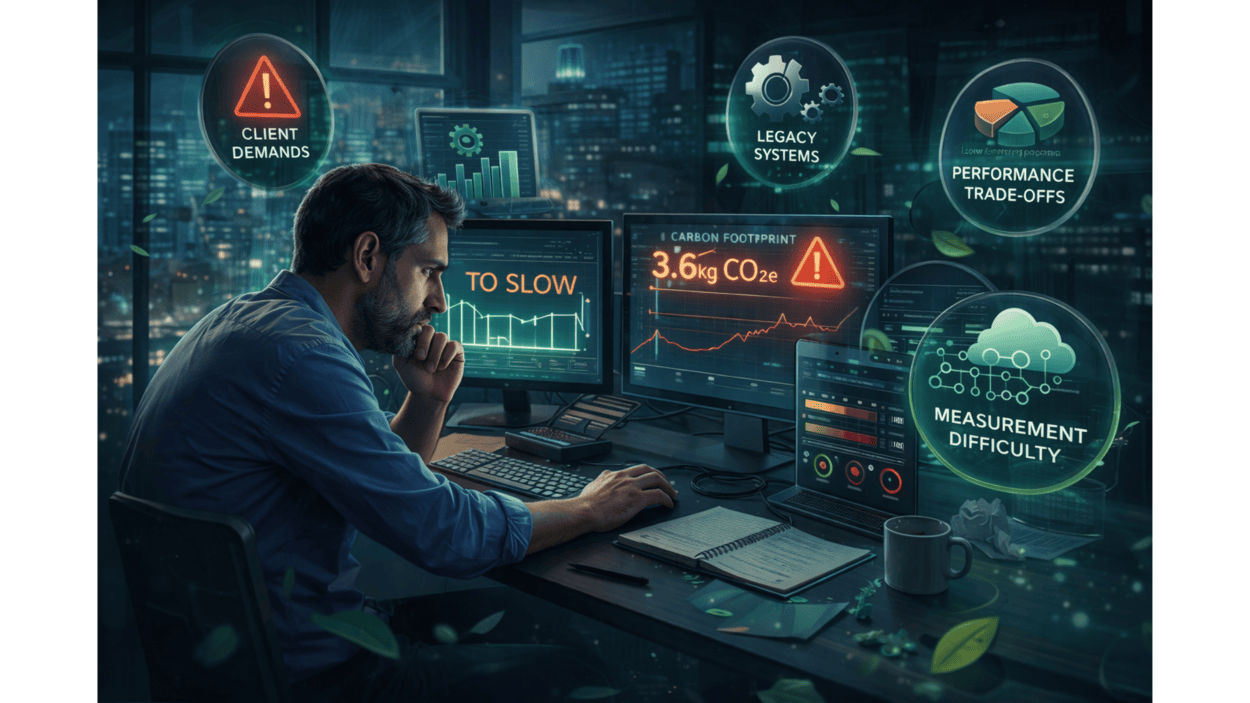
Although the advantages are obvious, the task of implementing green app development is not simple.
Lack of Standardization: There is no method of measuring software sustainability at the present time.
Measurement Complexity: Quantifying energy consumption on a code level is complex. Most development teams use proxy metrics that don’t necessarily show real-world effects.
Limited Tooling: There are no advanced tools available for measuring and improving software sustainability.
Trade-offs with Speed: Making the choice for efficiency might mean slower development time.
Trade-offs with User Experience: Opting for fewer resources might mean compromises on user experience.
Skill Gaps: The developers might lack the skills required for the task of sustainable software development.
Legacy Systems: The existing software might not be designed for efficient use. Opting for efficiency in these systems is a complex task.
Business Alignment: Sustainable development has to be aligned with business needs.
Client Awareness: Clients may not demand sustainable development.
Data-Heavy Architectures: Modern applications involve constant data interchange. This increases resource consumption if not carefully optimized.
Cloud Misconceptions: Moving to the cloud is not the same as being sustainable. Unoptimized applications are not automatically green.
Organizational Resistance: People are often measured on speed and efficiency. Sustainability is not considered unless mandated at the top.
The Business Case for Green App Development
Green app development is often perceived as an ethical choice. However, it is ultimately up to the business.
- Cost Optimization: Efficient applications can significantly reduce infrastructure costs. This is directly beneficial to the bottom line.
- Improved User Experience: Efficient applications run better on any given platform. This leads to higher user engagement and retention.
- Performance Stability: Efficient applications can handle load better. This means fewer crashes and system failures under pressure.
- Scalability Efficiency: Efficient applications scale without proportionally increasing infrastructure costs. This means that growth is sustainable.
- Faster Time to Optimize and Maintain: Efficient applications are easier to debug and maintain.
- Brand Positioning: Sustainability is becoming a key differentiator. Companies that implement green practices have higher credibility and trust.
- Regulatory Readiness: Digital system regulations for the environment are constantly changing. Efficient applications can help organizations comply.
- Better Device Compatibility: Efficient applications can work well even on low-end devices and slower networks. This helps in expanding the market.
- Reduced Technical Debt: Development that is focused on efficiency can eliminate redundant processes and poor designs. This can prevent system bloat.
- Operational Transparency: Resource usage can be monitored. This can increase understanding of system behavior.
- Future Readiness: Technology and sustainability will continue to increase in expectations. This will be a key advantage for those who start early
How App Development Companies Can Adopt Green Practices

For app development companies, the transition to green practices needs to be done through structured changes.
- Build Awareness: The developers should be made aware of the implications of software-related decisions on energy consumption, cost, and performance.
- Make Sustainability Part of Requirements: Defining the requirement for efficient code can prevent future rework.
- Modify Development Guidelines: Defining coding guidelines that prevent unnecessary processing and resource consumption.
- Design Efficient Architectures: Defining architectures that prevent idle computing and complex systems.
- Monitor Sustainability Metrics: Monitoring energy consumption, data transfer, and computing in addition to performance metrics.
- Optimize Data Transfer: Defining payload sizes, API usage rates, and background syncs.
- Utilize Cloud Benefits: Defining auto-scaling and right-sizing to prevent wastage.
- Develop App Development Teams: Educating app developers on writing efficient code and developing efficient apps.
- Target High Impact Areas: Target those modules that consume the highest resources to yield maximum results.
Real-World Use Cases of Sustainable App Development
Streaming Applications
Adaptive bitrate streaming reduces unnecessary bandwidth consumption during playback.
E-commerce Platforms
Optimized search and image delivery improve speed while lowering server load.
Fintech Applications
Lean transaction flows reduce processing overhead and improve response times.
Healthcare Applications
Efficient data exchange ensures reliability in bandwidth-constrained environments.
Logistics Applications
Route and load optimization reduce repeated computations and system strain.
Social Media Platforms
Controlled media loading and compression reduce excessive data consumption.
Enterprise SaaS Platforms
Efficient tenant and resource management prevents unnecessary infrastructure scaling.
The Future of Green App Development
Green app development is still evolving. Several trends are shaping its future:
- Apps will run more work when cleaner energy is available
- DevOps pipelines will include efficiency checks
- Clear standards will define how sustainability is measured
- AI will help find and fix inefficiencies
- Cloud platforms will show detailed energy and resource usage
- Sustainability will become part of compliance and reporting
- Design choices will directly impact how much resources apps use
As these trends mature, sustainability will become a core aspect of software quality.
Green app development is not a temporary shift. It reflects a broader change in how software is built and evaluated.
Efficiency, performance, and sustainability are no longer separate goals. They are interconnected.
For app development companies, this is an opportunity to rethink how applications are designed and delivered.
The focus is not on doing less. It is on doing things better, with greater precision and responsibility.
At iProgrammer Solutions, sustainability is approached as a practical engineering discipline. It is integrated into how applications are designed, developed, and optimized.
From efficient architectures to optimized code practices, the focus remains on delivering applications that perform well while consuming fewer resources.
If you are looking to build applications that are efficient, scalable, and aligned with long-term sustainability goals, explore our approach to mobile app development.