





How Odoo Is Adapting to AI-Driven ERP in 2026
- What AI-Driven ERP Actually Means for Real Operations
- Why Legacy ERP Systems Struggle With AI Adoption
- Why Odoo Was Structurally Ready for AI
- How Does Odoo Use AI in Practice
- Key Odoo Modules Already Using AI Capabilities
- Where AI Delivers Operational Value in Odoo
- Automation Becomes Smarter, Not Heavier
- Where AI Can Hurt ERP If Done Wrong
- The Role of the Odoo AI Assistant
- Odoo’s Integration With External AI Tools
- Preparing Your Business for AI-Driven ERP Success
- AI Governance and Control
- Industry-Specific Intelligence
- AI Maturity Path in Odoo ERP
- Where Odoo AI 19 Fits Into This Evolution
- The Role of Odoo Implementation Partners
- The Reality Behind Odoo AI Chatbot and Conversational Tools
- Measuring ROI From AI-Driven ERP
- Why Odoo AI Feels Different to Users
- How Roles Change With AI Inside ERP
- Looking Ahead
- Why iProgrammer Sees This Shift Clearly
Operations rarely break in dramatic ways. They slow down quietly.
- A planner notices forecasts feel off but cannot prove it.
- A finance head reviews numbers that look correct yet feel slightly wrong.
- A sales leader trusts instinct more than the CRM because patterns are hard to see.
Most ERP systems record these moments. Very few help resolve them. That gap between data and decision is where modern enterprises struggle. It happens because their systems do not think alongside them. This is the shift defining ERP in 2026.
Nearly 70% of ERP implementations with AI features reported faster decision-making processes, showing how intelligence integrated into operational systems tangibly improves responsiveness. Intelligence is no longer a feature on top. It is becoming part of how systems respond, predict, and adapt.
Here, Odoo’s direction really matters because its understanding of AI-based ERP isn’t really about automation at the expense of human roles but rather enhancing the decision-making process within daily operations.
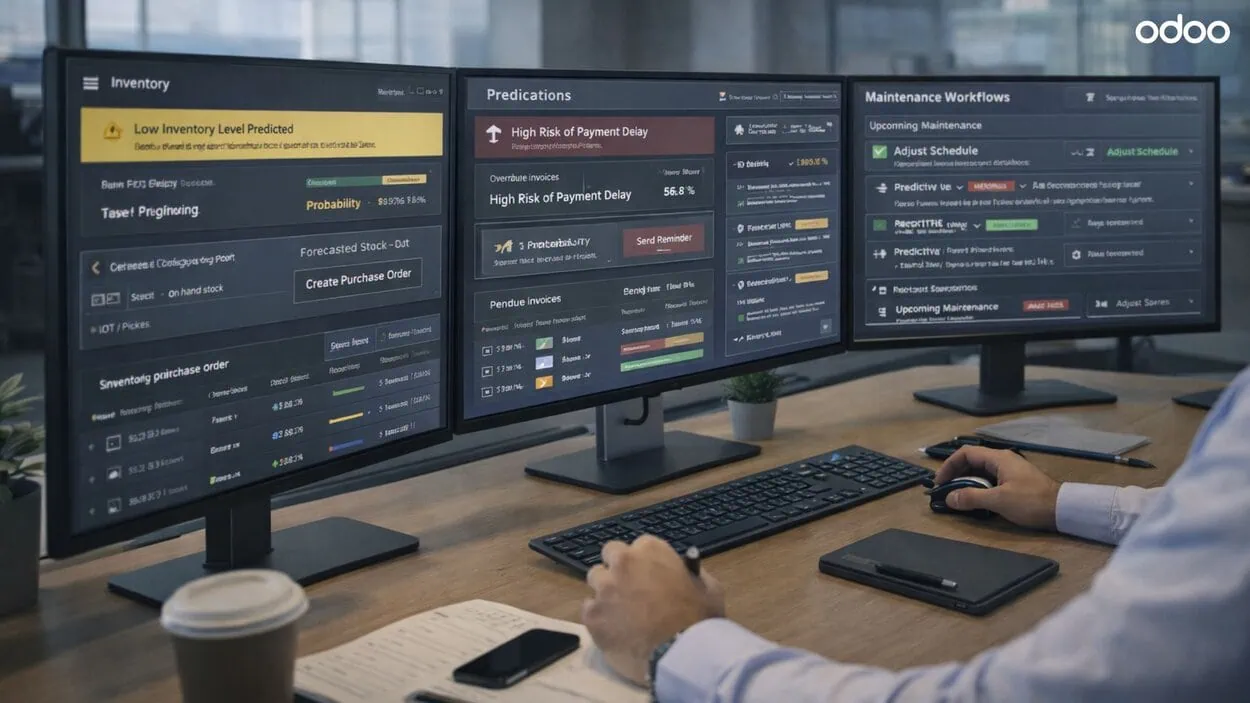
AI-driven ERP is often misunderstood as automation at scale. That view is incomplete. In practice, it means three things working together.
- First, systems move from reporting past activity to supporting present decisions. Instead of static dashboards, users receive context, signals, and probability-based insights.
- Second, predictions become operational. Forecasts influence actions, not just planning meetings. Inventory levels, credit risks, or maintenance cycles adjust before issues escalate.
- Third, workflows adapt based on patterns. The system learns which actions follow which signals and reduces unnecessary steps over time.
This shift changes how teams interact with their ERP every day.
Many established ERP platforms attempted to add AI layers. Most struggle to deliver consistent value. The root cause is structural, not technical.
- Legacy systems were built around rigid modules with limited data flow. Each function lives in its own silo. Sales data rarely speaks fluently with finance or inventory. AI thrives on connected data. Without it, predictions remain shallow.
- Customization-heavy architectures slow innovation. Every update risks breaking previous logic. AI models need iteration. Static systems resist learning.
- Closed ecosystems also limit integration. Modern intelligence often comes from external tools. APIs, data pipelines, and flexible extensions are essential. Many older ERPs were never designed for this openness.
As a result, AI becomes an add-on rather than a capability. Users see features, but not intelligence embedded into daily operations.
Odoo’s readiness for AI did not start with algorithms. It started with architecture.
Modular by Design
Each module of Odoo stands by its own while sharing a common data platform. This enables the application of intelligence at appropriate places without affecting the entire system.
Unified Data Model
For instance, sales, inventory, accounting, manufacturing, and human resource management all operate on the same set of data, and this encourages accurate predictions among other advantages.
Open-Source and API-First Approach
Odoo welcomes external tools. AI models, analytics platforms, and third-party engines integrate cleanly. Innovation does not depend on vendor roadmaps alone.
The practical application of Odoo AI focuses on decision support, not replacement.
The system detects patterns in transactions, behaviors, and outcomes. It flags anomalies, predicts outcomes, and makes recommendations. Users remain in control, but with better signals.
The intent is subtle. Reduce manual reviews. Surface risks earlier. Suggest next steps with context. This approach makes intelligence usable across teams, not limited to data specialists.
The presence of artificial intelligence in Odoo does not mean that it is implemented in a single feature, rather in different operational areas.
Sales and CRM: Lead scores become more accurate based on historic conversion patterns. Sales forecasts update dynamically based on changes to pipeline behavior.
Inventory and Supply Chain: Demand forecasting helps to avoid inventory build-ups or outages. Reordering decisions reflect seasonality and sales velocity.
Accounting and Finance: Financial anomaly detection flags unusual transactions early. Credit risks surface before payments fail.
Manufacturing: Predictive maintenance models anticipate equipment issues. Downtime reduces without excessive manual monitoring.
| Business Function | Traditional ERP Limitation | AI-Driven Enhancement in Odoo |
|---|---|---|
| Sales Forecasting | Static projections | Dynamic probability-based forecasts |
| Inventory Control | Manual reorder thresholds | Predictive demand planning |
| Finance Monitoring | Reactive audits | Real-time anomaly detection |
| Manufacturing Ops | Scheduled maintenance | Predictive maintenance insights |
One concern often raised is automation fatigue. Systems that automate without understanding context often create more work. Odoo avoids this by focusing on smarter triggers.
- Alerts appear only when patterns deviate meaningfully. Actions are suggested, not enforced. Users approve or refine outcomes.
- Workflows shorten naturally. Teams spend less time validating routine decisions and more time addressing exceptions.
AI strengthens ERP only when it is applied with restraint. Poor implementation creates risk faster than value.
- Over-automation can weaken judgment. When systems act without checkpoints, teams stop questioning outcomes.
- Excessive alerts create noise. If every anomaly triggers attention, real risks get ignored.
- Poor data trains poor intelligence. Inconsistent or biased data produces confident but incorrect recommendations.
- Black-box predictions erode trust. If users cannot understand why a recommendation appears, adoption declines.
- One-size models fail complex operations. Generic intelligence often misses context specific to business reality.
The Odoo AI assistant acts as a contextual layer rather than a chatbot novelty.
- It helps users query data conversationally. It explains trends in plain language. It also helps with navigation and interpretation, especially for non-technical users.
- It differs from rigid reporting tools since it is flexible and able to interpret the user’s intent. It reduces the need to depend solely on analysts.
This makes insights accessible when needed.
Odoo doesn’t try to compete with other special-purpose AI applications. It instead tries to integrate with these applications.
- Businesses already utilize forecasting engines or tools, recommendations, and/or AI-based analytics tools. For Odoo, connectivity is done via an API and thus allows insights to flow through these systems and workflows in ERP systems.
- This strategy respects existing investment. It is flexible as investment in AI is continuously evolving.
It’s not just the technology itself; rather, the business must be operationally prepared as well.
Clean and Consistent Data: AI amplifies patterns. Poor data produces misleading signals. Data governance becomes foundational.
Standardized Processes: Predictive models rely on repeatable workflows. Excessive process variation limits learning.
User Adoption and Trust: Teams must understand why recommendations appear. Transparency builds confidence and usage.
AI inside ERP changes how decisions are made. Governance defines how far intelligence is allowed to go.
- Decision ownership must remain clear. AI can advise, but accountability stays with people.
- Role-based controls determine who can act on recommendations. Not every user needs the same authority.
- Approval thresholds prevent unintended automation. High-impact actions should require validation.
- Explainability supports audits and compliance. Finance and regulatory teams need visibility into reasoning.
- Model behavior must be monitored over time. Intelligence should evolve with the business, not drift silently.
AI becomes valuable only when it reflects how an industry actually operates.
- Manufacturing relies on predictive maintenance and throughput patterns. Downtime prevention matters more than forecasts.
- Retail and distribution depend on demand volatility. Inventory intelligence must adapt to seasonality and promotions.
- Professional services focus on utilization and billing accuracy. AI must support resource planning, not stock movement.
- Finance-heavy organizations require explainable insights. Accuracy alone is not enough without traceability.
| Stage | Capability Focus | Business Impact |
|---|---|---|
| Observation | Pattern detection | Visibility into risks |
| Prediction | Forecasting outcomes | Proactive planning |
| Recommendation | Suggested actions | Faster decisions |
| Adaptation | Learning workflows | Continuous optimization |
Odoo AI 19 offers a refinement. This release improves the accuracy of predictions, increases assistant response time, and further develops intelligence in each module. This release contains features based on success in real-world usage rather than experimentation.
For businesses looking at upgrades, Odoo AI 19 sends an important message. Intelligence feels embedded, not experimental.
AI-driven ERP is not plug-and-play.
Odoo Implementation Partners play an important role in integrating technology with business operations through mapping, standardizing processes, and applying intelligence, which adds value whenever possible.
Without this alignment, even advanced capabilities underperform. Experienced partners ensure AI supports real decisions rather than theoretical use cases.
Tools like Odoo AI ChatGPT integrations are often misunderstood. Their value lies in interpretation, not conversation. They translate data into understanding. They reduce friction between questions and answers.
Used correctly, they shorten decision cycles. Used poorly, they become distractions. Odoo’s design emphasizes context and relevance, which keeps these tools grounded in operations.
AI investment must translate into operational outcomes, not abstract intelligence.
- Reduction in manual reviews and approvals across finance, inventory, and operations.
- Improved forecast accuracy leading to lower inventory holding costs.
- Faster exception handling due to early risk identification.
- Reduced downtime through predictive maintenance insights.
- Shorter decision cycles as insights appear inside workflows.
The difference is subtle but important.
- Users are not forced into rigid, system-driven actions. The system supports decisions rather than dictating them.
- Intelligence appears inside existing workflows. Users do not need to switch dashboards or learn new interfaces.
- Recommendations are contextual and explainable. They complement user experience instead of replacing judgment.
- Alerts and insights surface only when patterns genuinely matter, reducing noise and fatigue.
- Automation remains optional and adjustable, preserving user control at every step.
- This human-centered approach builds trust over time, making adoption feel natural rather than imposed.
AI reshapes responsibilities without removing relevance.
- Planners move from data preparation to scenario evaluation. Their focus shifts to judgment, not calculation.
- Finance teams spend less time reconciling numbers and more time interpreting risk and variance.
- Operations managers manage exceptions instead of monitoring routine activity.
- Sales leaders rely on probability-based insights rather than intuition alone.
- Executives gain earlier visibility without increasing reporting overhead.
In future, intelligence will no longer be optional. ERP systems that fail to adapt will feel increasingly disconnected from operations.
Odoo’s path reflects this reality. Its structure, philosophy, and execution align with how businesses actually work.
At iProgrammer, our work with enterprises across industries shows a consistent pattern. Organizations do not want louder software. They want quieter efficiency.
As experienced Odoo Implementation Partners, we focus on making intelligence useful. We help businesses prepare their data, align processes, and deploy Odoo AI where it improves decisions measurably.
Our approach treats ERP as a living system, not a static deployment. This perspective is why clients trust us for long-term transformation rather than short-term upgrades.