







Odoo ERP for Construction and Contracting Companies in Saudi Arabia: A Complete Guide

- Saudi Construction Growth Needs Stronger Project Control
- Odoo vs Traditional Construction ERP Systems in Saudi
- Common Challenges Faced by Construction and Contracting Companies
- What a Construction ERP Should Solve First
- How Odoo Supports Construction and Contracting Operations
- Odoo BOQ Management and Project Budgeting
- Odoo for Quantity Surveyors
- Odoo Procurement Management for Site and Material Control
- Odoo Subcontractor Management and Contractor Governance
- Odoo for Retention and Progress Billing
- Odoo Cost Control and Project Profitability
- Multi-Project Visibility for Saudi Construction Companies
- Construction KPI Dashboard in Odoo
- Data, Mobile and AI Readiness
- Technical Architecture for Odoo Construction Management
- Implementation Roadmap for Saudi Construction Companies
- Closing Note
- How iProgrammer Supports Odoo Construction ERP in Saudi Arabia
- FAQs
Construction companies in Saudi Arabia are working in a market where project ambition is high, but execution control decides profitability. The work itself may be clear. The harder part is keeping every commercial, procurement, site, subcontractor, and finance decision connected across the full project cycle.
A BOQ does not remain static after award. Quantities change. Supplier rates move. Site requirements shift. Subcontractor claims come in phases. Client billing depends on certified progress. When these details sit across emails, spreadsheets, WhatsApp updates, and disconnected tools, project control becomes difficult to maintain.
For contractors, the impact is direct. Procurement may buy without the latest budget view. Finance may receive bills without project context. Project teams may track progress without knowing the cost impact. Management may only see margin pressure after several decisions have already been made.
This is why Odoo construction ERP Saudi Arabia has become relevant for construction and contracting companies. Odoo can connect BOQ management, procurement, subcontractors, project accounting, approvals, documents, and cost control in one operating system. This guide explains how Odoo supports construction operations and how Saudi contractors can implement it with the right structure.
Saudi Construction Growth Needs Stronger Project Control
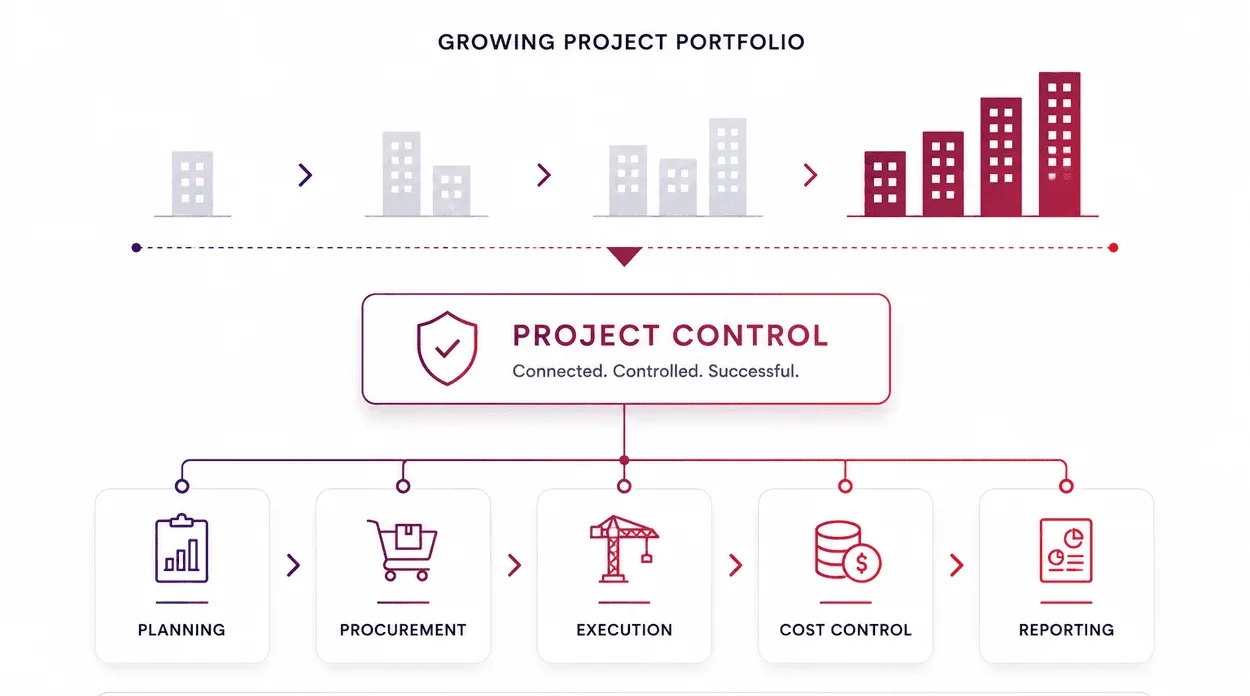
Saudi Arabia continues to invest in construction, infrastructure, tourism, housing, utilities and city development. Vision 2030 lists NEOM, Qiddiya, ROSHN, New Murabba and Sports Boulevard among key projects.
The U.S. International Trade Administration reported in August 2025 that Vision 2030 is driving demand for advanced construction technology and modern building methods. Mordor Intelligence estimated the Saudi construction market at USD 133.79 billion in 2025. It projected USD 142.30 billion in 2026 and USD 186.13 billion by 2031.
This growth changes how contractors must operate. A contractor may now manage many sites, subcontractors, equipment, purchase orders and payment milestones together.
Manual tracking cannot support that pace for long. Spreadsheets can record numbers, but they cannot control workflows. Email can send approvals, but it cannot create clean audit trails. Standalone software can manage one activity, but construction needs connected control.
A construction project ERP must connect commercial planning with site execution. Odoo construction management becomes useful when it is configured around this real project chain.
Odoo vs Traditional Construction ERP Systems in Saudi
Traditional construction ERP systems often come with long implementation cycles. They may offer deep features, but they can feel heavy for growing contractors. User adoption can suffer when screens are complex.
Odoo takes a different route. It gives a modular base across projects, procurement, inventory, accounting, documents, HR, CRM and approvals. Companies can start with the highest pain area and expand in phases.
This does not mean Odoo is ready-made for every contractor. Construction needs careful configuration. BOQ, retention, progress claims, project budgets, subcontractor billing and cost reporting must be designed.
For many Saudi contractors, the difference is practical. They need a construction project ERP that can adapt without slowing every change request. Odoo supports that model when implementation is handled by a partner with construction and accounting knowledge.
| Decision Area | Traditional Construction ERP | Odoo Construction ERP |
|---|---|---|
| Implementation approach | Large upfront scope | Phased rollout by priority |
| Flexibility | Change requests can be slow | Modular configuration and customization |
| Cost model | Higher license and consulting load | Lower entry point with scalable modules |
| BOQ and budget control | Often available in fixed structures | Configurable through projects, budgets and analytics |
| Procurement | Strong but sometimes rigid | RFQ, PO, inventory and bills connected |
| Subcontractor flows | Often industry-specific | Needs partner-led configuration |
| User adoption | Can be heavy for site teams | Cleaner interface with role-based workflows |
| Integration | Possible but may cost more | API-ready and easier to extend |
| Best fit | Very large enterprises with fixed processes | Growing and mid-large contractors needing flexibility |
Common Challenges Faced by Construction and Contracting Companies
Construction companies rarely struggle because one department is weak. They struggle because work moves faster than information. Saudi contractors face this strongly because scale is large and compliance expectations are rising.
- The first challenge is BOQ discipline. A BOQ often starts as a tender document. During execution, quantities change, rates move and scope expands. If those changes are not controlled, project margin becomes unclear.
- The second challenge is procurement timing. Materials need to reach the site before work stops. Without Odoo procurement management or a similar process, teams depend on calls and manual follow-up.
- The third challenge is subcontractor coordination. Each subcontractor may have different payment terms, work packages and progress claims.
- The fourth challenge is project cost visibility. Labour, material, equipment, subcontractor bills and overheads must map to the correct project and cost head. Without Odoo cost control, management sees the problem late.
- The fifth challenge is document control. Drawings, RFIs, inspection reports, payment certificates, LPOs and contract amendments need order. Missing documentation creates disputes and payment delays.
- The sixth challenge is multi-project reporting. A leadership team cannot manage five, ten or fifty projects through separate trackers. They need live visibility across budgets, committed costs, billed amounts and open risks.
These challenges affect cash flow, claims, project delivery, client trust and audit readiness.
What a Construction ERP Should Solve First
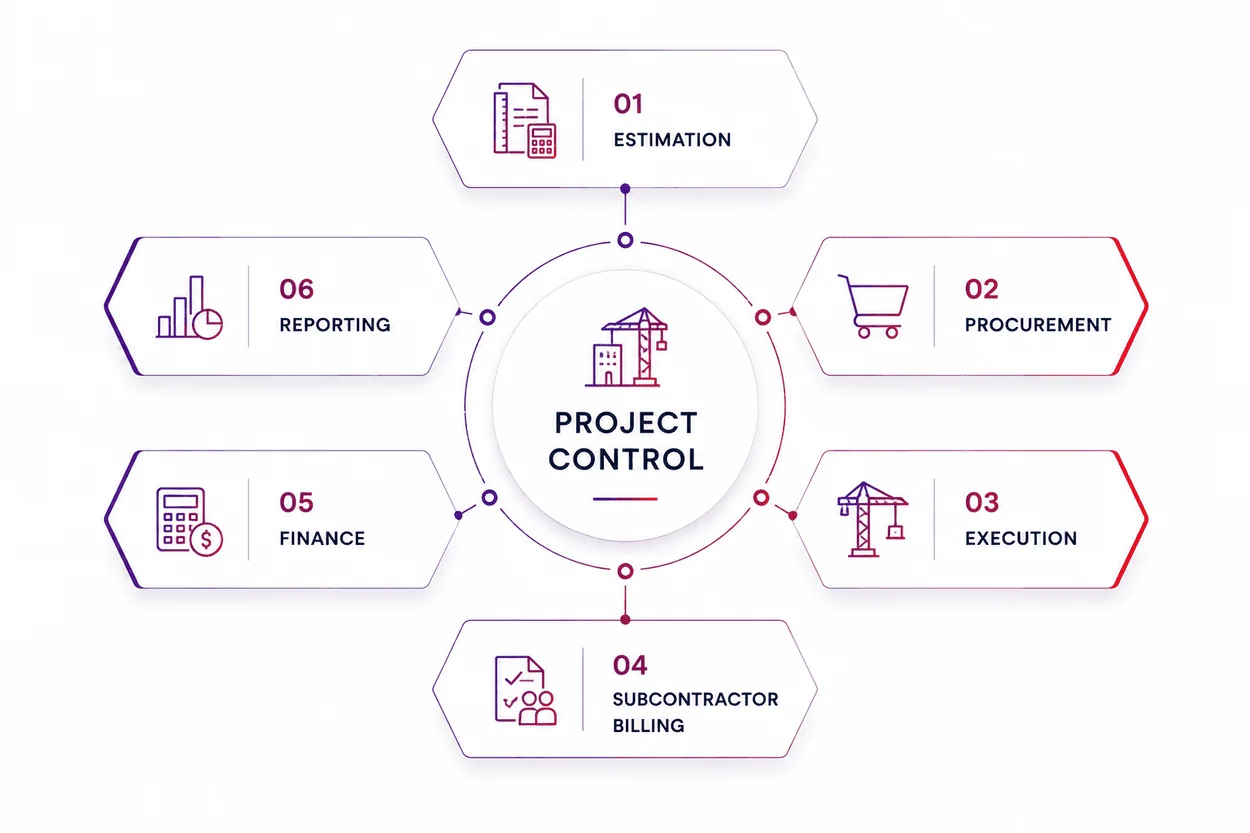
A construction ERP Saudi Arabia implementation should never begin with software screens. It should begin with control points.
- The first control point is estimation. The system should capture BOQ items, cost categories, planned quantities, margins and approved revisions.
- The second is procurement. Purchase requests should link to projects, BOQ heads, budgets and site needs.
- The third is execution. Tasks, milestones, inspections, issues and progress updates should connect with commercial data.
- The fourth is subcontractor billing. Work orders, certification, retention, advances and deductions must follow clear rules.
- The fifth is finance. Vendor bills, customer invoices, milestones and analytic accounts should remain aligned.
- The sixth is reporting. Management needs project-wise profitability, budget variance and cost-to-complete views.
Odoo can support these control points through standard modules and construction-specific configuration. The strength lies in connecting modules without forcing teams into a rigid ERP structure.
How Odoo Supports Construction and Contracting Operations
Odoo is a modular ERP. Companies can start with core construction needs and extend later. Odoo project management can organize each project into stages, tasks, milestones, responsibilities and deadlines. Project teams can track site work, assign activities and monitor progress in one place. Odoo documentation says Project helps companies schedule tasks, assign activities and track profitability.
Odoo analytic accounting tracks costs and revenues by project, department or cost center. Purchase supports RFQs, vendor quotations, blanket orders, purchase orders and vendor bills. Inventory can track materials by warehouse, site location or internal transfer. Documents can manage contracts, drawings, certificates and supporting files.
Sales and invoicing help manage client billing. Timesheets can capture labour effort. Expenses can record site spending. Approvals can structure purchase, payment and variation approval flows. Odoo contractor management can bring these workflows into one connected model. This gives teams better control without buying a heavy ERP from day one.
| Project Stage | Main Construction Risk | Odoo Control Layer | Business Outcome |
|---|---|---|---|
| Tender and estimation | BOQ assumptions are lost | BOQ structure, costing template, analytic account | Better budget baseline |
| Project kickoff | Scope and documents are scattered | Project setup, milestones, document folders | Cleaner project start |
| Material planning | Site requests exceed budget | Purchase requests linked to project budget | Stronger spend control |
| Procurement | Supplier rates lack approval clarity | RFQs, purchase orders, approval rules | Faster buying |
| Site execution | Progress stays outside finance | Tasks, timesheets, expenses, milestones | Better visibility |
| Subcontractor work | Claims lack certification | Work orders, progress claims, retention tracking | Fewer disputes |
| Client billing | Invoices do not match progress | Milestone invoicing and certificates | Improved cash flow |
| Project review | Margin is known too late | Analytic accounting and profitability reports | Earlier action |
Odoo BOQ Management and Project Budgeting
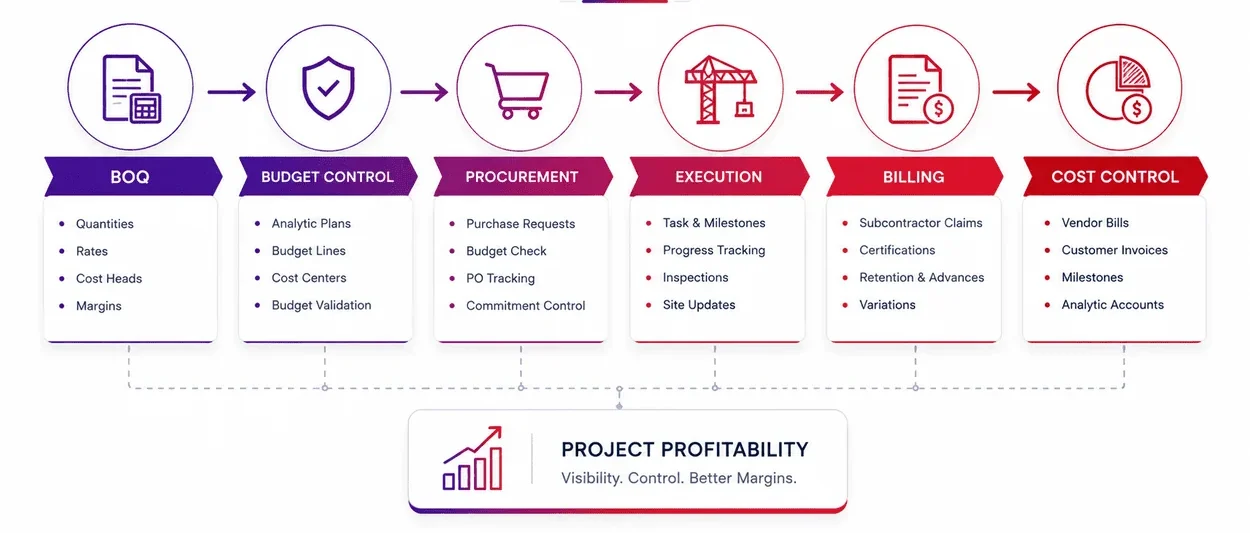
BOQ control is one of the most important needs in construction. A BOQ is not only a tender attachment. It becomes the commercial base for procurement, execution, billing and margin control.
Odoo BOQ management can be configured through products, service items, analytic accounts, budget lines and project cost heads. Each BOQ line can carry quantity, rate, cost type, planned margin and execution status.
Budget management in Odoo works through analytic plans and accounts. Odoo documentation explains that budgets can be built using plans and accounts. For construction, those accounts can represent projects, phases, work packages or cost centers.
A practical BOQ design should separate material, subcontractor cost, labour, equipment, site overheads and indirect costs.
When BOQ and budget data sit inside ERP, approvals become sharper. A purchase request can be checked against available budget. A subcontractor claim can be compared with work package value. A variation order can be tracked separately from base scope.
This is where Odoo construction ERP Saudi Arabia implementations need construction-specific thinking. Standard ERP features must be mapped to contracting logic.
Quantity Surveyors need clear control over BOQ values, measured quantities, variations, certified work, and billing impact. In construction projects, even small changes in quantity or scope can affect margins, procurement, subcontractor payments, and client billing.
Odoo can help QS teams manage BOQ lines, cost codes, quantity revisions, work packages, measurement records, and approved variations in one system. Each commercial update can be linked to the project budget, subcontractor scope, purchase requirement, and billing stage.
This gives Quantity Surveyors a clearer view of:
- Original BOQ vs revised BOQ
- Planned quantity vs actual measured quantity
- Approved and pending variations
- Certified work value
- Subcontractor claim value
- Client billing value
Odoo Procurement Management for Site and Material Control
In Saudi construction, material availability, supplier pricing and logistics timing can affect site productivity.
Odoo procurement management supports RFQs, vendor comparison, purchase orders, blanket agreements and vendor bills. Purchase control policies help decide whether vendor bills should be based on ordered or received quantities. This matters when materials arrive in partial deliveries.
- A site engineer or project manager can raise a material request. The request should carry project, BOQ head, cost code, quantity and required date.
- Vendor quotes can be compared against budget and past rates.
- Inventory can help track stock across central stores and project sites. Internal transfers can record movement between warehouses. This reduces confusion around unused material, excess buying and stock lying at sites.
- Good ERP procurement also protects cash. For contractors, that discipline directly supports project margin.
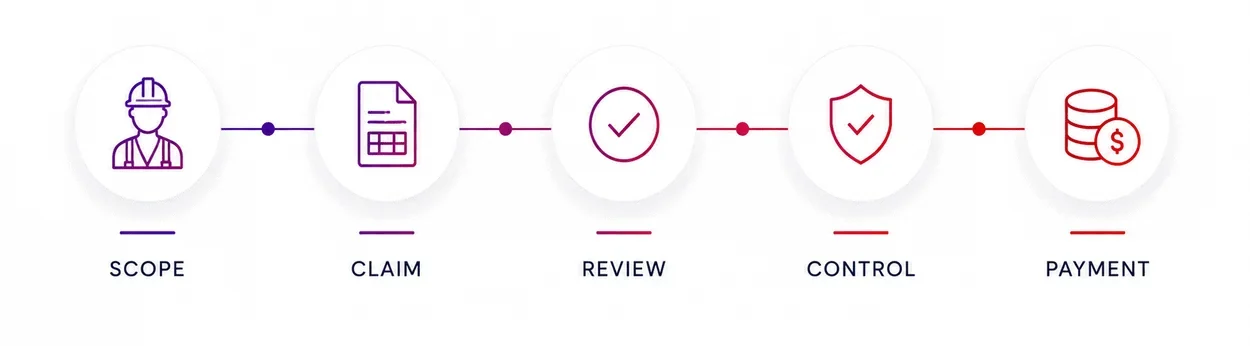
Subcontractor management is one of the hardest areas for Saudi contractors. A project may involve subcontractors across civil, MEP, façade, finishing and specialized works.
Odoo subcontractor management can be designed using vendor records, subcontract agreements, purchase orders, project tasks, progress certificates and vendor bills. Each subcontractor can be linked to work packages, rates, retention rules and payment milestones.
- The process should start with work allocation. The subcontractor receives a defined scope, agreed value, terms and deliverables.
- Certification is the next control point. A subcontractor claim should not directly become a payable bill. It should pass through measurement, site approval, commercial review and finance validation.
- Retention, advances, penalties and deductions can be managed through configured accounting and billing rules. Documents can hold contracts, insurance, compliance certificates and safety records.
This structure helps reduce disputes. It gives management visibility into committed subcontractor cost before invoices arrive.
Construction billing depends on certified progress, contract terms, retention rules, deductions, and payment milestones. If these are tracked manually, finance teams often struggle to match invoices with actual project progress.
Odoo can support progress billing through milestone invoices, payment certificates, certified quantities, BOQ values, and variation billing. For subcontractors, claims can move through site verification, QS review, project approval, and finance validation before payment.
Retention can also be tracked through configured invoice lines, payment terms, accounting rules, and reports. This helps contractors monitor retention withheld, retention payable, and retention release timelines.
Odoo can help manage:
- Interim payment applications
- Running account bills
- Certified progress billing
- Retention deductions
- Advance recovery
- Variation billing
- Subcontractor payment certificates
- Retention release
Odoo Cost Control and Project Profitability
A construction company can be busy and still lose money. Odoo cost control depends on correct analytic accounting. Every cost should carry project context. Material purchases, subcontractor bills, labour, expenses, equipment cost and overheads should map to the right analytic account.
Odoo profitability reporting shows project revenue and cost linked to analytic accounts. Contractors can use this to track margin during execution, not only after completion.
Cost control should answer five questions.
- Is the project within approved budget?
- Which cost heads are moving beyond plan?
- What has been committed but not billed yet?
- What has been billed but not paid yet?
- What margin remains after pending claims and variations?
Large projects can carry long payment cycles and many moving parts. A small cost drift can become serious when found late.
Multi-Project Visibility for Saudi Construction Companies
Many contractors begin with one strong project manager. As the business grows, this model becomes risky. Leadership needs system-level visibility, not person-level memory.
Odoo can support multiple construction projects with separate analytic accounts, budgets, documents, procurement flows and reporting dashboards. Each project can have its own team, approval matrix and cost structure.
At management level, dashboards can compare progress, revenue, costs, procurement status, issues and cash exposure.
Multi-company features also matter for Saudi groups. Some contractors operate through different legal entities, branches or joint ventures. Odoo can support multi-company operations when designed properly.
For Odoo infrastructure projects, the system can also integrate with planning, document, HR, payroll, attendance, fleet or external reporting tools. The goal is to connect business control around project execution.
A Construction KPI Dashboard in Odoo gives management a live view of project health across cost, progress, procurement, billing, and profitability.
Instead of depending on month-end reports, leaders can track real-time project performance across sites, teams, subcontractors, and work packages.
A practical dashboard can show:
- Project budget vs actual cost
- BOQ value vs executed value
- Open purchase orders
- Pending approvals
- Subcontractor claims submitted vs certified
- Client billing completed vs pending
- Retention receivable and payable
- Project margin movement
- Delayed milestones
- Cash flow exposure by project
Data, Mobile and AI Readiness
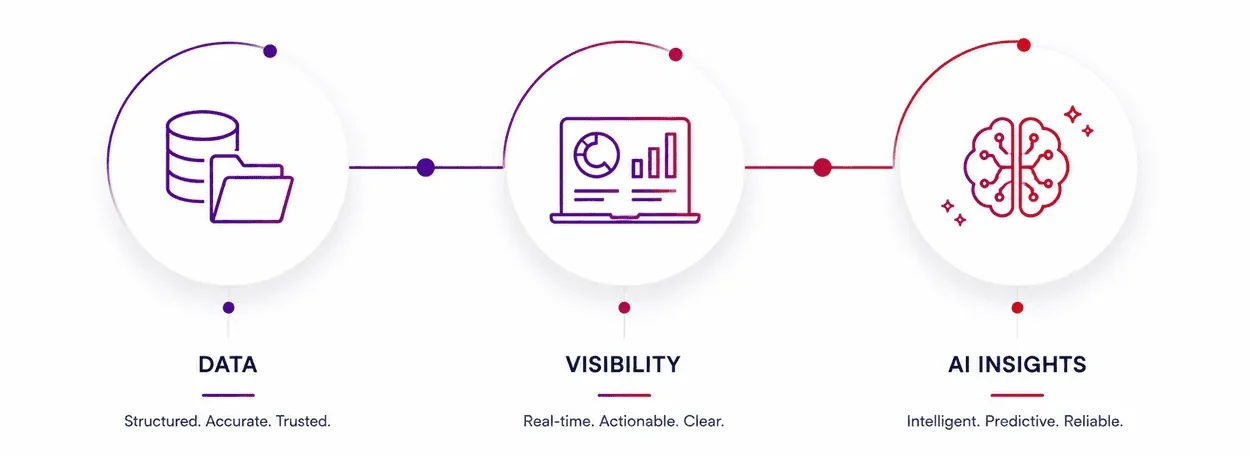
The next layer for Saudi contractors is data readiness. Once project, procurement and finance data are structured, management can use dashboards, alerts and predictive checks. Odoo can support mobile access for site teams, so updates do not wait until the end of the day.
With AI, Odoo can also assist when the data foundation is clean. It can summarize project issues, flag unusual cost movement, classify vendor bills, draft progress notes and support document search. These use cases should be governed carefully. Construction data includes prices, contracts, claims and client records.
The right approach is simple. Build clean workflows first. Add dashboards next. Bring AI only where the data is trusted. This keeps technology useful for engineers, commercial teams and finance users. This path supports better reporting without forcing site users into complex digital routines too early during active project delivery phases.
Technical Architecture for Odoo Construction Management
A sound Odoo implementation in Saudi Arabia needs more than module activation.
- The foundation is master data. Projects, cost codes, products, vendors, subcontractors, warehouses, taxes and analytic accounts must be structured properly. Poor master data creates reporting problems later.
- The second layer is workflow configuration. Purchase approvals, payment approvals, subcontractor certification, variation approvals and document review steps should match company authority rules.
- The third layer is localization. Saudi contractors need VAT, ZATCA e-invoicing, Arabic-English documents, local formats and audit-ready reporting. ZATCA states that Phase Two integration started from January 1, 2023 in waves. It requires integration with ZATCA systems and e-invoices in the required format.
- The fourth layer is integration. Odoo may connect with BIM tools, document systems, payroll, attendance devices, banking, fleet tracking or client portals. API design should protect data quality.
- The fifth layer is security. Project access should follow role, department, company and site responsibility.
Implementation Roadmap for Saudi Construction Companies
A successful Odoo implementation should move in phases.
- Phase one should cover discovery and process mapping. The partner should study estimation, BOQ, procurement, subcontractor billing, finance and reporting.
- Phase two should define master data and control architecture. This includes cost codes, project structures, approval limits and analytic accounts.
- Phase three should implement core modules. HR, payroll, fleet and equipment can follow.
- Phase four should configure construction workflows. This includes BOQ budgets, purchase requests, subcontractor claims, retention and cost reports.
- Phase five should handle localization and compliance. Saudi VAT, ZATCA, Arabic-English formats and reporting outputs should be validated.
- Phase six should test real project scenarios. Testing should use actual BOQs, vendor bills, claims and project reports.
- Phase seven should train users by role. Site teams, procurement, finance, commercial and management need different training paths.
- Phase eight should run controlled go-live. A pilot project reduces risk before full rollout.
It helps contractors avoid one common mistake: trying to automate unclear processes.
Saudi construction rewards companies that control details. Contractors need systems that connect BOQ, procurement, subcontractors, finance and project reporting.
Odoo construction ERP Saudi Arabia projects can give contractors that connected base. The result is better project discipline, cleaner approvals, cost visibility and reliable reporting.
BOQ must connect to budget. Procurement must connect to site need. Subcontractor claims must connect to certified progress. Finance must connect to project reality.
That is the difference between installing ERP and building operational control.
How iProgrammer Supports Odoo Construction ERP in Saudi Arabia
At iProgrammer Solutions, we help companies design, implement, customize, and scale Odoo for real business operations. As an Odoo Ready Partner with 18 years of product development experience, we bring the technical depth and implementation discipline needed to build ERP systems that support long-term business growth.
For construction and contracting companies, our focus is practical execution. We help map BOQ structures, project budgets, procurement workflows, subcontractor processes, cost reports and Saudi compliance needs into Odoo.
If your company is evaluating Odoo construction ERP Saudi Arabia options, explore our Saudi Arabia Odoo services now!
