





Designing Multi-Agent AI Systems for Enterprise Applications
- What Are Multi-Agent AI Systems?
- Why Enterprises Are Moving to Multi-Agent Systems
- How Multi-Agent Systems Work in AI Applications
- When Not to Use Multi-Agent Systems
- Core Components of a Multi-Agent Architecture
- Architecture Patterns for Multi-Agent Systems
- Designing Multi-Agent AI Systems for Enterprise
- AI Agents Architecture: A Practical Guide
- LLM Agents Design Considerations
- Security and Governance in Multi-Agent Systems
- Agent-Based AI Applications Across Industries
- Scalability and Performance Considerations
- Integration with Enterprise Systems
- Challenges in Multi-Agent System Adoption
- Failure Modes in Multi-Agent Systems
- Implementation Roadmap: From Pilot to Production
- Future Trends in Multi-Agent AI Systems
- Conclusion
- About iProgrammer
- FAQ
Ever experienced a manageable workflow suddenly start to stretch? This usually happens because the workflow grows beyond the limits of how it was designed. More tools get added. More rules get layered. More exceptions get patched in. Eventually, what should be a system becomes a collection of workarounds.
This is where most AI applications fall flat on their face. It moves away from individualized intelligence towards collective intelligence. Rather than burden one model to perform all tasks, enterprises design a system where several agents work together to specialize and adapt.
Designing multi-agent AI systems changes that equation. It shifts the focus from isolated intelligence to coordinated intelligence. Instead of asking one model to do everything, enterprises design systems where multiple agents collaborate, specialize, and adapt.
This blog unpacks how to design such systems for enterprise use. Not as a conceptual exercise, but as a practical blueprint grounded in architecture, governance, and real-world constraints.
What Are Multi-Agent AI Systems?
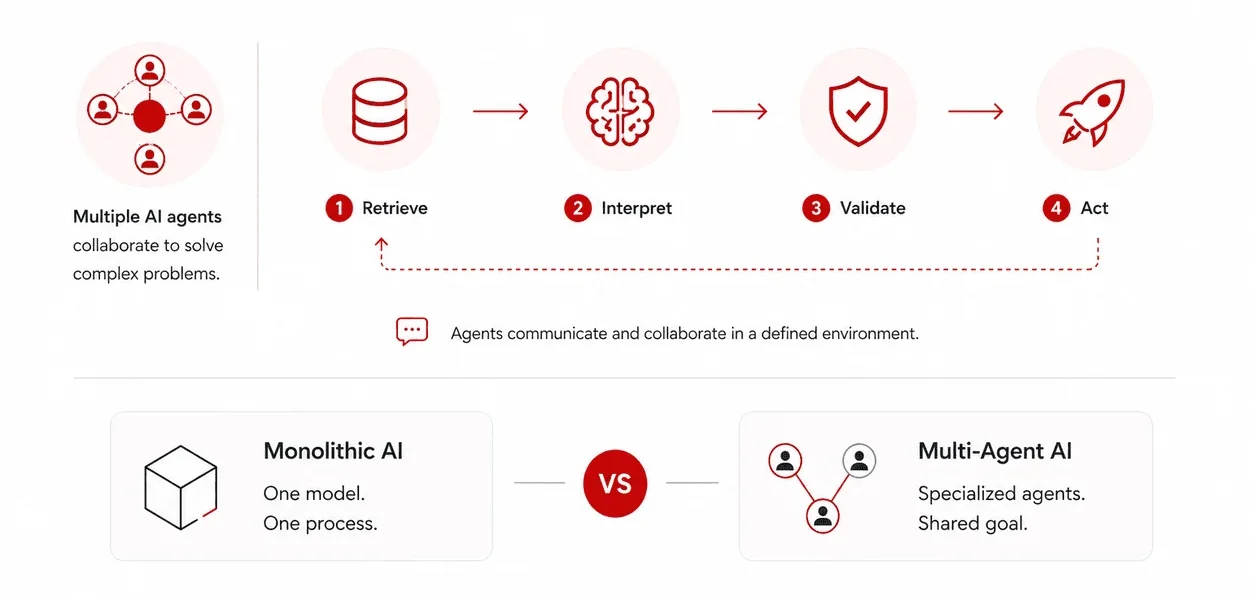
From an architectural perspective, multi-agent AI systems consist of several agents operating together in solving complex problems. Each agent serves a particular purpose. The agents communicate, share data, and collaborate in a specified setting.
In contrast to monolithic AI, which uses a single model for handling an entire process flow, multi-agent AI splits up responsibilities. One agent retrieves data. Another interprets it. A third validates outputs. A fourth executes actions.
This distribution is not just architectural. It is strategic.
It allows enterprises to design systems that are:
- Modular in structure
- Resilient to failure
- Easier to scale and maintain
- Better aligned with real business workflows
The shift is subtle but important. AI stops being a feature and becomes an operating layer.
Why Enterprises Are Moving to Multi-Agent Systems
The move toward multi-agent systems enterprise adoption is not driven by hype. It is driven by practical limitations that organizations face with single-model AI deployments.
1. Complexity Outpaces Single Models
Enterprise workflows are rarely linear. These include decision trees, dependencies, approval, and exception handling. One model cannot handle all these requirements without failing.
2. Specialization Improves Accuracy
Diverse roles need diverse skills. These include retrieving information, making judgments, planning actions, and implementing decisions. A specialized agent does each role better than one designed for general use.
3. Reusability Reduces Long-Term Cost
When an agent is created, it can then be used in many different scenarios. There will be no redundancy of effort in doing so.
4. Collaboration Reflects Real Operations
Human teams work collaboratively. Multi-agent systems mirror this structure. They allow AI to integrate more naturally into existing operational models.
5. Scalability Becomes Manageable
Scaling a single model often increases cost and latency. Scaling agents allows targeted optimization. Teams can scale only what is needed.
How Multi-Agent Systems Work in AI Applications
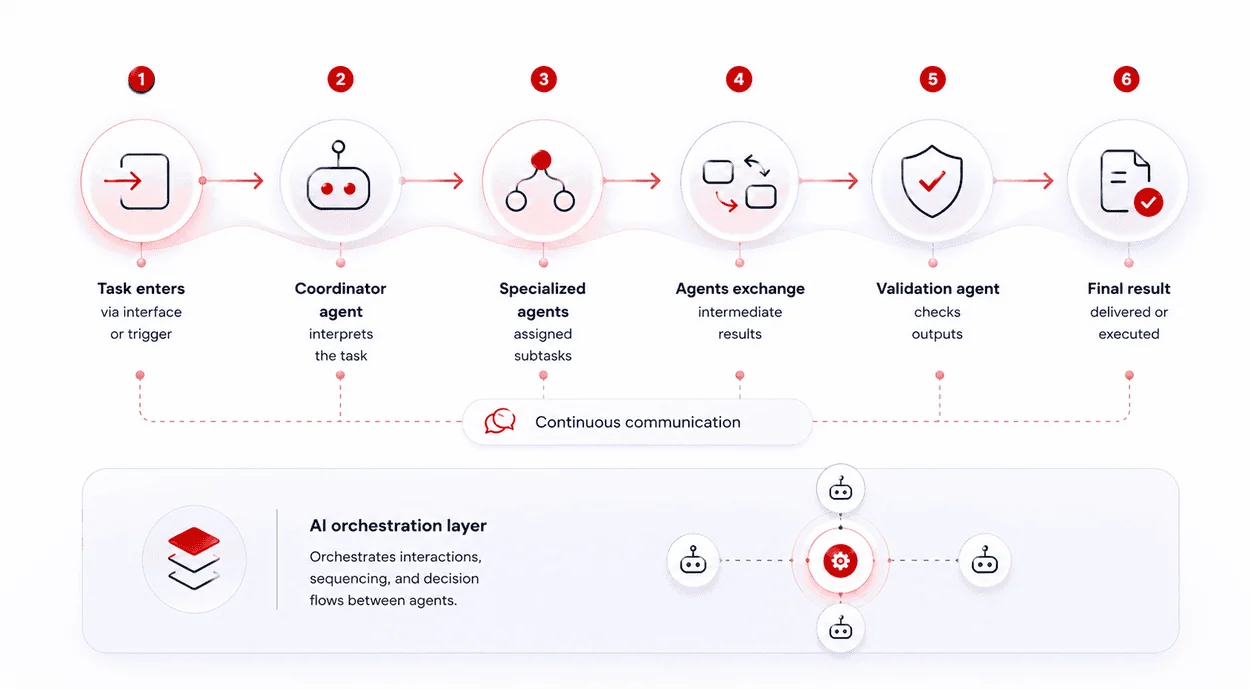
At a high level, multi-agent systems operate through coordination and communication. A typical flow looks like this:
- A task enters the system through an interface or trigger
- A coordinator agent interprets the task
- Specialized agents are assigned subtasks
- Agents exchange intermediate results
- A validation agent checks outputs
- The final result is delivered or executed
This is a communication-intensive process. Agents do not act independently. They depend on a common context, memory, and communication mechanisms.
Here, an AI orchestration layer comes into play. This acts as a foundation that orchestrates the interactions, sequencing, and decision flows.
A multi-agent system does not have to be the first choice in all situations. For a process flow that is linear, straightforward, and variable-free, a multi-agent system can create unwanted complications. Single agents equipped with retrieval or rules-based processes prove more suitable.
Furthermore, they would not perform effectively in cases where latency is critical for decision-making. The multi-step coordination is about additional precision and flexibility. Likewise, if the need for governance is low and there is no requirement for coordinating across systems, the added costs might outweigh any potential benefits.
Consider how a telecom team handles a network outage. Detection is only the first step. Logs need analysis, impact must be assessed, and actions have to be triggered quickly. In a multi-agent setup, a monitoring agent flags the issue, a diagnostic agent identifies the root cause, and a prioritization agent evaluates severity based on affected users.
An execution agent then initiates corrective actions, while a communication agent updates teams and customers in real time. The orchestration layer keeps everything aligned and sequential. The outcome is a faster, more reliable response without constant manual coordination.
Core Components of a Multi-Agent Architecture
Designing a robust system requires clarity on its building blocks.
1. Agents
Role: Agents are the execution units of the system. Each agent is responsible for a clearly defined task within the workflow.
What They Include:
|
How They Operate:
|
Design Consideration: Agents should be scoped to carry out narrow functions. Increasing responsibility leads to reduced transparency and additional opportunities for failure.
2. Orchestrator
Role: The orchestrator is responsible for coordinating agents’ activity. It ensures workflows execute in a structured and predictable manner.
What It Handles:
|
How It Operates:
|
Design Consideration:
Without proper orchestration, systems tend to be disorganized and lack control and observability.
3. Memory Layer
Role: The memory layer provides context that agents need to make accurate decisions. It ensures continuity across interactions.
What It Includes:
|
How It Operates:
|
Design Consideration:
Quality of retrieval is prioritized over the size of storage. This is achieved through techniques such as retrieval-augmentation generation.
4. Tooling and Integrations
Role: This layer connects agents to real-world systems, allowing them to perform meaningful actions.
What It Connects To:
|
How It Operates:
|
Design Consideration: Access needs to be strictly controlled. Agents should be restricted to interact with systems relevant to their tasks.
5. Communication Protocols
Role: Communication protocols outline how agents communicate and share data with each other.
What They Define:
|
How They Operate:
|
Design Consideration: Lack of structured communication results in misunderstandings. Communication protocols help agents coordinate and facilitate debugging
Architecture Patterns for Multi-Agent Systems
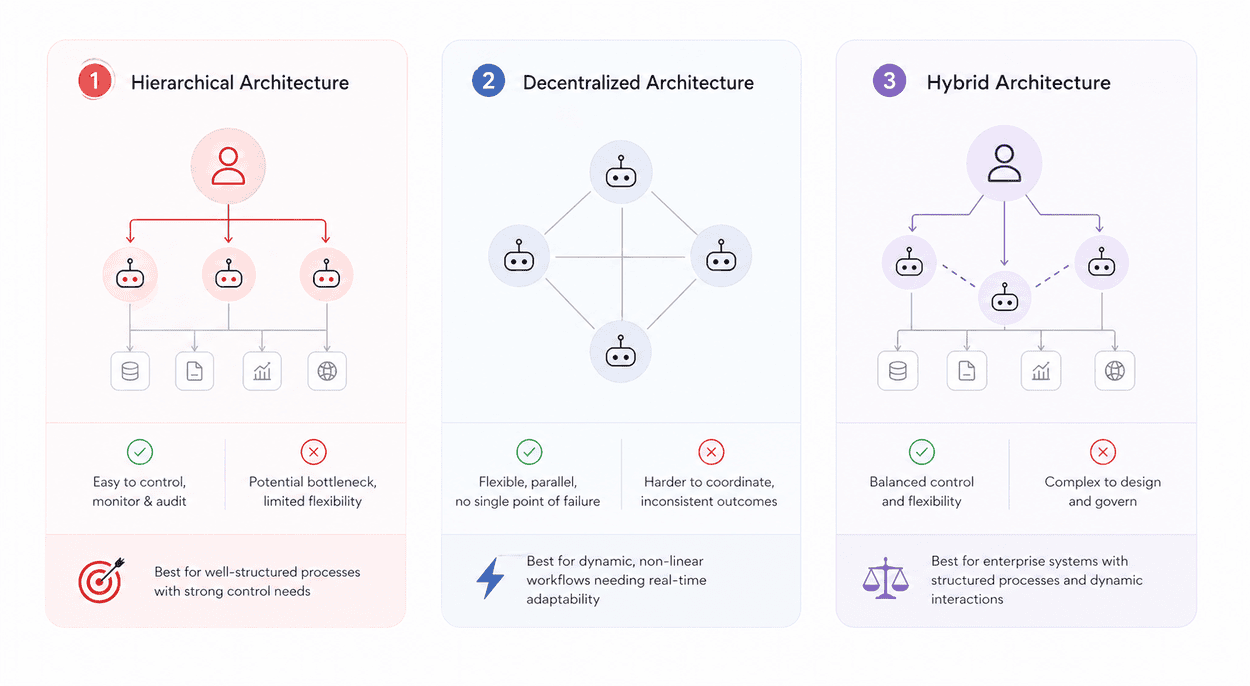
No one-size-fits-all architecture pattern exists. The architecture pattern selection should be based on process complexity and business needs.
1. Hierarchical Architecture
The hierarchical architecture pattern leverages an orchestrator responsible for distribution of tasks and agents involved in a workflow. All the decisions made are funneled through this level. Therefore, the orchestrator always has the same perception of the state of affairs in the system.
Hierarchical architecture patterns have several advantages. They make the system easy to control, monitor, and audit. This architecture ensures the determinism of workflows. However, its main disadvantage is the limited flexibility of decision-making. As workload or interaction complexity increases, the orchestrator can become a performance bottleneck. It also limits parallel decision-making across agents.
It suits well-structured work processes where there are known dependencies and strong control requirements.
2. Decentralized Architecture
In a decentralized approach, each agent operates as a separate individual that communicates with other entities. The process of decision-making is distributed, and each agent decides based on the environment around them within guidelines.
The advantage is increased flexibility and the possibility of running processes in parallel. There are no single points of failure, and it is capable of adapting to varying input data. The disadvantage is difficulty coordinating large numbers of agents. There is no guarantee of consistent results without proper communication agreements.
This pattern is suited for dynamic environments where workflows are non-linear and require real-time responsiveness.
3. Hybrid Architecture
This model combines centralized management with selected peer-to-peer interactions amongst the agents. Centralized management is responsible for orchestrating the whole process, while the agents interact with one another for some tasks.
This model balances control with flexibility. It ensures governance where necessary while supporting parallelism and localized decision-making where necessary. It also minimizes the likelihood of bottlenecks that might occur in a completely centralized approach. The challenge here is determining the boundary between orchestration and autonomy as well as ensuring proper communication standards.
The hybrid approach allows effective management without losing the flexibility. This helps ensure the necessary governance and decision-making capabilities while reducing congestion. The challenge in adopting such an approach is in establishing clear delineations between governance and independence and in developing uniform standards of communication.
Hybrid architecture is the most practical choice for enterprise systems, where workflows include both structured processes and dynamic interactions.
Architecture Pattern Comparison
| Pattern | Strengths | Limitations | Best Use Case |
|---|---|---|---|
| Hierarchical | Strong control, clear flow | Bottleneck risk | Regulated workflows |
| Decentralized | Flexible, adaptive | Coordination complexity | Dynamic environments |
| Hybrid | Balanced control and flexibility | Higher design complexity | Enterprise-scale applications |
Designing Multi-Agent AI Systems for Enterprise
Multi-agent AI design is more than just putting together agents; it involves adopting a systems perspective.
- Start with Workflow Decomposition: Decompose the business process into individual tasks. Locate decision-making nodes, dependencies, and potential points of failure.
- Define Agent Roles Clearly: One task per agent is key. Overlapping roles lead to confusion and increased mistakes.
- Build for Observability: Any action taken by the agent must be traceable. Logs, metrics, and audits are required.
- Design for Failure: Agents will fail. The system should detect, contain, and recover from failures without causing other problems.
- Optimize for Latency and Cost: Additional agents do not necessarily result in better performance. Each interaction adds latency and cost. Balance is critical.
AI Agents Architecture: A Practical Guide
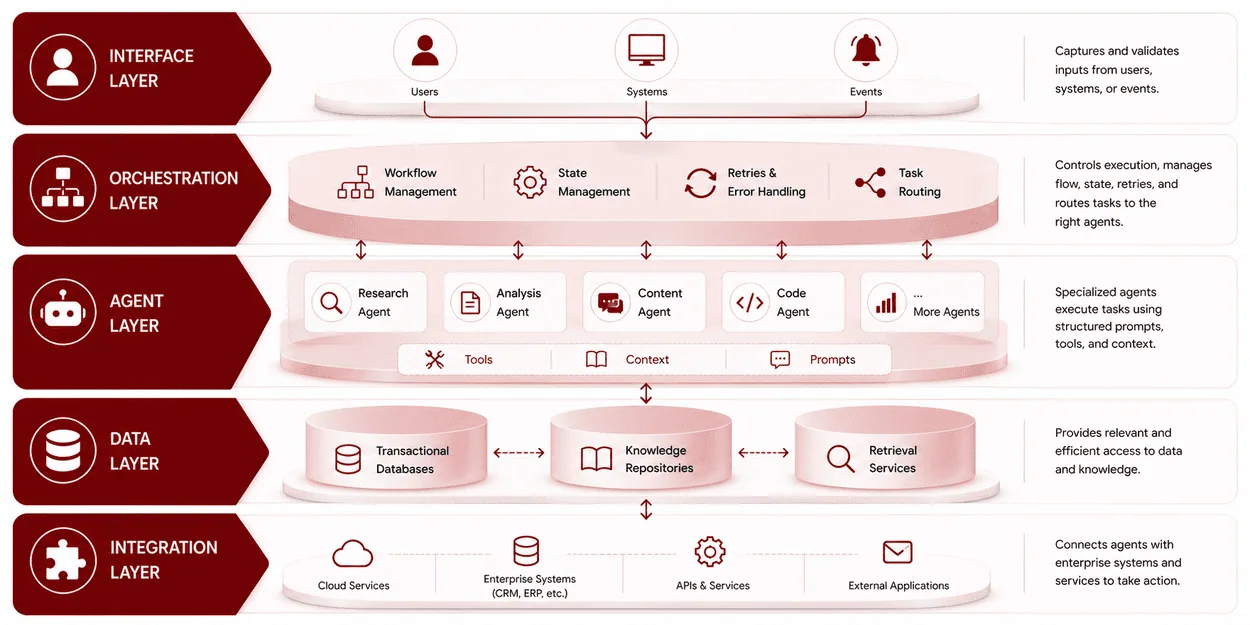
A well-designed AI agents architecture aligns technical components with business outcomes.
Layered Architecture Approach
- Interface Layer: Catches inputs from users, systems, or events. It validates inputs, standardizing them to ensure they can be reliably consumed by the system.
- Orchestration Layer: Controls the execution of workflows. It understands how to execute a task, determine the flow, and direct the tasks to the right agents. State management, retrying, and exception handling are also managed in this layer.
- Agent Layer: The layer in charge of executing tasks by using specialized agents. Agents are able to function within a particular domain and generate an output by following structured prompts, tools, and context. Role distinction is crucial in this layer.
- Data Layer: This comprises transactional databases, knowledge repositories, and retrieval facilities. The issue in this layer is relevance and efficiency of retrieval rather than volume, because the effectiveness of an agent hinges on its ability to access relevant data efficiently.
- Integration Layer: Facilitates connections between agents and the rest of enterprise systems and services. Enables actions beyond inference, such as updating data or workflow initiation. Access control should be ensured in this layer.
This layered approach ensures modularity and scalability.
LLM Agents Design Considerations
Designing effective LLM agents design requires attention to prompt engineering, memory, and tool usage.
Prompt Structuring
The structure of prompts affects an agent’s understanding of intent and generation of replies. A clear specification of goals, limitations, and format ensures that actions are performed consistently with the intended task. Ill-formed prompts may cause erratic reasoning when processing analogous prompts.
Prompts can be viewed as versions of system modules to ensure robustness. It enables organizations to define consistent behaviors, try out different prompts, and ensure uniformity among agents functioning on the same task.
Tool Integration
Tool integration enables agents to move beyond text generation and perform real actions. By invoking APIs or functions, agents can retrieve accurate data and execute tasks within enterprise systems. This improves precision and reduces reliance on inferred outputs.
The key is controlled invocation. Agents must operate with clear rules on when to use tools versus internal reasoning. Unstructured tool usage increases latency, cost, and the risk of incorrect execution.
Context Management
Context influences the effectiveness of agent outputs. Context relevant to the task enhances the precision of results; more context leads to higher costs and lower speeds. The key is to provide just enough context to make decisions.
The dynamic search process plays an important role in keeping this balance. It helps to provide the agents with timely access to appropriate information, without stressing the model or injecting noise in the reasoning process.
Continuous Evaluation
One cannot evaluate the behavior of the agent by just conducting a static test. There is an element of variance due to the real-life input data which needs to be continuously checked. Systems must be tested against evolving scenarios to remain reliable.
Ongoing evaluation helps detect failure patterns early and supports iterative improvements. Without it, performance drift becomes inevitable as workflows, data, and usage conditions change.
Security and Governance in Multi-Agent Systems
Security is often underestimated in early designs. In multi-agent systems, the risk surface expands significantly.
Key Risks
|
Governance Strategies
|
Governance Framework for Multi-Agent Systems
| Layer | Control Mechanism | Purpose |
|---|---|---|
| Agent Layer | Role-based permissions | Restrict capabilities |
| Orchestration | Policy enforcement | Ensure workflow compliance |
| Data Layer | Encryption and masking | Protect sensitive data |
| Monitoring | Logs and alerts | Detect anomalies |
| Validation | Output verification | Ensure reliability |
Agent-Based AI Applications Across Industries
The impact of agent-based AI applications is already visible across sectors.
Healthcare
Agents assist in triage, diagnostics support, and patient workflow coordination. They structure incoming data, prioritize cases, and guide decision paths based on clinical rules and historical patterns.
This improves response time and reduces operational load on medical staff. The focus remains on augmenting decision-making rather than replacing clinical judgment.
Finance
Agents manage workflows such as fraud detection, compliance validation, and customer interaction handling. They analyze transaction patterns, flag anomalies, and initiate predefined actions where required.
This enables faster detection and response while maintaining auditability. Systems remain aligned with regulatory requirements through controlled decision paths.
Manufacturing
Agents monitor production environments, perform quality checks, and optimize process parameters in real time. They detect deviations early and trigger corrective actions before issues scale.
This improves consistency in output and reduces downtime. The system adapts to operational variability without requiring constant manual recalibration.
Customer Service
Multi-agent systems manage query handling, escalation, and personalization across channels. Agents classify requests, retrieve relevant context, and coordinate responses based on user history and intent.
This reduces response time and improves consistency across interactions. Complex queries can be escalated seamlessly without breaking the workflow.
Scalability and Performance Considerations
Scaling multi-agent systems is not just about adding more agents. It requires thoughtful design.
Horizontal Scaling
Horizontal scaling involves adding more agents to handle increased workload. This improves throughput and allows parallel execution of tasks across the system.
The challenge lies in coordination. As the number of agents grows, communication overhead increases, which can impact latency if not managed properly.
Vertical Scaling
Vertical scaling focuses on enhancing the capability of existing agents. This includes improving reasoning quality, expanding tool access, or refining prompts and logic.
While this improves individual agent performance, it must be balanced carefully. Overloading agents with multiple responsibilities reduces modularity and increases failure impact.
Load Balancing
Efficient task distribution is critical for maintaining system performance. Load balancing ensures that no single agent becomes a bottleneck while others remain underutilized.
This requires real-time monitoring of agent capacity and intelligent routing of tasks. Poor distribution leads to delays and inconsistent response times.
Performance Monitoring
Continuous monitoring is essential to maintain system reliability. Key metrics include latency, accuracy, cost per task, and failure rates across agents.
Integration with Enterprise Systems
For multi-agent systems to deliver value, they must integrate deeply with enterprise ecosystems.
This includes:
- ERP systems
- CRM platforms
- Data warehouses
- Custom applications
Organizations often rely on strong engineering capabilities such as IT product engineering to build and maintain these integrations.
For front-end and customer-facing workflows, solutions like web application development services and mobile app development services play a critical role in delivering seamless experiences.
Challenges in Multi-Agent System Adoption
Despite their potential, multi-agent systems introduce challenges.
- Coordination Complexity: As the number of agents increases, interaction paths grow rapidly, making dependencies and sequencing harder to manage. Without strong orchestration and communication standards, systems can produce inconsistent outputs and become difficult to debug, especially in multi-step workflows.
- Cost Management: Each agent interaction consumes compute and API resources, which can escalate quickly in complex workflows. Inefficiencies such as redundant calls, excessive context usage, and poor task distribution increase operational costs, making continuous monitoring and optimization essential.
- Reliability Issues: Errors in one agent can propagate across the system, particularly when outputs are chained. Without validation layers, fallback mechanisms, and controlled retries, small inaccuracies can compound into larger failures that impact overall system performance.
- Lack of Standards: The absence of widely adopted interoperability standards makes it difficult to integrate agents across different frameworks and vendors. This limits flexibility and increases the effort required to scale systems or adopt third-party components.
Multi-agent systems often fail not because individual agents are inaccurate, but because coordination breaks down. One common issue is cascading failure, where an incorrect output from one agent propagates through subsequent steps, amplifying the error. This is especially risky in chained workflows without intermediate validation.
Other failure patterns include conflicting outputs between agents, deadlocks in orchestration where tasks wait indefinitely, and repeated tool invocation loops that increase cost without improving outcomes. Latency can also compound across multiple agent interactions, slowing down the entire system. These failure modes require explicit handling through validation layers, timeout controls, and clear execution boundaries.
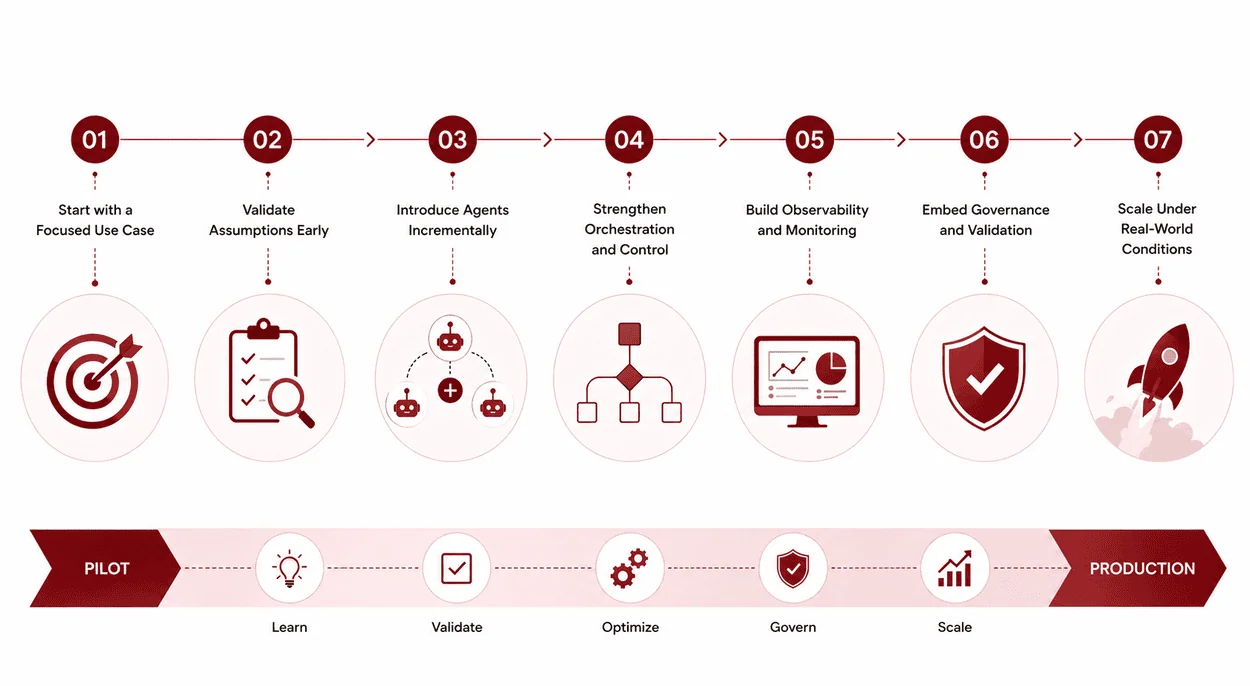
Now that you know how to design multi-agent AI Systems, the next important step is implementation. Multi-agent systems require a phased approach rather than a full-scale rollout. The goal is to validate value early while building the foundation for scale.
- Start with a Focused Use Case: Begin with a narrow, high-impact workflow where coordination between agents is clearly justified. This reduces complexity and allows faster validation of system design and outcomes.
- Validate Assumptions Early: Test the system under controlled conditions to evaluate accuracy, latency, and coordination behavior. Identify gaps in reasoning, tool usage, and data access before scaling further.
- Introduce Agents Incrementally: Expand the system by adding agents gradually. Each addition should solve a specific problem and integrate cleanly into existing workflows without increasing ambiguity.
- Strengthen Orchestration and Control: As the system grows, refine orchestration logic to manage dependencies, retries, and edge cases. This ensures workflows remain predictable as complexity increases.
- Build Observability and Monitoring: Implement logging, tracing, and performance tracking across agents. Visibility into decisions and failures becomes critical as interactions scale.
- Embed Governance and Validation: Introduce validation layers, access controls, and policy enforcement to ensure outputs remain reliable and compliant across workflows.
- Scale Under Real-World Conditions: Move beyond controlled environments and test the system under actual load, variability, and edge cases. Production readiness depends on consistent performance, not just functional success.
Future Trends in Multi-Agent AI Systems
The evolution of multi-agent AI systems is closely tied to advancements in standards and tooling.
- Interoperability Protocols: Standardized communication protocols are emerging to enable structured interaction between agents across platforms. As these mature, enterprises will be able to integrate multi-vendor agents more easily, reducing dependency on isolated ecosystems.
- Autonomous Agent Ecosystems: Agents are expected to operate beyond single enterprise boundaries, interacting with external systems across partners and vendors. This will enable more dynamic collaboration but will also require stronger governance and trust frameworks.
- Improved Observability Tools: Advanced monitoring tools are being developed to track agent behavior, decision flows, and system performance in real time. This will improve debugging, ensure compliance, and provide greater transparency in complex deployments.
- Human-AI Collaboration Models: Systems are increasingly designed to augment human decision-making rather than replace it. Agents handle structured tasks while humans retain oversight, creating a more balanced and practical approach to enterprise adoption.
Designing multi-agent systems is not about adopting a new trend. It is about aligning AI with how enterprises actually operate.
The real shift lies in moving from isolated intelligence to coordinated systems. This requires rethinking architecture, governance, and integration from the ground up.
Enterprises that get this right will not just automate tasks. They will redesign how work gets done.
At iProgrammer, we work with organizations that are scaling AI beyond experimentation. Our focus on building systems that stay reliable has been constant since the last18 years.
From designing agent architectures to integrating them into enterprise ecosystems, we approach AI as a system, not a feature. This enables our clients to move from isolated use cases to connected, scalable solutions. If you’re looking for something that stays consistent in quality, contact us now!
1. How do AI agents communicate?
2. What is the difference between single-agent and multi-agent AI?
3. Are multi-agent systems scalable?
4. When should enterprises use multi-agent AI?
5. What industries benefit most from multi-agent systems?