





Context Engineering: The Next Evolution After Prompt Engineering
- What is Context Engineering?
- Why Prompt Engineering Is No Longer Enough
- Context Windows Explained
- Long-Term vs Short-Term Memory
- Retrieval as Context
- AI Observability
- Tool Calling and Action Context
- Model Context Protocol, MCP
- Context Compression Techniques
- Context Caching
- Multi-Agent Context Sharing
- Enterprise Use Cases
- Real Enterprise Examples
- Security and Governance
- The Future of Context Engineering
- How iProgrammer Looks at Context Engineering
- FAQs
A good AI answer can still feel useless inside a real business system. This sentence may sound harsh, but most delivery teams have seen it happen. A model explains policy well, yet ignores the latest contract Annexure. For example, a chatbot understands the question, but misses the customer’s open ticket. A sales assistant writes a polished response, but recommends a product unavailable in that region. The issue is rarely language quality. The issue is that the model did not receive the business reality needed for the task.
This is why Context Engineering has become one of the most serious AI disciplines today. It moves attention from clever instructions to reliable information design. Prompt Engineering still matters, but enterprise AI needs more than a well-written prompt. It needs relevant data, user intent, memory, permissions, tools, workflow state, and output controls. All of that must reach the model at the right moment.
The timing matters because AI adoption has moved beyond experiments. Stanford’s 2025 AI Index reported that 78 percent of organizations used AI in 2024, up from 55 percent the previous year. McKinsey’s 2025 AI survey also found that 62 percent of respondents were at least experimenting with AI agents, while nearly two-thirds had not started scaling AI across the enterprise. That gap explains the current market tension. Companies have access to powerful models, but many still lack dependable context systems.
What is Context Engineering?
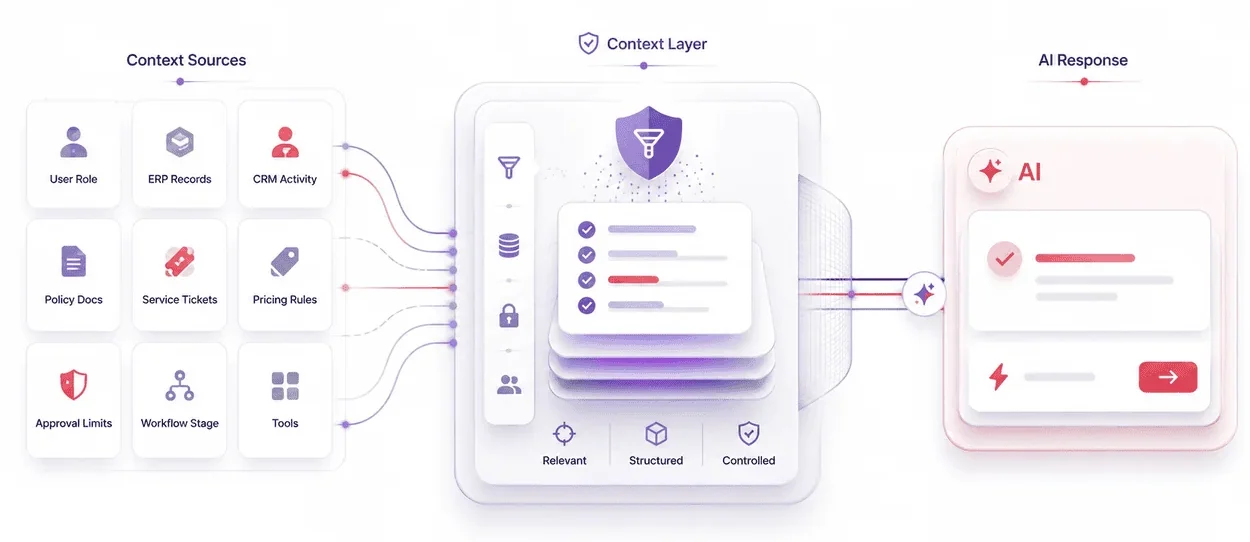
Context Engineering is the practice of designing, assembling, managing, and governing the information an AI system receives before it responds or acts. It includes the prompt, but it also includes the surrounding data and execution environment.
In a business application, that context may include user role, account history, product rules, policy documents, ERP records, CRM activity, service tickets, pricing conditions, approval limits, and current workflow stage. The model should not guess these details. The system should supply them in a structured, secure, and cost-aware way.
LangChain defines Context Engineering as building dynamic systems that provide the right information and tools in the right format, so an LLM can complete a task. Anthropic describes context as a critical and finite resource for AI agents. These definitions point to the same idea. The strongest AI systems do not rely on a single perfect prompt. They manage the full information environment around the model.
A simple way to frame it is this. Prompt Engineering tells the model how to behave. Context Engineering gives the model what it needs to know, what it can use, and what it must not access.
Why Prompt Engineering Is No Longer Enough
Prompt Engineering became popular because it made early LLMs usable. Better instructions improved tone, structure, reasoning style, and output format. It helped teams move from vague chatbot replies to repeatable business responses.
That stage was necessary. It taught teams how models respond to constraints, examples, roles, and formatting. Yet many enterprise workflows are not static writing tasks. They involve changing data, user permissions, business exceptions, and tool decisions.
A prompt can say, answer using the latest policy. It cannot guarantee that the latest policy was retrieved. A prompt can say, do not reveal confidential data. It cannot replace access control. A prompt can say, create a quote. It cannot validate pricing, stock, tax, margin, and approval rules by itself.
This is where AI Context Management becomes essential. The system must decide which documents to retrieve, which memories to keep, which tools to expose, and which information to remove. It must also track what the model saw, why it saw it, and whether that context was enough.
For enterprise AI, the prompt becomes one component in a larger design. The real work is building repeatable context pipelines around the model.
| Area | Prompt Engineering | Context Engineering |
|---|---|---|
| Core focus | Instructions and response format | Information flow and decision environment |
| Main question | What should the model do? | What should the model know and access? |
| Typical asset | Prompt template | Context pipeline and governance layer |
| Data handling | Often pasted manually | Retrieved, filtered, ranked, and secured |
| Enterprise risk | Inconsistent outputs | Wrong, missing, excessive, or leaked context |
| Success measure | Better response quality | Reliable task completion with traceability |
Context Windows Explained
The Context Window is the amount of text, measured in tokens, that an LLM can reference during a single request. It includes the system message, user prompt, conversation history, retrieved documents, tool outputs, and the generated response. IBM and Anthropic both describe the context window as the model’s working memory for a request.
Longer windows have changed what AI applications can attempt. Google’s Gemini documentation discusses one million token long context, and Anthropic announced one million token context for Claude Opus 4.6 beta. This allows larger documents, codebases, transcripts, and case histories to fit inside one request.
Yet a bigger Context Window does not solve context quality. More text can increase latency, cost, and attention dilution. Anthropic’s context window documentation also warns that more context is not automatically better, because accuracy and recall can degrade as token count grows.
This makes LLM Context design a prioritization problem. The question is not how much information can fit. The better question is which information deserves to be there for this task.
Long-Term vs Short-Term Memory
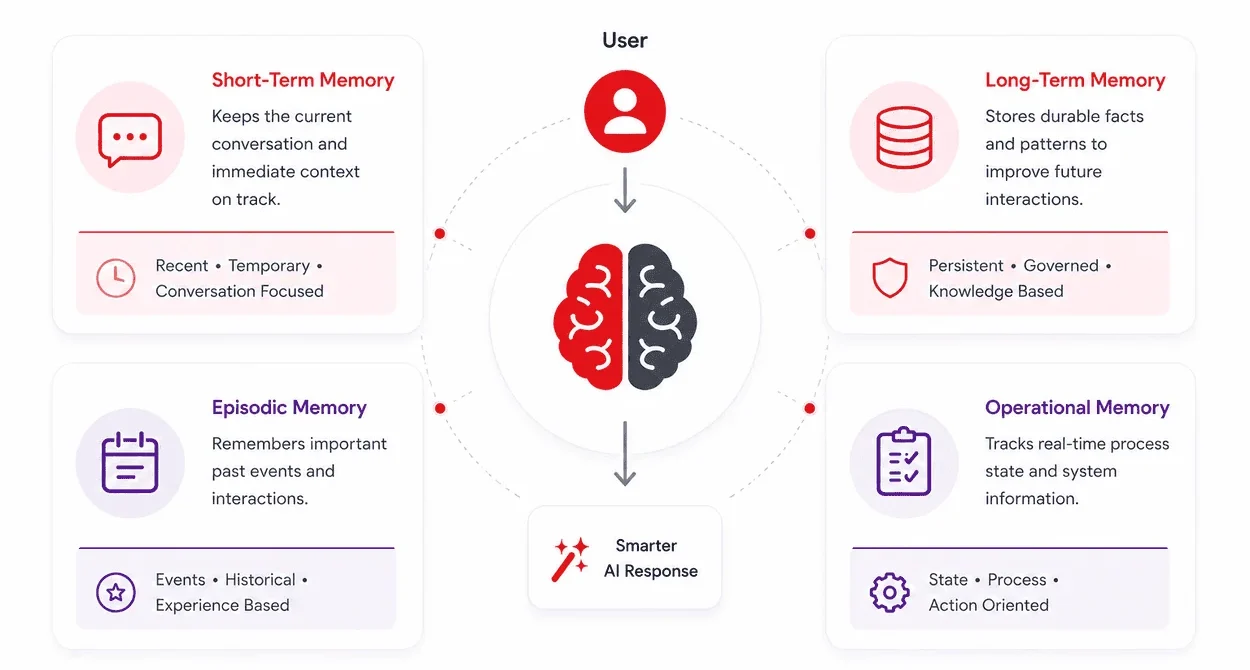
AI Memory is often discussed as if it means remembering everything. That approach creates noise, risk, and cost. Enterprise systems need several memory layers, each with a clear purpose.
Short-term memory keeps the current interaction coherent. It remembers the user’s last few turns, active form fields, selected record, and immediate task. This memory is useful for continuity, but it should fade quickly.
Long-term memory stores durable facts that improve future interactions. In enterprise systems, it may include customer preferences, user role patterns, recurring exceptions, product mappings, or process learning. This data needs governance because it can influence future decisions.
Episodic memory stores important past events. For example, an AI support agent may remember that a customer had three failed escalations last month. Operational memory stores process state, such as approval stage, pending documents, failed integrations, and open dependencies.
The best AI Agent Context systems separate these memory types. They do not push every past interaction into every request. They select memory based on task, role, recency, permission, and business impact.
Retrieval is the bridge between static model knowledge and live enterprise truth. Retrieval-Augmented Generation, known as RAG, combines a language model with external knowledge sources. The original RAG paper described how explicit non-parametric memory can help models answer knowledge-intensive tasks with more factual and specific outputs.
For enterprises, Context Retrieval usually starts with documents. Policies, contracts, manuals, proposals, tickets, emails, product sheets, invoices, and SOPs become searchable knowledge sources. The system embeds, indexes, filters, ranks, and returns relevant chunks to the model.
Basic retrieval is no longer enough for serious use cases. Teams now need metadata filters, hybrid search, reranking, document permissions, citation tracking, freshness checks, and query rewriting. A legal answer may need clause-level references. A service answer may need latest ticket status. An ERP answer may need live stock and customer credit data.
Good retrieval makes Context-Aware AI feel grounded. Poor retrieval makes even strong models sound confident with the wrong evidence.
As Context Engineering matures, organizations also need better ways to measure whether context is actually improving AI performance. This has given rise to AI Observability, one of the fastest-growing areas in enterprise AI.
Traditional application monitoring focuses on infrastructure, uptime, and system health. AI systems require a different layer of visibility. Teams need to understand whether the right context reached the model, whether retrieval produced relevant evidence, whether the response remained factual, and how efficiently the system completed the task.
Several metrics are becoming standard for production AI. Context quality measures whether the information supplied to the model was relevant and sufficient. Hallucination rate tracks how often the model generates unsupported or incorrect information. Retrieval success evaluates whether the retrieval layer returned the evidence needed for accurate responses. Evaluation frameworks compare outputs against expected results to measure consistency and task completion. Latency monitors how quickly the entire context pipeline retrieves information, calls tools, and generates responses.
Tool Calling and Action Context
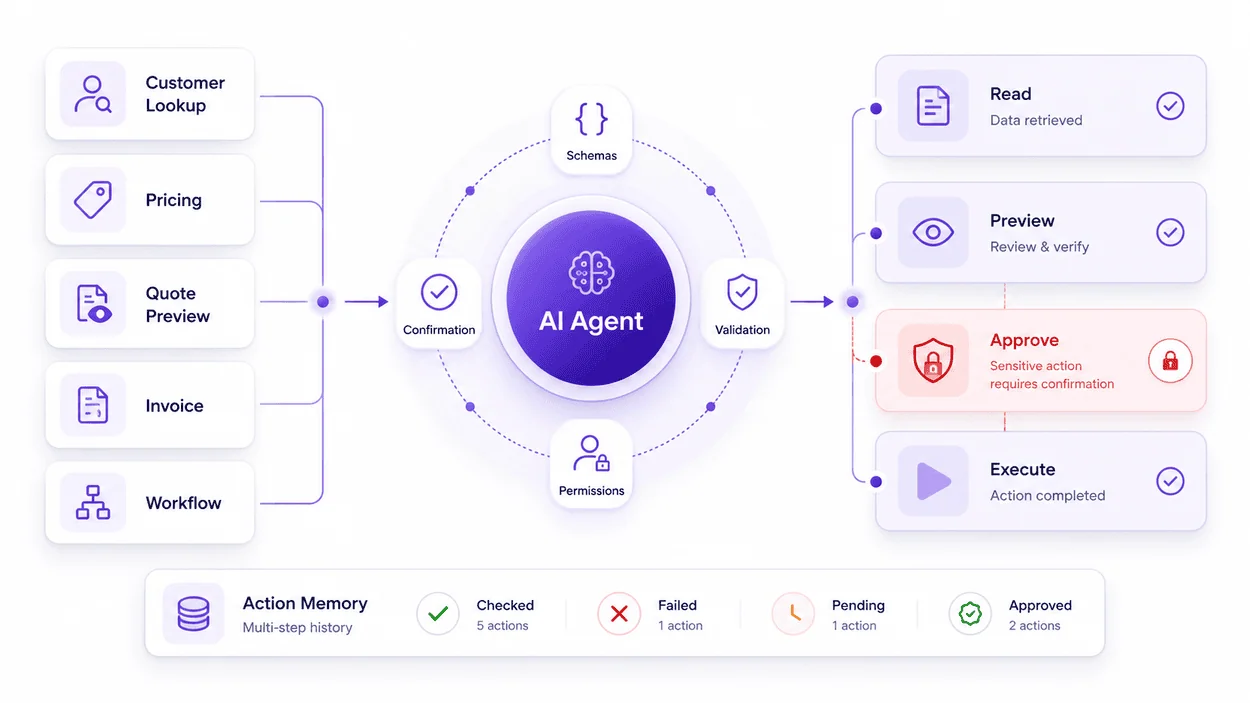
Enterprise AI becomes more useful when it can act inside systems. Tool calling allows an LLM to call external functions, APIs, databases, or workflows through defined schemas. OpenAI’s function calling documentation describes this as a way for models to access data and actions provided by an application.
Tool calling adds a new layer to Context Engineering. The model must know which tools exist, when to use them, what inputs they require, and what risks they carry. A read-only customer lookup is different from confirming an order. A quote preview is different from issuing an invoice.
This is why production AI agents need tool context, not just tool access. Tool descriptions should be specific. Inputs should be validated. Sensitive actions should require confirmation. Backend systems should enforce permissions, even when the model chooses the right tool.
AI Agent Context also needs action memory. The agent should know what it already checked, what failed, what returned stale data, and what still needs approval. Without this, multi-step workflows become repetitive and fragile.
Model Context Protocol, MCP
Model Context Protocol, or MCP, is one of the most important developments in this space. The official MCP documentation describes it as an open standard for connecting AI applications to external systems, including data sources, tools, and workflows. Anthropic introduced MCP in 2024 as a standard for secure two-way connections between AI tools and data sources.
MCP matters because AI applications need consistent ways to discover and use context. Without standards, every integration becomes a custom bridge. That slows development and increases security gaps.
For enterprise teams, MCP can help connect agents to file systems, CRMs, ERPs, ticketing systems, code repositories, analytics platforms, and internal tools. Yet MCP is not a full governance strategy by itself. Identity, authorization, audit logging, tool risk levels, and approval flows must still be designed around it.
A good MCP implementation should answer four questions before the model acts. Who is the user? What is the request? Which context is allowed? Which action requires human approval?
Context Compression Techniques
As agents run longer tasks, context grows quickly. Conversation history expands. Tool outputs pile up. Retrieved documents repeat similar facts. Without compression, the model carries too much baggage.
Context compression reduces token load while preserving task-critical meaning. It can summarize older conversation turns, remove irrelevant tool outputs, merge duplicate facts, extract structured entities, or keep only decision-relevant state.
Compression has risk. A poor summary may drop a constraint that matters later. A support agent may forget that the customer refused a workaround. A finance assistant may lose an exception tied to approval. This is why compression should be tied to task type and evaluation.
LangChain groups agent context strategies into write, select, compress, and isolate. That framing is useful for enterprise architecture. Write stores useful information. Select chooses what enters the window. Compress reduces load. Isolate separates unrelated context so agents do not contaminate each other.
Context Caching
Context caching is becoming practical because many AI tasks reuse large context blocks. A support assistant may use the same product manual across thousands of queries. A legal assistant may use the same agreement pack during a review session. A coding assistant may repeatedly reference the same repository map.
OpenAI says Prompt Caching can reduce latency by up to 80 percent and input token costs by up to 90 percent. Google’s Gemini documentation says context caching suits cases where a substantial initial context is referenced repeatedly by shorter requests.
Caching changes the economics of Enterprise Context Engineering. It encourages teams to identify reusable context layers, such as policies, product catalogs, brand rules, schema descriptions, and user manuals.
Caching also needs invalidation rules. A cached pricing policy can become dangerous after a rate update. A cached SOP can mislead users after a compliance change. Every cache should have ownership, expiry, versioning, and audit trails.
| Context layer | Purpose | Enterprise example | Governance need |
|---|---|---|---|
| System context | Defines behavior and boundaries | Assistant role, response rules, safety limits | Version control and approvals |
| User context | Personalizes task handling | Role, location, department, permissions | Access control and consent |
| Business context | Grounds decisions in company reality | Product catalog, policy, contract, SOP | Freshness and ownership |
| Workflow context | Tracks current process state | Lead stage, ticket status, approval step | Audit trail and rollback |
| Tool context | Enables safe system action | CRM lookup, ERP quote, payment retry | Validation and confirmation |
| Memory context | Reuses past learnings | Preferences, exceptions, repeated issues | Retention and deletion rules |
Enterprise AI is also moving from single assistants to multi-agent systems, where specialized agents collaborate to complete complex workflows.
One agent may retrieve enterprise knowledge, another may analyze business data, a third may execute workflow actions, while another validates compliance before the final response is delivered. For this collaboration to work, agents cannot operate in isolation.
The process typically follows a simple pattern:
Multiple agents
↓
Shared memory
↓
Shared context
↓
Task coordination
Shared memory allows agents to reuse previous decisions instead of repeating work. Shared context ensures every agent operates with the same business facts, permissions, and workflow state. Task coordination enables agents to divide responsibilities while maintaining a consistent view of the user’s objective.
Enterprise Context Engineering for AI becomes visible when AI must work inside real operations.
- In sales, context includes account history, product fit, region, pricing, past objections, open opportunities, and distributor rules. A Context-Aware AI assistant can prepare account briefs, recommend next actions, and generate proposal drafts grounded in CRM data.
- In customer support, context includes ticket history, warranty status, product version, SLA, previous fixes, and escalation policy. The agent can respond faster because it does not ask the customer to repeat known facts.
- In ERP, context includes customer credit, stock, tax, margin, purchase orders, approvals, and delivery schedules. This allows AI to support quote creation, invoice explanation, inventory questions, and procurement workflows.
- In engineering, context includes codebase structure, issue history, architecture decisions, test failures, and release notes. A coding agent becomes safer when it sees the right files and tool limits.
- In analytics, context includes metric definitions, data lineage, business calendars, access rules, and dashboard logic. This prevents AI from answering revenue questions using the wrong table or date range.
Across these use cases, the pattern is consistent. The model performs better when the enterprise context is curated before the answer begins.
may start with a simple AI assistant for inventory questions. Users ask whether material is available for production. A prompt can explain stock concepts, but it cannot confirm availability. Context Engineering connects the model with warehouse stock, reserved quantities, purchase orders, lead times, and user permissions. The answer then becomes operational, not generic.
may use AI to explain policy, reports, or exceptions. The context layer must include approved documents, customer category, regulatory constraints, audit history, and source references. Without this, the answer may sound correct while missing a rule that applies to one segment.
may use AI to explain policy, reports, or exceptions. The context layer must include approved documents, customer category, regulatory constraints, audit history, and source references. Without this, the answer may sound correct while missing a rule that applies to one segment.
These examples show why Context Engineering is becoming board-level architecture. It decides whether AI remains a smart interface or becomes a dependable operating layer. That difference matters most when AI touches revenue, compliance, or customer trust at scale daily.
Context is also a security boundary. If the wrong context enters the model, the output can leak confidential data, violate policy, or trigger an unsafe action.
OWASP lists prompt injection as a leading LLM application risk. It also lists sensitive information disclosure and insecure plugin design among major risks. NIST’s AI Risk Management Framework provides a broader approach for managing AI risks across organizations and society.
Governed Context Engineering should include role-based access, document-level permissions, source attribution, input sanitization, output filtering, human approval for sensitive actions, and audit logs. It should also include evaluations that test whether the agent used the right context.
Security teams should treat model inputs and outputs as part of the application surface. Developers should treat tool results as untrusted until validated. Business owners should define which decisions AI can support and which decisions need human ownership.
The future of AI products will depend less on single prompts and more on context infrastructure. Agent systems will need shared memory, tool registries, context graphs, policy-aware retrieval, cache layers, and monitoring.
We will also see stronger separation between model intelligence and enterprise context. Companies may change models over time, but their context layer will become a durable asset. That layer will contain business rules, approved knowledge, workflow state, evaluation data, and governance controls.
This shift will create new engineering roles. AI architects will design context flows. Data engineers will prepare retrieval-ready knowledge. Security teams will define context boundaries. Business teams will own policy and process truth. Product teams will measure whether context improves task completion.
The winners will not be teams with the longest prompts. They will be teams that know how to supply precise, trusted, and permitted information at the right step.
At iProgrammer, we see Context Engineering as a core layer of enterprise AI delivery. It combines AI architecture, data engineering, application integration, workflow design, and governance.
For clients building AI agents, RAG platforms, ERP assistants, customer intelligence systems, or AI-powered analytics, the model is only one part of the solution. The real system must understand business context, retrieve the right evidence, call tools safely, and respect enterprise controls.
This is where iProgrammer helps organizations move from AI demos to production-grade AI. We design context pipelines, retrieval systems, agent workflows, MCP-ready integrations, and governed AI experiences that fit real business operations.
1. What are the challenges of Context Engineering?
2. How is Context Engineering used in enterprise AI?
3. Is Context Engineering the same as RAG?
4. Does a larger Context Window reduce the need for retrieval?
5. When should enterprises use context caching?
6. Who should own Context Engineering?
7. How do you measure Context Engineering quality?