




GraphRAG vs Traditional RAG: The Enterprise Guide to Smarter Knowledge Retrieval
- Traditional RAG Overview
- Vector Search Limitations
- What GraphRAG Means
- Graph Databases Explained
- Knowledge Graph Architecture
- Retrieval Pipeline Comparison
- Entity Relationships: The Real Advantage
- Performance Comparison
- Query Routing
- Performance and Cost Decision Matrix
- Cost Comparison
- AI Observability
- Enterprise Use Cases
- Does GraphRAG Replace Vector Search?
- Which Databases Support GraphRAG?
- Which One Should You Choose?
- iProgrammer on Enterprise GraphRAG
- FAQ
Most enterprise knowledge is not missing. It is trapped in the wrong shape. A policy may explain one rule. A contract may mention one exception. A ticket may describe one failure pattern. A product document may define a technical constraint. The real answer appears only when these pieces connect.
That is why Retrieval Augmented Generation became important. It gave enterprises a way to ground AI answers in private knowledge. The model could answer with retrieved context, not memory alone.
Traditional RAG made this shift practical across PDFs, manuals, wikis, tickets, policies, and repositories. It works well until the answer depends on relationships, ownership, dependency, lineage, or risk.
This is where GraphRAG has gained attention. Microsoft describes GraphRAG as a method that combines text extraction, network analysis, LLM prompting, and summarization into one system. Its documentation also presents GraphRAG as a structured, hierarchical approach that extracts a knowledge graph from text, builds communities, creates summaries, and uses those structures during retrieval.
GraphRAG does not make Traditional RAG useless. It changes the retrieval conversation. The question becomes less about finding similar paragraphs. It becomes about retrieving connected knowledge that reflects how the business works.
For enterprise AI teams, that difference affects accuracy, cost, explainability, governance, and user trust.
Traditional RAG Overview
Traditional RAG connects a large language model with an external knowledge base. The system retrieves relevant context before generating an answer.
The pipeline starts with document ingestion. Files are cleaned, split into chunks, and converted into embeddings. These embeddings are stored in a vector database or vector index. User queries follow the same embedding path, and Vector Search finds semantically similar chunks.
This works because most enterprise knowledge is unstructured. PDFs, help articles, policies, and proposals can be indexed without heavy modeling. Databricks describes RAG as useful for proprietary, changing, and domain-specific data. Pinecone explains RAG as a way to reduce reliance on model memory through external retrieval.
Traditional RAG is strong for direct questions. It works well when the answer exists in one document, one section, or a small group of related passages.
The limitation is the retrieval shape. Vector Search retrieves by similarity. Enterprise reasoning often needs structure. It needs Knowledge Retrieval across entities, relationships, processes, and dependencies.
Vector Search Limitations
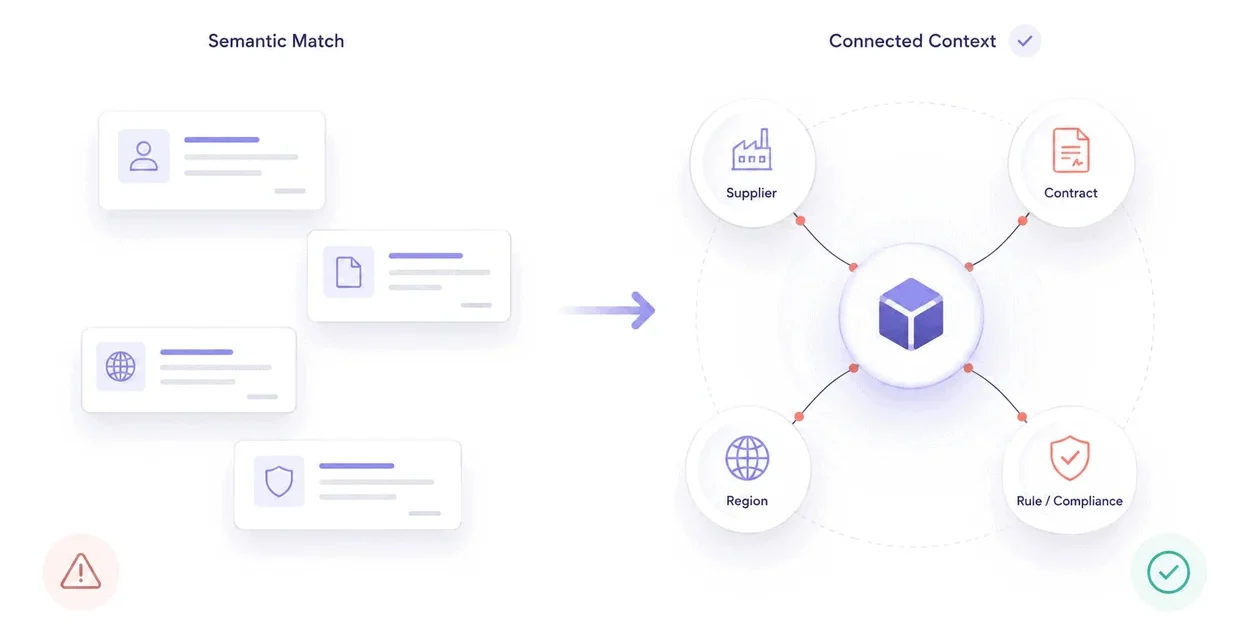
Vector Search is excellent at finding meaning. It can match a user query with text that uses different words. This is why semantic retrieval changed Enterprise Search. Employees no longer need perfect keywords to find relevant material.
Yet similarity is not the same as understanding relationships. A search engine may retrieve passages about a supplier, contract, region, and compliance rule. It may still miss how those items connect. The answer may require several hops across different data points.
A legal team may ask which contracts are affected by a clause change. A manufacturing team may ask which products share a faulty component. These questions need entity relationships, not only similar text chunks.
Chunking also creates context loss. A paragraph may mention a product, while the next section explains its dependency. Larger chunks keep more context, but they also add noise and token cost.
Hybrid Search reduces some gaps by combining lexical and semantic retrieval. Elastic defines hybrid search as a combination of lexical search and semantic search into one ranked list. Azure AI Search also supports hybrid search by combining vector and full-text queries with reciprocal rank fusion.
GraphRAG goes further by adding relationship-aware retrieval. It uses a Knowledge Graph or Graph Database to model entities and connections. The retrieval layer can then follow relationships instead of relying only on similarity.
What GraphRAG Means
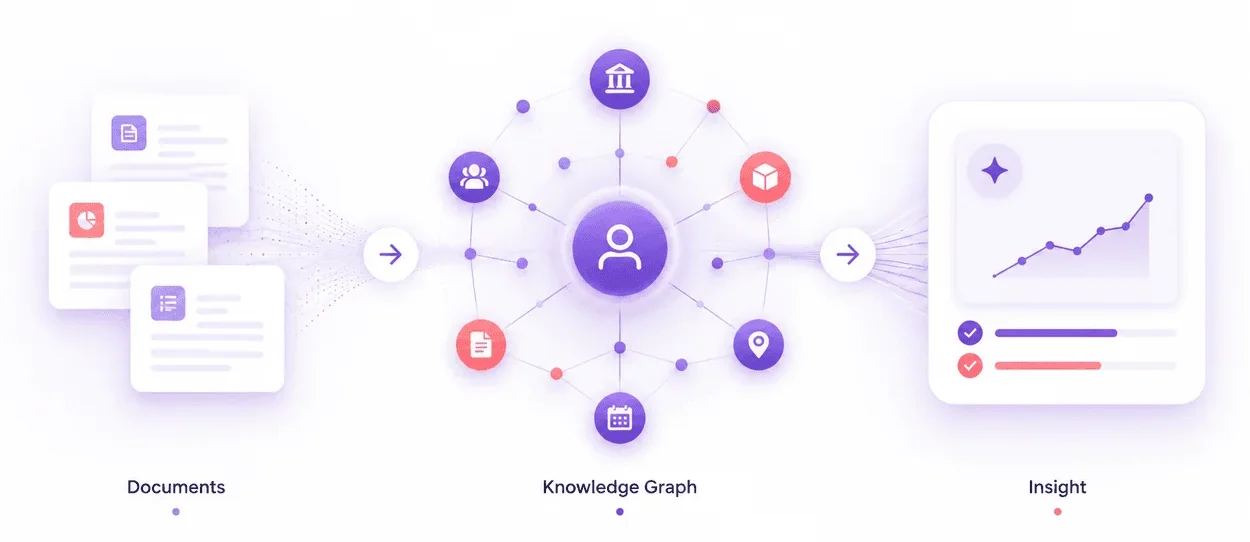
GraphRAG is Retrieval Augmented Generation supported by a graph structure. It uses a Knowledge Graph to represent entities, relationships, and communities within enterprise knowledge.
An entity can be a person, product, policy, vendor, customer, machine, asset, project, regulation, claim, or document. A relationship describes how two entities connect.
Traditional RAG retrieves text chunks. GraphRAG retrieves connected knowledge. It can start from a user question, identify entities, traverse relationships, collect evidence, and pass structured context to the language model.
Microsoft’s GraphRAG research proposed graph-based question answering over private text corpora. The paper reported improvements over naive RAG for global sensemaking questions, especially on comprehensiveness and diversity. A later systematic evaluation found that RAG and GraphRAG have different strengths across tasks, and their combination can improve downstream results.
This is a useful signal for enterprises. GraphRAG is most useful when questions require relationship traversal, multi-hop reasoning, source coverage, explainability, or structured knowledge discovery.
AWS provides a managed GraphRAG capability with Amazon Bedrock Knowledge Bases and Amazon Neptune. AWS documentation says the feature combines graph modeling, vector search, and graph analysis for RAG applications. Neo4j’s GraphRAG package supports knowledge graph creation, embeddings, graph search, vector search, and integration with vector databases.
Enterprise Search is moving from document matching toward knowledge reasoning. Gartner’s 2025 Market Guide says generative AI is shifting enterprise search from information retrieval to information synthesis. That shift needs better grounding, retrieval, and context control.
Graph Databases Explained
A Graph Database stores data as nodes and relationships. Nodes represent entities. Relationships represent how those entities connect. Properties store details about both.
This model fits enterprise knowledge because business data is naturally connected. Customers place orders. Orders contain products. Products use components. Components come from suppliers. Regulations create obligations.
Relational databases can store this data too. The difference is access pattern. Graph databases are designed to traverse connections. This makes them useful when answers depend on paths, dependencies, ownership chains, and influence.
In GraphRAG, the Graph Database acts as a reasoning layer for retrieval. It helps the AI system locate relevant entities and connected evidence.
GraphRAG does not require every fact to live in a graph database. Many enterprise systems work better with a hybrid design. Structured records remain in systems of record. Vector indexes support semantic retrieval. The graph layer connects important entities and relationships.
Knowledge Graph Architecture
A Knowledge Graph is the enterprise meaning layer behind GraphRAG. It defines what entities matter, how they relate, and which evidence supports each relationship.
- Source ingestion connects to PDFs, SharePoint, Confluence, CRM, ERP, ticketing tools, data warehouses, and document stores. Each source must carry access permissions and metadata.
- Extraction identifies entities, relationships, dates, events, and claims. LLMs can help extract this structure from unstructured text. Rules, taxonomies, and domain dictionaries improve consistency.
- Normalization resolves different names for the same entity. A company may appear by legal name, brand name, short name, or abbreviation. Entity resolution links these references to one canonical node.
- Graph construction turns entities into nodes and relationships into edges. Documents, chunks, tables, and source records stay linked as evidence. This matters because users need citations, not just confident language.
- Indexing uses graph indexes, vector indexes, lexical indexes, and metadata filters together. Retrieval orchestration then decides how to answer each query. Some queries need vector search. Some need graph traversal. Some need Hybrid Search, reranking, and entity expansion.
Retrieval Pipeline Comparison
| Pipeline Stage | Traditional RAG | GraphRAG |
|---|---|---|
| Data preparation | Splits documents into chunks and creates embeddings. | Extracts entities, relationships, communities, chunks, and evidence links. |
| Main retrieval method | Uses Vector Search for semantic similarity. | Uses graph traversal, entity matching, semantic retrieval, or hybrid retrieval. |
| Context shape | Returns ranked text chunks. | Returns connected subgraphs, source chunks, and relationship paths. |
| Best query type | Direct questions with evidence in nearby text. | Multi-hop questions across people, assets, policies, products, or events. |
| Explainability | Depends on chunk citations and metadata. | Can show citations plus entity paths and relationship evidence. |
| Operating complexity | Lower setup effort and faster first release. | Higher modeling effort, stronger governance needs, deeper retrieval control. |
| Ideal use case | FAQ bots, document search, policy lookup, support knowledge. | Risk analysis, contract intelligence, supply chains, compliance, enterprise knowledge maps. |
Entity Relationships: The Real Advantage
GraphRAG becomes useful when relationships carry meaning. A relationship can change the answer more than the entity itself.
Consider a warranty query. Traditional RAG may retrieve a warranty clause and product manual. GraphRAG can connect product, batch, part, supplier, region, warranty rule, claim history, and service bulletin.
This matters for AI Knowledge Systems. Employees ask for impact, cause, dependency, ownership, exception, next action, or risk. Those questions depend on connected knowledge.
Entity relationships also help reduce answer drift. When the system knows that a clause belongs to a specific contract version, it can avoid mixing versions. When it knows which product belongs to which region, it can avoid applying the wrong rule.
This does not happen automatically. GraphRAG quality depends on extraction quality, graph design, entity resolution, access control, and evaluation. A noisy graph can hurt performance.
Performance Comparison
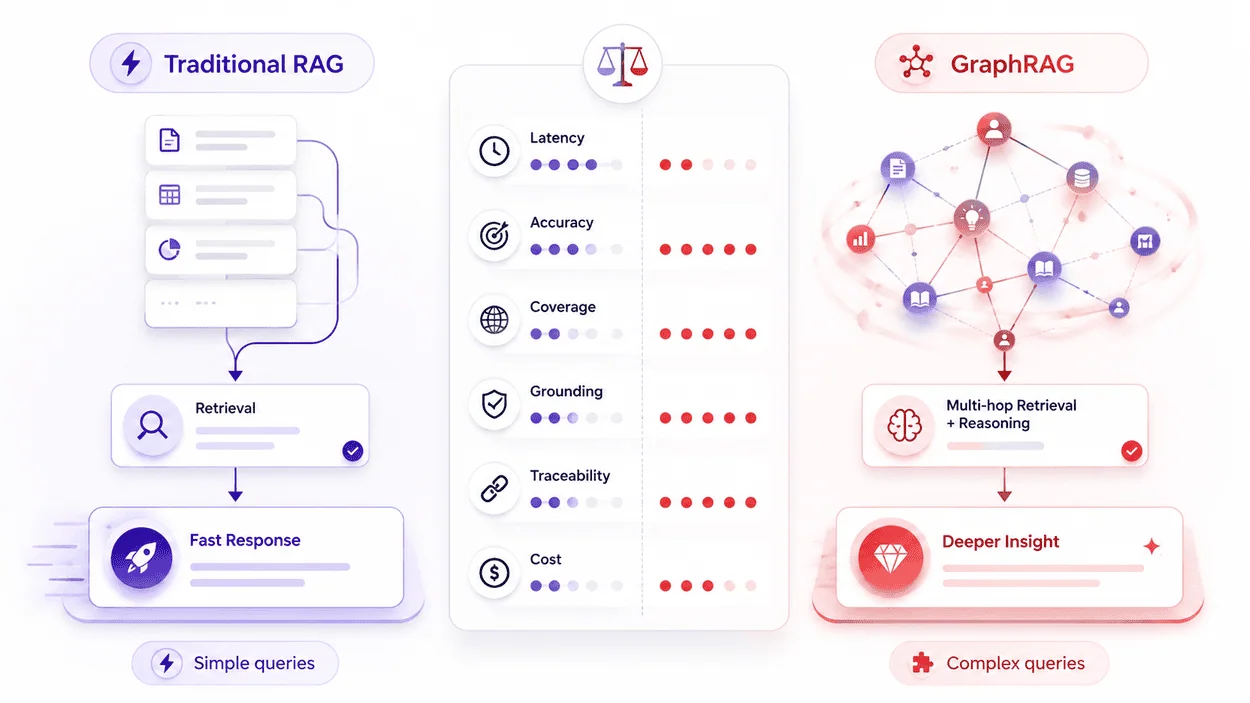
Performance in RAG is not only latency. It includes answer accuracy, coverage, grounding, traceability, and cost per useful answer.
Traditional RAG is usually faster to build and run. It can answer direct queries with low latency, especially when the vector index is tuned well. It also benefits from simpler infrastructure.
GraphRAG may require more processing during ingestion. Entity extraction, relation extraction, graph construction, community detection, and summaries add cost. Query-time graph traversal may also add latency if the graph is large or poorly indexed.
The performance payoff appears in more complex questions. Microsoft’s GraphRAG paper found gains over naive RAG for global sensemaking questions across large private text collections. GRAG research also argues that naive RAG struggles with networked documents because it focuses on individual documents.
Recent evaluation work gives a balanced view. A 2025 RAG vs GraphRAG study found each approach has different strengths across tasks. Traditional RAG may win on simple factual lookup. GraphRAG may win when relationships and global context matter.
Production teams should evaluate both using company questions. Build a test set from real tickets, compliance reviews, sales questions, engineering issues, and leadership queries.
Modern AI systems use Query Routing to determine the most appropriate retrieval strategy before the model begins generating a response.
The routing layer first analyzes the user’s intent rather than immediately searching the knowledge base. Straightforward factual questions may only require semantic retrieval, while dependency or impact analysis may require graph traversal. Queries containing exact product codes, policy IDs, or error messages often benefit from keyword matching alongside semantic search.
The decision flow typically follows this pattern:
User Query
↓
Intent Detection
↓
Simple Question?
↓
Traditional RAG
↓
Relationship-Based?
↓
GraphRAG
↓
Keyword-Heavy?
↓
Hybrid Search
Performance and Cost Decision Matrix
| Decision Area | Traditional RAG Fit | GraphRAG Fit | Enterprise Guidance |
|---|---|---|---|
| Time to pilot | Strong fit for quick validation. | Slower because graph design is needed. | Start with Traditional RAG when the problem is document Q&A. |
| Multi-hop reasoning | Limited unless heavily engineered. | Strong fit for connected evidence. | Use GraphRAG for dependency, impact, lineage, and risk questions. |
| Cost profile | Lower ingestion and infrastructure cost. | Higher ingestion and modeling cost. | Use GraphRAG where better answers justify added build effort. |
| Governance | Works with metadata and access filters. | Needs entity-level and source-level controls. | Plan permissions before graph construction. |
| Explainability | Citations explain source chunks. | Paths explain relationships and sources. | Use GraphRAG where users must trust the reasoning path. |
| Scaling pattern | Scales well for large document collections. | Scales with graph quality and traversal design. | Combine both for large enterprises with mixed query types. |
Cost Comparison
Traditional RAG usually has a lower starting cost. Teams need ingestion pipelines, embeddings, a vector database, prompt templates, and evaluation. The main recurring costs are embedding generation, vector storage, LLM calls, monitoring, and maintenance.
GraphRAG adds more cost centers. It needs entity extraction, relationship extraction, graph storage, graph queries, graph governance, and graph maintenance. If LLMs are used for extraction, ingestion cost can rise.
A managed service can reduce engineering effort. AWS Bedrock Knowledge Bases with Neptune offers managed GraphRAG. Neo4j provides a GraphRAG Python package. These options reduce custom work, but they do not remove knowledge modeling needs.
The best cost discussion should focus on value per answer. A cheaper system that retrieves incomplete evidence can become expensive in operations.
GraphRAG can justify its cost when wrong answers carry business risk. Contract obligations, compliance rules, medical policies, manufacturing dependencies, and financial exposure need stronger retrieval than simple semantic matching.
For many enterprises, the right pattern is phased. Start with Traditional RAG for document search. Add Hybrid Search where keyword precision matters. Add GraphRAG where relationship reasoning creates clear business value.
Unlike traditional application monitoring, AI observability measures the quality of the retrieval pipeline as well as the generated response. Teams need to know whether the graph returned the correct relationships, whether retrieved evidence supported the answer, and whether the model remained grounded in enterprise knowledge.
Key areas that organizations monitor include:
- Retrieval quality – Did the system retrieve the most relevant documents, entities, and evidence?
- Graph accuracy – Are entity relationships correct, complete, and up to date?
- Citation quality – Does every answer reference the appropriate supporting sources?
- Hallucinations – Did the model generate information that cannot be verified by retrieved evidence?
- Latency – How long did retrieval, graph traversal, reranking, and response generation take?
Enterprise Use Cases
GraphRAG is strongest where enterprise knowledge has connected entities.
Contract intelligence is a strong fit. Legal teams need clauses, obligations, customers, dates, renewals, exceptions, and jurisdictions. GraphRAG can retrieve contract paths and related evidence.
- Manufacturing knowledge is another fit. Teams need machines, batches, components, vendors, defects, quality checks, and maintenance logs. A graph can help trace root causes across operational records.
- Financial services can use GraphRAG for policy interpretation, risk exposure, client onboarding, and audit support. The graph can connect entities, accounts, documents, regulations, approvals, and exceptions.
- Healthcare and life sciences teams can use GraphRAG for clinical knowledge, research mapping, patient pathways, and regulatory documentation. Access control must be designed with care in these environments.
- Telecom teams can connect customers, plans, complaints, network events, billing rules, service tickets, and campaign journeys. This can improve agent support and customer-facing AI assistants.
- ERP and enterprise operations are natural candidates. An AI assistant can connect purchase orders, invoices, vendors, inventory, approvals, branches, warehouses, and policies.
Customer support also benefits when cases share products, symptoms, fixes, versions, and known issues.
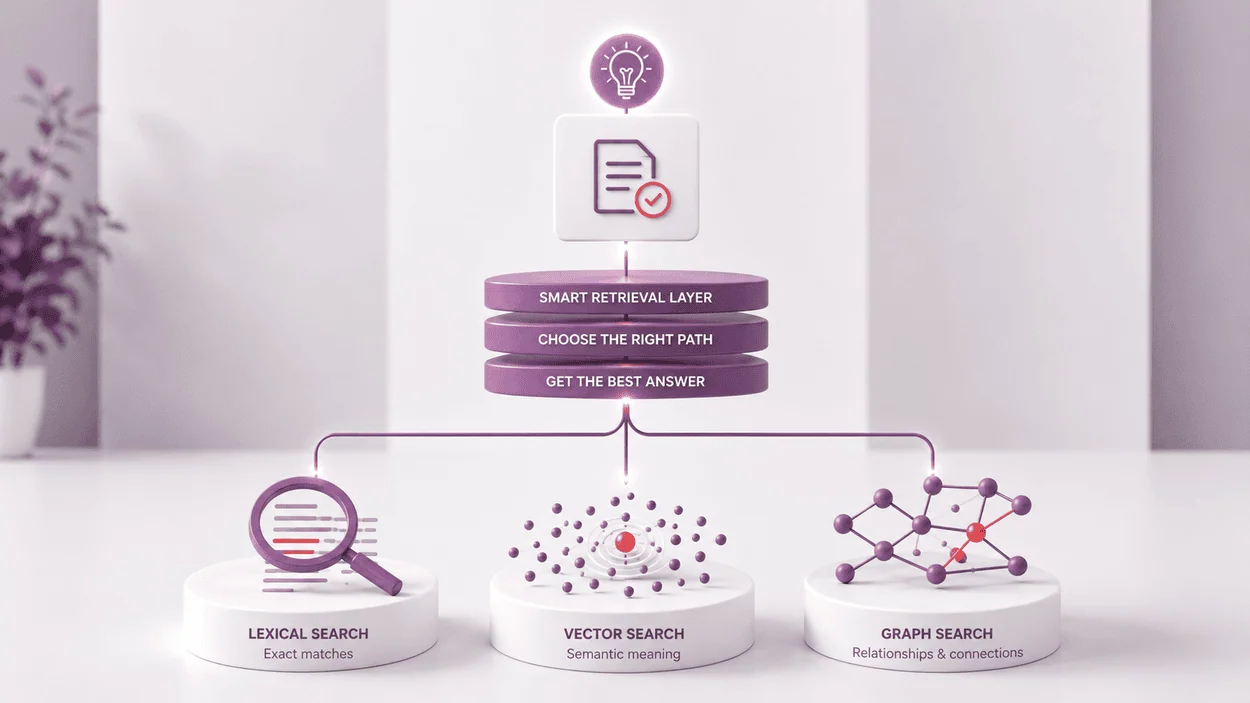
GraphRAG does not replace Vector Search for most enterprise systems. It usually works with Vector Search.
Vector Search is still excellent for semantic retrieval. It finds conceptually similar passages quickly. GraphRAG adds structure when the answer depends on connected knowledge. Hybrid Search can combine keyword precision, semantic recall, graph traversal, and reranking.
This is why modern retrieval design is becoming layered. One query may need lexical search for exact codes. Another may need vector search for meaning. Another may need graph traversal for dependencies. A complex query may need all three.
The right architecture uses the least complex retrieval path that answers well. Simple questions should not pay GraphRAG cost. Relationship-heavy questions should not rely only on chunk similarity.
Which Databases Support GraphRAG?
GraphRAG can be supported by native graph databases, multimodel databases, and combinations of graph and vector systems.
Neo4j is widely used for knowledge graphs and offers a GraphRAG Python package. Amazon Neptune supports graph workloads, and AWS Bedrock Knowledge Bases now offers managed GraphRAG with Neptune. TigerGraph, ArangoDB, NebulaGraph, and other graph systems can also support graph-based retrieval patterns.
Teams may also combine Qdrant, Pinecone, Weaviate, Milvus, Elasticsearch, Azure AI Search, or Databricks Vector Search with a graph database. This pattern is common when semantic retrieval and relationship retrieval both matter.
Database choice should follow workload needs. Choose based on graph size, update frequency, query language, cloud preference, governance, latency, and team skill.
Which One Should You Choose?
Choose Traditional RAG when your main need is enterprise document search. It also suits FAQs, policy lookup, onboarding assistants, support article retrieval, and internal knowledge assistants.
Choose GraphRAG when users ask relationship-heavy questions. Look for words such as connected, affected, dependent, caused by, related to, owned by, approved by, supplied by, or governed by.
Choose Hybrid Search when exact terms and semantic meaning both matter. Product codes, policy IDs, clauses, names, part numbers, and error messages often need lexical matching.
Choose a combined architecture when the AI system supports many departments. Enterprise Search rarely has one query pattern. AI Knowledge Systems must route queries intelligently.
A good enterprise approach starts with user questions, not tools. Collect real questions. Classify them by retrieval need. Test Traditional RAG first. Add GraphRAG where evidence shows a real gap. Measure the difference with answer quality, not technical excitement.
iProgrammer on Enterprise GraphRAG
At iProgrammer, GraphRAG is part of larger enterprise AI architecture. The goal is trusted AI inside real operations.
That requires more than embeddings and prompts. It needs source integration, access control, evaluation, observability, domain modeling, and workflow fit. It also needs the patience to design retrieval around business questions.
iProgrammer works across AI product engineering, product re-engineering, cloud consulting, and custom enterprise systems. Its service pages mention AI development, product engineering, cloud consulting, and system modernization as core capabilities. The company also references 300 plus apps, Fortune 500 trust, 4 million daily active users, and 18 years of experience on its product engineering page.
That engineering background matters for GraphRAG. Enterprise retrieval touches data pipelines, application architecture, permissions, user experience, and measurable outcomes.
For enterprises planning AI assistants, knowledge copilots, AI agents, or Enterprise Search modernization, the practical path is clear. Start with the questions users already ask. Build retrieval that respects business structure. Use GraphRAG where relationships matter. Keep Traditional RAG where it performs well.
The future of Retrieval Augmented Generation will belong to systems that know when to use each method.
1. What is GraphRAG?
2. Does GraphRAG replace Vector Search?
3. Which databases support GraphRAG?
4. Is GraphRAG expensive?
5. When should enterprises use GraphRAG?
6. Can GraphRAG work with existing enterprise systems?
7. How do you evaluate a GraphRAG system?
8. Can GraphRAG support role-based access control?
9. Is GraphRAG only useful for large enterprises?
10. How long does a GraphRAG pilot take?