





Enterprise Super Apps Development: Building the Unified Mobile Platform for Modern Business
- What Is a Super App?
- Super App vs Mobile App: The Structural Difference
- Consumer and Enterprise Super Apps Solve Different Problems
- Why Enterprises Are Moving Toward a Unified Mobile Platform
- The Technical Foundation of Enterprise Super Apps Development
- Mini App Architecture: Small Modules Inside a Governed Platform
- AI in Super Apps: From Search Box to Action Layer
- Enterprise Use Cases by Industry
- Security Cannot Be Added After the Ecosystem Grows
- Examples of Super Apps and What Enterprises Can Learn
- A Practical Super Apps Development Roadmap
- Future Trends Shaping Enterprise Super Apps
- The Mobile Platform Decision Ahead
- Building Enterprise Super Apps with iProgrammer
- Frequently Asked Questions
Most enterprise mobile portfolios began with sensible decisions. Each decision solved a real need. Together, they created a mobile experience that few people enjoy using.
The average company now uses 101 applications, according to Okta’s 2025 Businesses at Work research. Microsoft also found that employees can receive a meeting, email, or chat interruption every two minutes. Tool switching is no longer a small usability problem. It affects attention, adoption, security, support costs, and process completion.
This pressure is changing how enterprises think about mobile platforms. Instead of adding another standalone application, many are considering a shared digital entry point. That platform can bring workflows, data, services, communication, and AI into one governed experience.
That is the practical case for Enterprise Super Apps Development.
A well-designed enterprise super app does more than place several features behind one login. It creates a reusable mobile ecosystem. Teams can release focused mini apps without rebuilding identity, security, notifications, analytics, and integrations securely each time.
This article explains how Super Apps Development works and creates business value. It clearly covers technical decisions shaping success.
What Is a Super App?
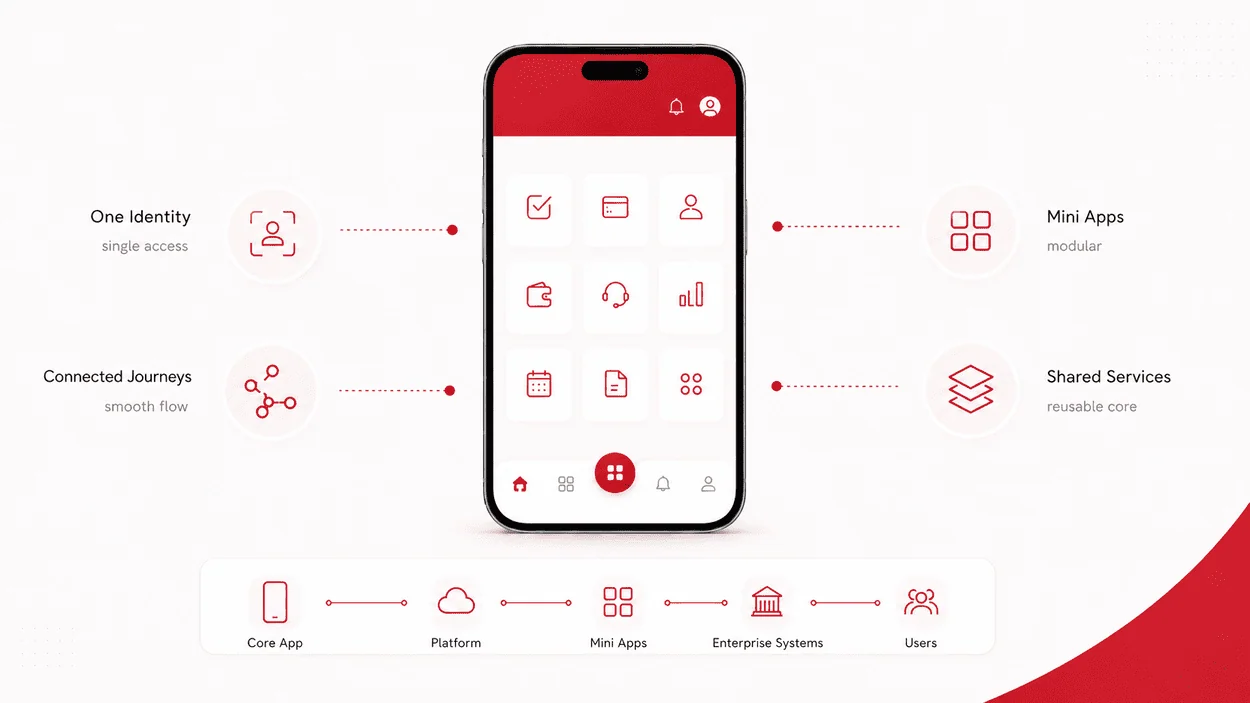
A super app is a mobile platform that combines several related services within one consistent application. Users sign in once, retain context across journeys, and access capabilities through shared navigation and identity.
The platform usually contains a core application, common platform services, and a catalogue of mini apps. Each mini app handles a defined journey. Examples include expense approval, equipment maintenance, appointment booking, loan servicing, or field reporting.
Gartner describes super apps as unified front ends where internal teams and third parties can publish mini apps. The definition matters because a super app is designed as a platform. It avoids bloated applications with deep, endless menus.
The strongest Super Apps share five characteristics:
- One identity and access layer
- Shared data and integration services
- Modular mini apps with clear ownership
- Common design, observability, and security controls
- A governed release model for adding new capabilities
A super app may serve customers, employees, partners, dealers, agents, or several groups. Its value comes from connected journeys. A customer can discover a product, verify identity, complete payment, request support, and track fulfilment without restarting elsewhere.
For employees, the same principle supports a connected Digital Workplace. Staff can view tasks, approve requests, find policies, contact experts, and complete operational work through one mobile interface.
Super App vs Mobile App: The Structural Difference
Enterprise Mobile Apps usually support one focused product, department, or user journey. Its team controls the interface, backend, release cycle, and data model. New capabilities often require changes inside the same codebase.
A super app separates the stable platform from changeable business functions. The shell manages identity, navigation, permissions, device services, analytics, and mini-app delivery. Business teams can then release modules within agreed controls.
| Decision area | Standalone mobile app | Enterprise super app | Business implication |
|---|---|---|---|
| Primary scope | One product or process | Multiple connected journeys | Broader adoption potential |
| Architecture | Single application codebase | Platform shell plus mini apps | Easier modular expansion |
| Identity | App-specific authentication | Shared identity and consent | Lower login friction |
| Integrations | Built for each application | Reusable APIs and events | Reduced duplicate engineering |
| Releases | Full application deployment | Independent mini-app releases | Faster controlled updates |
| Governance | Owned by one product team | Platform rules with distributed ownership | Stronger portfolio consistency |
| Analytics | Journey-specific reporting | Cross-journey behavioural view | Better operational insight |
Consumer and Enterprise Super Apps Solve Different Problems
Consumer Super Apps usually grow around frequent activities. Messaging, payments, transport, food delivery, commerce, and entertainment create repeated engagement. WeChat, Gojek, and similar platforms connect everyday services around a trusted account and payment layer.
Tencent reported in April 2026 that Weixin Mini Programs served more than 1.1 billion monthly active users. Its ecosystem covered 100 countries and regions across 108 industry categories during 2025. That scale shows how a stable platform can support many focused experiences.
Enterprise Super Apps follow a different logic. Their purpose is coordinated work, trusted access, faster decisions, and process completion. Daily usage can matter, but operational value matters more than engagement time.
Enterprise Mobility platforms may connect HR, finance, sales, service, procurement, assets, analytics, and collaboration. External users may access dealer ordering, partner onboarding, customer support, or supplier workflows through separate role-based experiences.
Business Super Apps also carry stricter governance needs. Access must reflect job roles, locations, legal entities, risk levels, and device posture. Sensitive actions may require step-up authentication, maker-checker controls, or recorded approvals.
This distinction should guide product strategy. Copying a consumer interface will not produce an effective enterprise platform. The experience must reflect how work moves across people, systems, policies, and exceptions.
Why Enterprises Are Moving Toward a Unified Mobile Platform
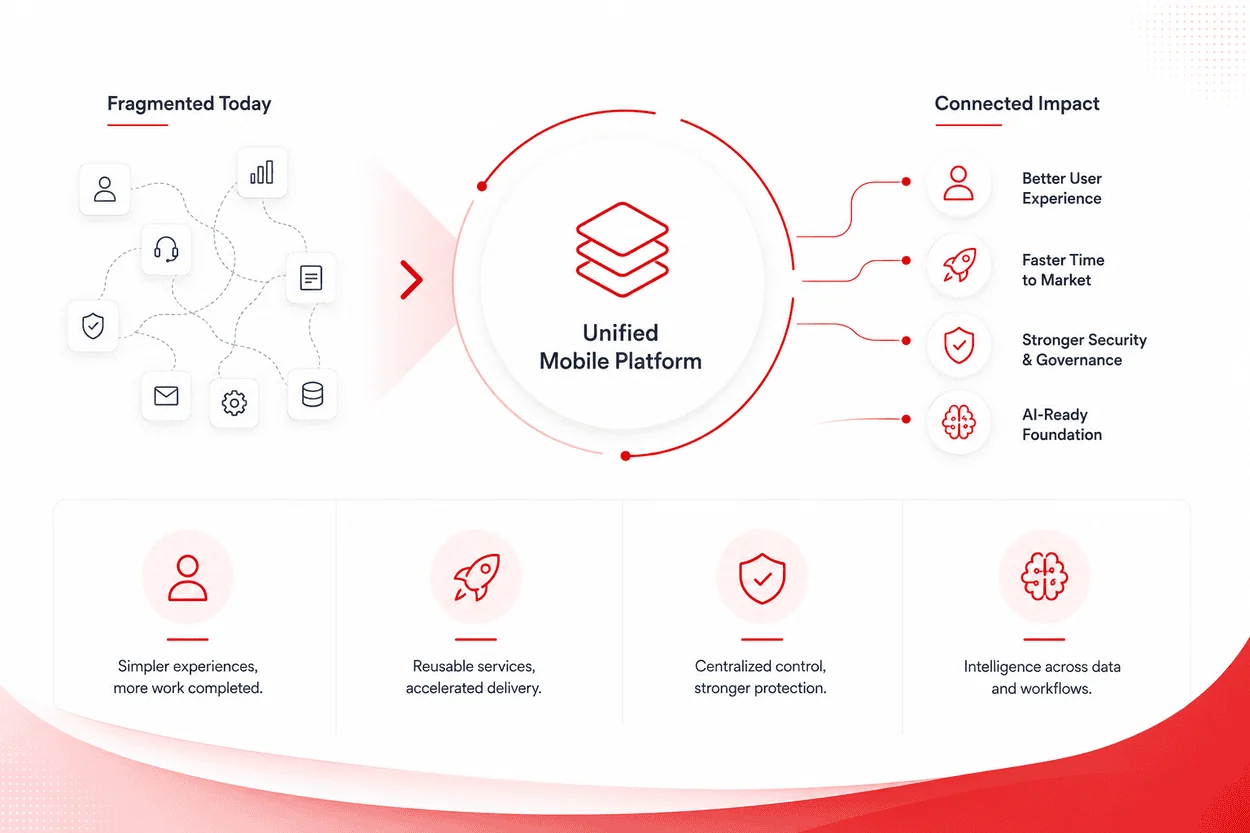
Application sprawl creates costs that rarely appear in one budget line. Separate products require separate integrations, security reviews, release processes, support teams, and user training. Fragmented journeys also produce duplicate data and incomplete context.
A Unified Mobile Platform can reduce that duplication through reusable capabilities. One notification service can support approvals, service alerts, delivery updates, and compliance reminders. One identity layer can serve employees, partners, and customers through different policies.
The benefits of Super Apps Development usually appear across four areas.
- First, users complete more work because navigation and authentication become simpler. They retain context while moving between related processes.
- Second, product teams ship faster because common services already exist. They can focus on business rules and experience design.
- Third, security teams gain central control over identity, permissions, telemetry, data movement, and release standards.
- Fourth, enterprises create a foundation for AI Mobile Apps. AI can work across approved data and actions, rather than remaining isolated inside one application.
These gains require disciplined platform design. Combining weak applications inside one menu only centralizes frustration. The platform must remove duplication while improving each journey.
The Technical Foundation of Enterprise Super Apps Development
The architecture normally begins with a native or cross-platform host application. This shell handles authentication, navigation, device permissions, secure storage, deep links, updates, and shared interface components.
Behind the shell sits a platform layer. It exposes reusable capabilities through APIs, events, SDKs, and policy services. Mini apps consume those capabilities without receiving unrestricted access to enterprise systems.
A typical architecture includes:
- Identity, single sign-on, consent, and session management
- API gateway and backend-for-frontend services
- Event streaming and workflow orchestration
- Design system and reusable interface components
- Notification, search, document, payment, and communication services
- Analytics, feature flags, logging, and crash monitoring
- Mini-app registry, versioning, review, and distribution controls
Super Apps Development also needs clear domain boundaries. Customer identity, payments, inventory, cases, and employee records should have defined ownership. Shared access does not mean shared control of every database.
Mini App Architecture: Small Modules Inside a Governed Platform
Mini Apps are focused applications that run within the host platform. They are usually lighter than standalone applications and rely on the super app for common services.
The W3C MiniApp work describes packages containing manifests, templates, stylesheets, scripts, media, and related resources. Its architecture also separates the view layer from the logic layer, supporting controlled execution inside a runtime.
Enterprises can implement mini apps through web views, JavaScript runtimes, micro-frontends, native modules, or cross-platform components. The right choice depends on performance, offline needs, device access, security, and release speed.
| Layer | Core responsibility | Enterprise design question |
|---|---|---|
| Host application | Navigation, runtime, device services | Which functions must remain native? |
| Experience layer | Screens, components, accessibility | How will every mini app follow one design system? |
| Mini-app runtime | Loading, isolation, lifecycle, versioning | How will modules execute without excessive privilege? |
| Platform services | Identity, search, notifications, files, payments | Which capabilities should every team reuse? |
| Integration layer | APIs, events, workflow orchestration | How will legacy systems expose stable contracts? |
| Data and intelligence | Analytics, profiles, recommendations, AI | Which data can be combined lawfully and safely? |
| Governance layer | Reviews, policies, monitoring, kill switches | Who approves, releases, suspends, and audits modules? |
Independent deployment is one of the main advantages. A benefits module can update without forcing a complete app-store release. The host still controls compatibility, permissions, and rollback.
Every mini app should declare its required APIs, permissions, data categories, supported versions, and owners. The platform can then prevent unapproved access and identify risky changes before release.
AI in Super Apps: From Search Box to Action Layer
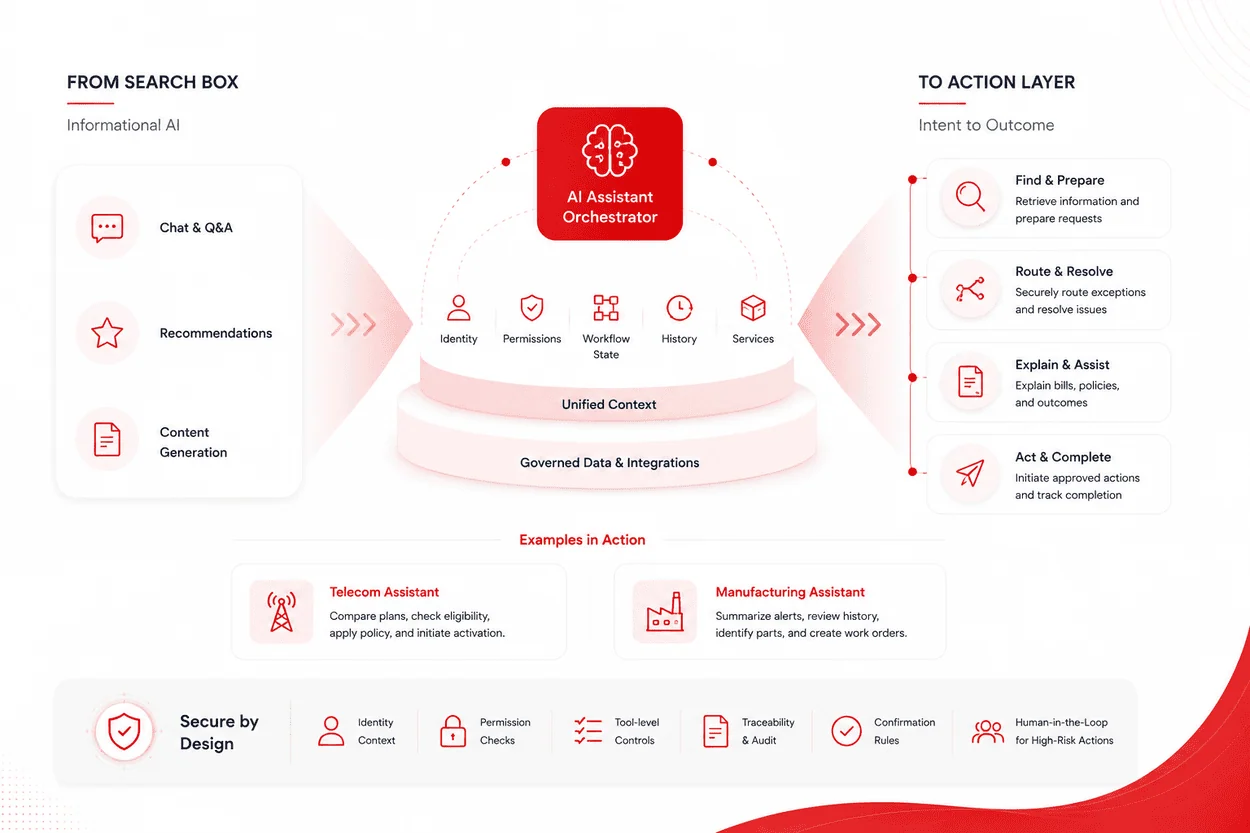
AI becomes more useful when it has governed access to context and approved actions. A super app provides both. It can combine identity, permissions, workflow state, history, and available services within one interface.
Early AI Mobile Apps focused on chat, recommendations, or content generation. The next stage connects models with enterprise workflows. An assistant can find information and prepare requests. It can securely route exceptions, explain bills, or initiate approved actions.
Gartner expects task-specific AI agents to appear across a growing share of enterprise applications. It also argues that agentic AI will reshape workforce super apps and their mini-app model.
That change affects interface design. Users may no longer browse ten modules to complete one task. They may describe the outcome, review a proposed plan, and approve selected actions.
A telecom assistant could compare plans, check eligibility, apply policy, and initiate activation. A manufacturing assistant could summarize a machine alert, inspect maintenance history, identify parts, and create a work order.
AI should not receive unrestricted access across the Mobile Ecosystem. Every action needs identity context, permission checks, tool-level controls, traceability, and confirmation rules. High-risk decisions should remain reviewable by authorised people.
Enterprise Use Cases by Industry
Banks can use Business Super Apps to connect onboarding, accounts, cards, lending, payments, investments, service, and financial guidance. Customers receive one identity and a continuous account view.
Mini apps allow product teams to release journeys independently while retaining shared compliance controls. A loan module can use identity verification, document services, risk checks, consent, and notifications. Payments are provided by the platform.
Employee versions can support relationship managers, branch teams, collections, and field agents. AI can prepare customer summaries, explain transactions, detect service risks, and recommend compliant next steps.
Telecom operators already manage high-frequency relationships across recharge, billing, plans, support, entertainment, rewards, devices, and partner services. This makes telecom a natural fit for Super Apps Development.
A telecom super app can connect customer care with commerce and network context. Users can understand charges, change plans, troubleshoot services, buy devices, manage family accounts, and access partner offerings.
AI can reduce menu dependence by interpreting intent and orchestrating backend services. The challenge lies in joining legacy billing, CRM, network, identity, catalogue, and fulfilment systems. Teams must hide their complexity.
Healthcare super apps can connect appointment scheduling, teleconsultation, prescriptions, reports, payments, insurance, care plans, and patient communication. Clinicians may use separate mini apps for rounds, tasks, alerts, and secure collaboration.
The architecture must respect consent, clinical roles, regional data rules, and emergency access requirements. Information should follow the care journey without becoming broadly visible across the platform.
Manufacturing Super Apps can serve operators, supervisors, technicians, warehouse teams, suppliers, and managers. Mini apps may cover inspections, maintenance, quality, inventory, approvals, safety, and production reporting.
Offline-first design is often essential. Factory and field environments may have weak connectivity, shared devices, gloves, noise, and limited screen time. The interface must support fast capture and reliable synchronization.
AI can explain alerts, identify patterns, retrieve procedures, extract readings, and assist root-cause analysis. Integration usually spans ERP, MES, IoT platforms, quality systems, and asset management.
Security Cannot Be Added After the Ecosystem Grows
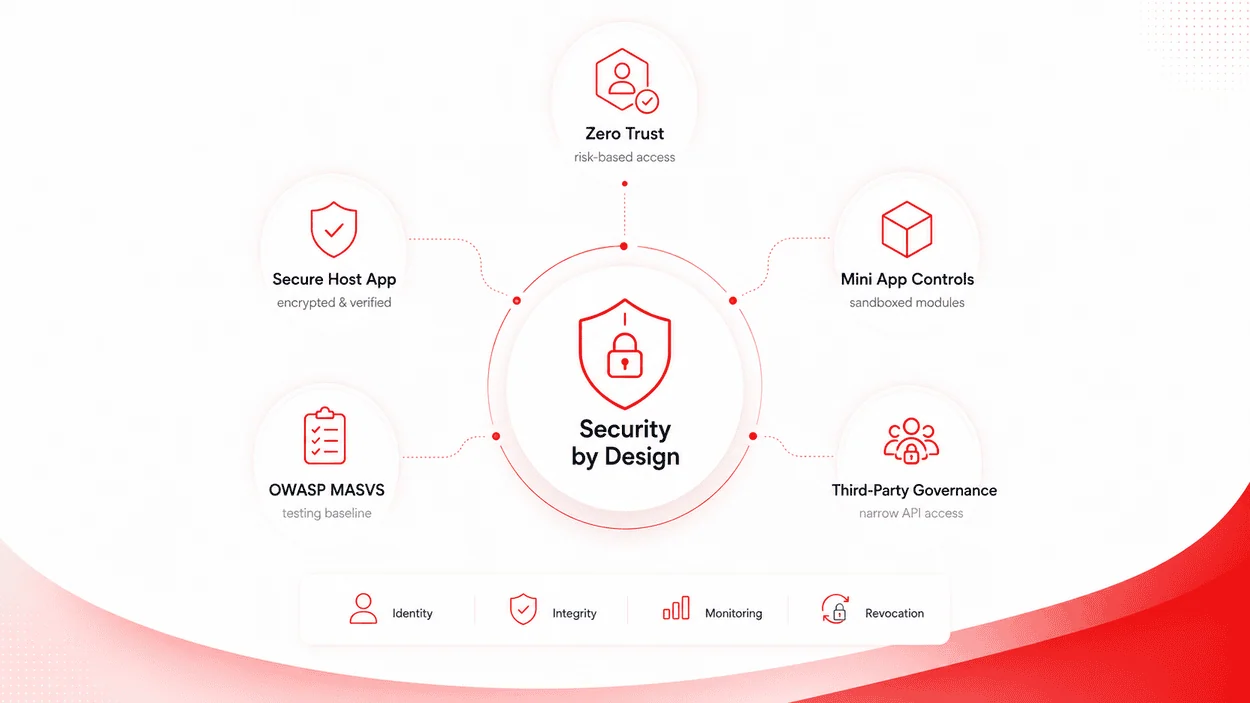
A super app concentrates access, which increases both convenience and responsibility. A compromised host, weak mini app, or exposed platform API can affect several business journeys.
Security should begin with zero-trust principles. Access decisions should consider user identity, device posture, location, session risk, requested resource, and transaction sensitivity. NIST guidance applies zero trust through continuous inspection, risk-based access, monitoring, and restricted resource access.
The host application should use secure storage, certificate protections, runtime integrity checks, encrypted transport, and controlled inter-module communication. Sensitive actions may require biometrics or step-up authentication.
Mini apps need sandboxing, signed packages, permission manifests, code review, dependency scanning, and revocation controls. Platform teams should maintain kill switches for modules, APIs, and features.
OWASP MASVS provides a recognised baseline for mobile security architecture and testing. Its controls cover storage, cryptography, authentication, networking, platform interaction, code quality, resilience, and privacy.
Security governance must also cover third-party mini apps. Contracts should define data use, incident duties, testing evidence, version support, and removal rights. Partners should receive narrow APIs rather than direct backend access.
Examples of Super Apps and What Enterprises Can Learn
WeChat demonstrates the scale possible when communication, identity, payments, content, and mini programs share one ecosystem. Its lesson for enterprises concerns platform consistency and reusable distribution.
Gojek connects transport, food, delivery, shopping, and payments within one application. Its service catalogue shows how related journeys can share location, identity, payment, and fulfilment context.
The goal is not to imitate their feature lists. Enterprises should identify their own anchor journey. That anchor may be communication, payments, field work, customer service, employee tasks, or partner commerce.
A credible platform grows from repeated user needs and shared services. It should not become a container for every application the organisation already owns.
A Practical Super Apps Development Roadmap
Successful programmes usually begin with portfolio and journey analysis. Teams map mobile applications, user groups, integrations, pain points, duplicated services, security gaps, and adoption data.
The next step identifies the platform anchor and first connected journeys. These journeys should share context and demonstrate clear operational value. Launching many unrelated modules creates complexity before the platform proves itself.
A practical roadmap includes six stages:
- Define user groups, anchor journeys, and measurable outcomes.
- Design platform architecture, domain ownership, security, and governance.
- Build the host application and highest-value shared services.
- Release two or three mini apps with common context.
- Establish developer tooling, testing, analytics, and release controls.
- Expand through a prioritised mini-app portfolio and partner model.
Teams should measure completion, usage, journey time, and support demand. Release speed, API reuse, security events, and mini-app adoption matter. Download numbers alone say little about operational value.
Platform governance needs a product council, architecture standards, experience rules, and named owners. Business teams should retain control of their domains while following shared contracts.
Future Trends Shaping Enterprise Super Apps
Agentic interfaces will change navigation first. Users will increasingly request outcomes, while the platform coordinates mini apps and enterprise tools behind controlled approval steps.
Gartner predicts that AI assistants could reduce conventional mobile app usage by 25 percent by 2027. It also expects application consolidation and partnerships to help brands reach users through fewer apps.
Mini-app standards may improve portability across runtimes. W3C work on packaging, addressing, and lifecycle models points toward clearer structures for distribution and execution.
On-device AI will support faster inference, privacy-sensitive features, offline assistance, and multimodal input. Cloud models will still handle larger reasoning and enterprise retrieval tasks.
Identity will expand beyond people. AI agents, services, devices, and mini apps will need scoped identities, permissions, credentials, and audit histories.
Super apps will also become more adaptive. Modules, navigation, and recommendations can reflect role, location, customer status, risk, and current work. Personalisation must remain explainable and consent-aware.
The Mobile Platform Decision Ahead
Enterprises do not need another oversized application. They need a mobile foundation that can support change without recreating the same technical services.
Enterprise Super Apps Development offers that foundation when architecture and governance receive equal attention. The platform can reduce mobile fragmentation, connect journeys, improve release speed, and make AI operationally useful.
The strongest programmes start with a real user need, a clear platform anchor, and limited initial scope. They earn expansion through measurable adoption and reusable engineering.
Super Apps will not replace every specialised system. They can become the trusted interaction layer through which people access those systems and complete connected work.
Building Enterprise Super Apps with iProgrammer
iProgrammer helps enterprises design secure mobile platforms and mini-app ecosystems. It also builds AI-assisted journeys and their integration layers.
Our teams work across mobile engineering, web platforms, product architecture, cloud, data, AI, APIs, quality engineering, and DevSecOps. This combined capability matters because Super Apps Development crosses several engineering disciplines.
We support discovery, architecture, experience design, host-app engineering, and mini-app development. We also cover legacy integration, AI orchestration, security testing, and modernization.
Explore our Mobile App Development Services and Web Application Development Services. Read practical guidance on Composable Architecture in Mobile Apps. Another enterprise guide covers Mobile App Security for Regulated Industries.
A super app should feel simple to its users, even when the enterprise behind it is complex. That simplicity comes from disciplined product and platform engineering.
1. How much does Enterprise Super Apps Development cost?
2. Can existing mobile apps become mini apps?
3. Does every mini app need app-store approval?
4. How should mini apps support multiple countries?
5. What team operates an enterprise super app?