





Designing Multi-Company Governance in Odoo for Enterprise-Scale Operations
- Why Multi-Company Governance Matters More Than ERP Setup
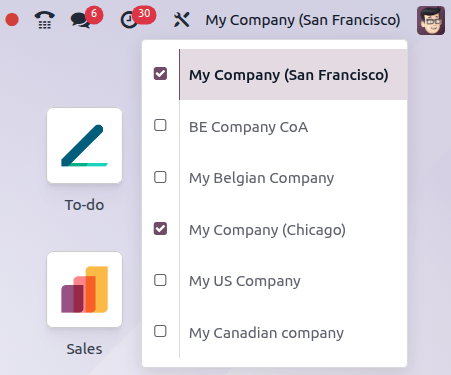
- Understanding How Odoo Handles Multi-Company Operations
- Building a Data Governance Layer Across Multiple Companies
- Centralized vs Distributed Multi-Company Governance in Odoo
- Designing Scalable Company Architecture Before Configuration Begins
- Odoo Access Control Across Multiple Entities
- Managing Intercompany Operations Without Operational Friction
- Building Centralized Finance Without Losing Entity-Level Visibility
- Maintaining Audit Readiness Across Multi-Entity Operations in Odoo
- Enterprise Multi-Company Governance Checklist for Odoo
- Governance Best Practices for Enterprise Multi-Company Setup in Odoo
- KPIs That Matter in Multi-Company Odoo Governance
- Odoo Multi-Company vs Multi-Entity: Understanding the Difference
- Common Mistakes Enterprise Teams Make in Odoo Multi-Company Projects
- Designing for Growth Beyond Current Structure
- Governance Does Not End at Go-Live
- How iProgrammer Streamlines Multi-Company Odoo Strategy
- FAQs
Running one company inside an ERP is straightforward. Running five companies inside the same ERP is where the real design work begins. At first, it often feels manageable. One legal entity becomes two. Then a regional office opens. A new subsidiary is acquired. Manufacturing sits under one company. Distribution under another. Finance wants consolidated reporting. Procurement wants shared visibility. HR wants separation. Compliance wants boundaries.
And more importantly, how do you keep all of this connected without losing control? This is where multi-company governance stops being a software configuration task. It becomes an operational design decision.
For enterprise businesses using Odoo, this layer matters more than most teams expect. Odoo gives companies the flexibility to operate multiple legal entities inside one environment. But flexibility without governance creates confusion quickly. The businesses that scale well in Odoo are not just enabling multi-company functionality. They are designing structure around it.
This blog breaks down how enterprise teams approach Odoo multi-company governance with long-term scale in mind. We’ll cover architecture, access control, intercompany workflows, finance structure, reporting models, and practical governance decisions that shape enterprise operations across multiple entities.
Why Multi-Company Governance Matters More Than ERP Setup
Most ERP implementation discussions begin with modules. But enterprise complexity rarely lives inside modules. It lives between companies. A group with multiple legal entities usually has operational dependencies that overlap every day.
A parent company funds operations. A subsidiary purchases inventory. A warehouse transfers stock to another company. Shared procurement negotiates vendor contracts. Finance consolidates reporting every month. Leadership needs one dashboard. Auditors need separate books. That tension between centralized visibility and entity-level control is where governance matters.
Without a structured Odoo multi-company setup, teams often face:
- Duplicate master data
- Unclear approval ownership
- Cross-company access leakage
- Incorrect intercompany accounting entries
- Difficult month-end reconciliation
- Reporting inconsistencies across entities
- Operational dependency on manual intervention
Most of these do not appear on day one. They appear at scale. Which is why architecture decisions made early matter so much later.
Understanding How Odoo Handles Multi-Company Operations
Odoo allows multiple companies to exist within the same database while maintaining legal separation. Each company can have its own:
- Chart of accounts
- Fiscal positions
- Tax structure
- Warehouses
- Inventory valuation
- Sales teams
- Purchase flows
- Journals
- Bank accounts
- Document sequences
- Users and permissions
At the same time, the platform allows shared operational layers where needed. That flexibility is why many enterprise businesses choose Odoo for Odoo multi-entity management.
But structure matters. Because every company added creates more intersections between data, users, and workflows. The ERP can technically support all of it, including complex manufacturing workflows handled through the Odoo manufacturing module. The harder question is whether the business design behind it supports scale.
Building a Data Governance Layer Across Multiple Companies
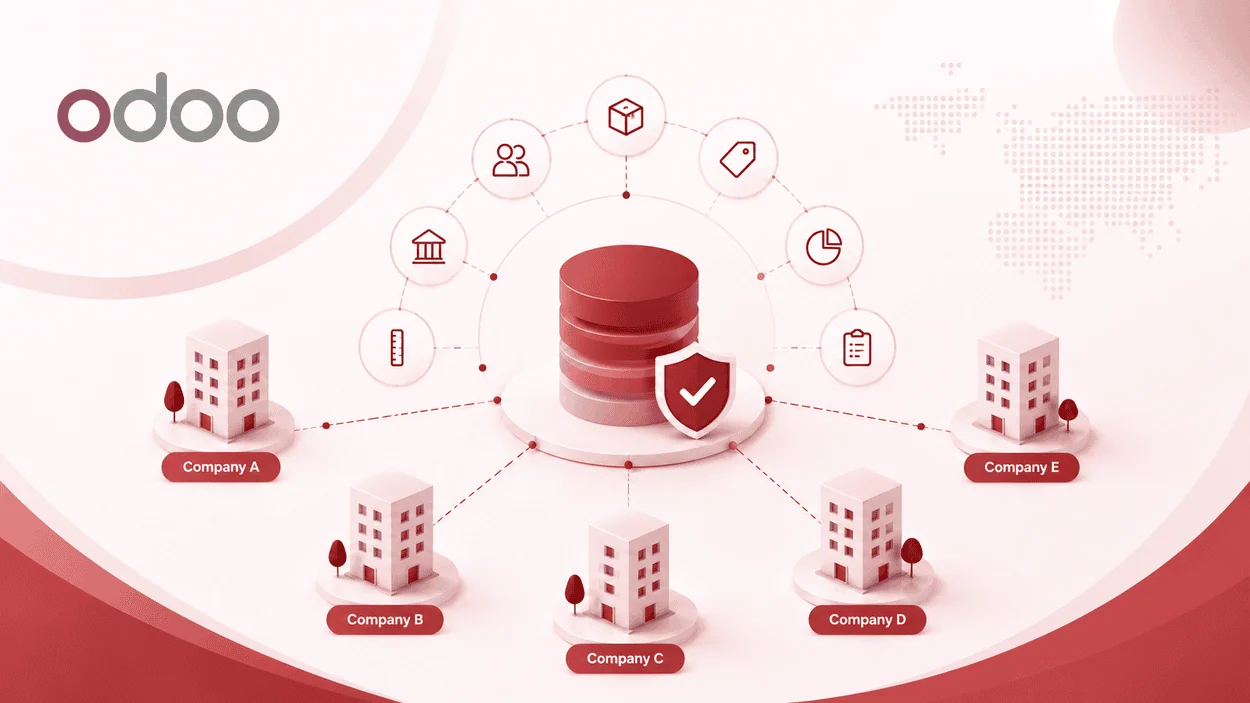
Multi-company governance does not stop at workflows or user permissions. It extends into the data that every team touches every day.
This is often where complexity starts quietly. The ERP is functioning. Transactions are moving. But the underlying data begins drifting apart. Over time, that drift becomes expensive.
Strong Odoo multi-company setup depends on clear ownership of master data across entities. Businesses need to decide early which records stay shared and which remain company-specific.
This usually includes:
- Product master ownership
- Customer and vendor creation rules
- Pricing governance
- Chart of account maintenance
- Tax mapping standards
- Unit of measure consistency
- Naming conventions across companies
- Duplicate record control policies
Without governance at the data level, teams end up solving ERP issues manually outside the system.
Centralized vs Distributed Multi-Company Governance in Odoo
| Governance Area | Centralized Model | Distributed Model | Recommended Use Case |
|---|---|---|---|
| Finance Control | Shared finance team manages all entities | Entity-wise finance ownership | Corporate groups with central CFO office |
| Procurement | Common vendor contracts | Localized purchasing | Manufacturing groups with shared sourcing |
| Inventory | Shared visibility across companies | Company-specific inventory control | Multi-warehouse operations |
| Reporting | Group-level dashboards | Independent entity reports | Holding structures with subsidiaries |
| User Access | Role-based cross-company permissions | Restricted per company | Compliance-heavy industries |
| Approval Workflow | Central approval layers | Local entity approvals | Regional operations |
| Master Data | Shared product/vendor/customer data | Segregated records | Large enterprise standardization |
Most enterprise Odoo environments use a hybrid model. Not fully centralized. Not fully isolated. The design usually sits somewhere between both.
Designing Scalable Company Architecture Before Configuration Begins
A common mistake is building the ERP exactly like the legal structure on paper. Operationally, that doesn’t always work. Legal entities and operating entities are not always identical.
For example:
A business may have:
|
But operations may run through:
|
If Odoo mirrors only the legal structure, workflows become fragmented. If Odoo ignores legal structure, compliance becomes risky. Good Odoo enterprise architecture balances both. Before implementation, teams usually define:
- Legal Entity Structure
Who owns financial books and tax reporting? - Operational Structure
How does work actually move across teams? - Reporting Structure
How does leadership want visibility? - Control Structure
Where are approvals managed? - Shared Service Structure
Which functions remain centralized?
This design work determines how scalable the ERP becomes and is often where Odoo consulting services create the strongest long-term impact.
Odoo Access Control Across Multiple Entities
Access control becomes significantly more complex in enterprise environments.
- One sales manager may need access to two regional companies.
- Finance may need access to all companies.
- Warehouse staff may need visibility only into one warehouse under one entity.
- Leadership may need read-only visibility across the entire group.
This is where Odoo access control becomes a governance framework, not just a permission matrix. Best practice usually includes layered control across:
- User groups
- Record rules
- Company restrictions
- Role-based visibility
- Approval hierarchy permissions
- Document-level access
- Audit logging
The goal is simple. Give users enough access to do their work. Without exposing financial or operational data they should not touch. Too much restriction slows teams down. Too much access creates compliance risk. Strong governance sits in the middle.
Managing Intercompany Operations Without Operational Friction
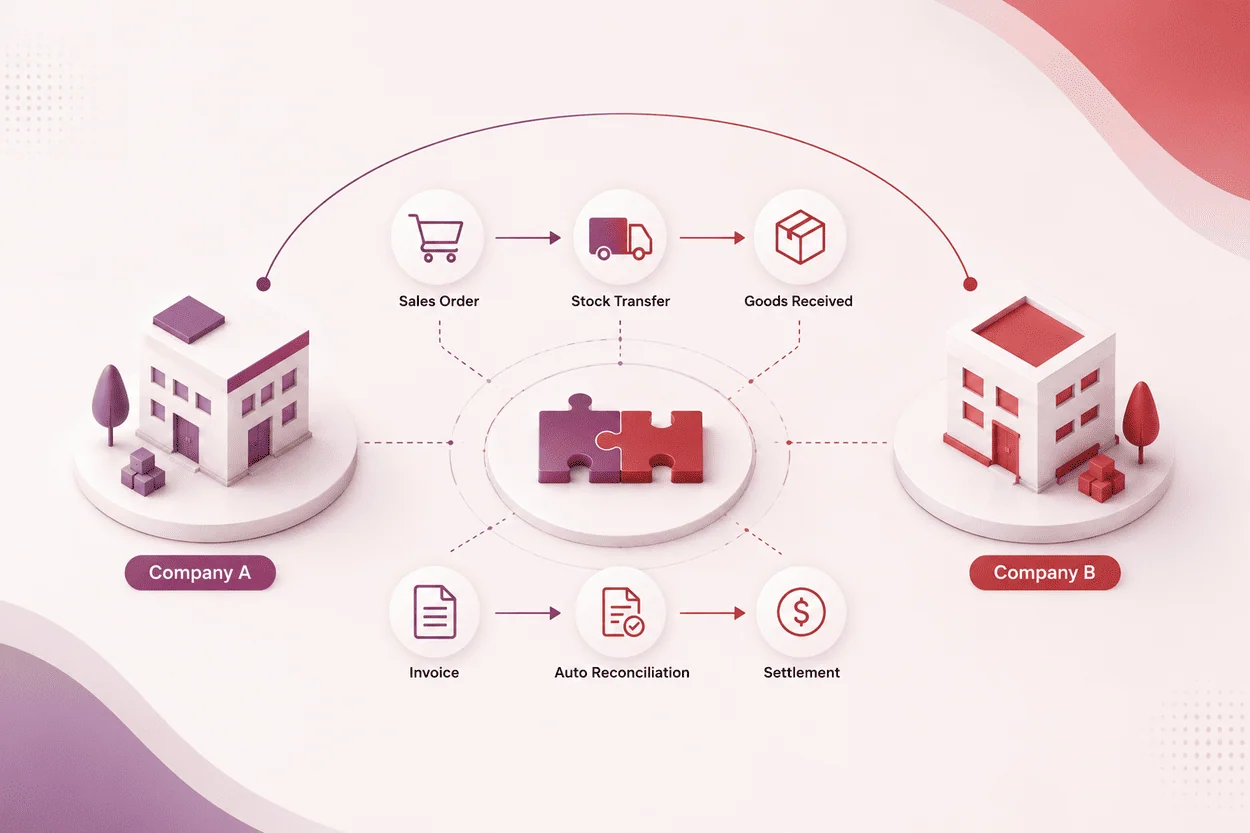
For many enterprise teams, this is the most important part of Odoo multi-company. Because companies rarely operate independently. They transact with each other every day. Examples include:
- Intercompany sales
- Stock transfers between warehouses
- Shared procurement billing
- Internal service recharge
- Internal invoicing
- Shared payroll allocations
- Centralized purchasing with distributed fulfillment
Without proper design, these processes create manual workload across departments. With the right Odoo intercompany operations setup, these workflows can move with minimal intervention.
Odoo supports automation for:
- Intercompany sales orders
- Matching purchase order generation
- Automated invoice creation
- Internal transfer handling
- Shared stock movement visibility
- Reconciliation support
This reduces duplication while keeping accounting separation intact, especially for businesses managing procurement, inventory, and fulfillment through Odoo for Supply Chain Management.
Building Centralized Finance Without Losing Entity-Level Visibility
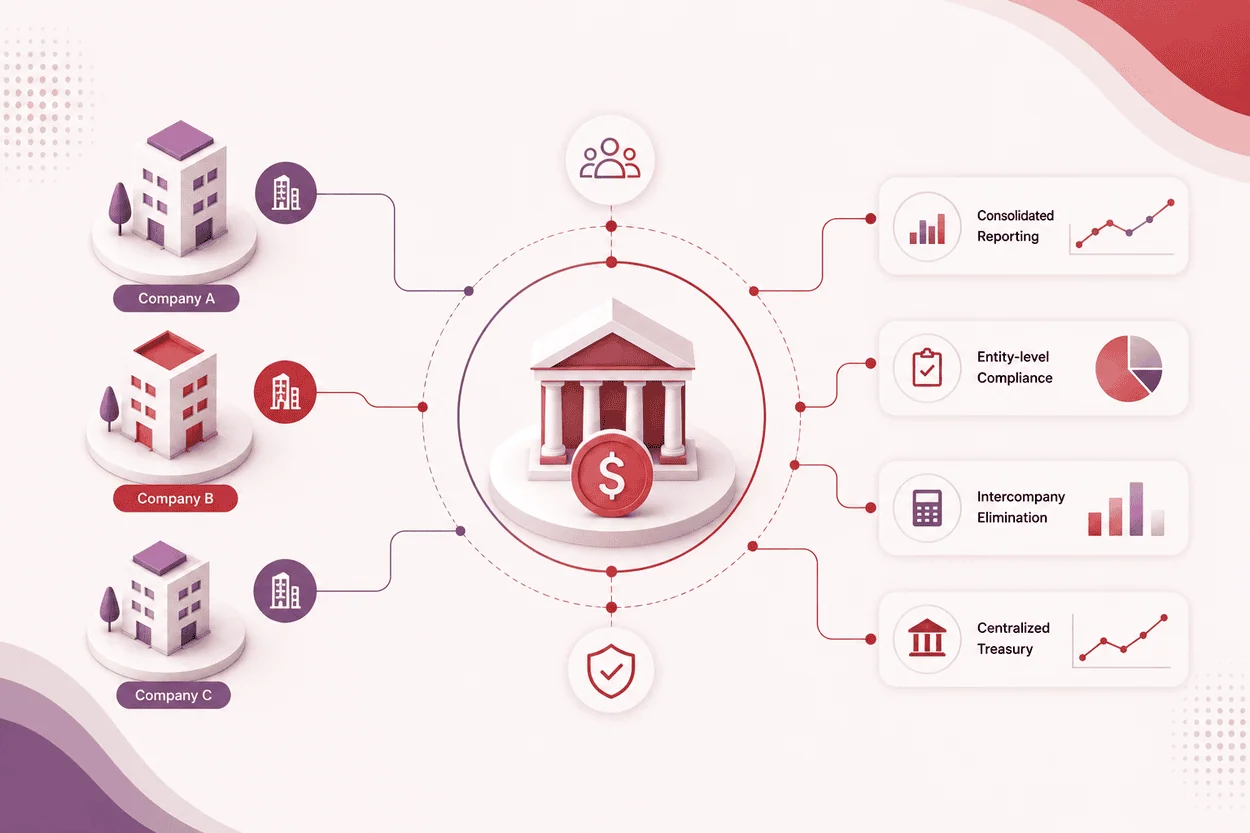
Finance teams often carry the biggest governance burden. They need both detail and consolidation.
Each company needs independent books. But leadership needs group-level reporting. Auditors need traceability. Tax teams need entity-level compliance. Management needs consolidated performance. This is why Odoo centralized finance design becomes critical. Strong setups often include:
- Company-wise chart of accounts mapping
- Consolidated reporting structures
- Shared accounting teams with role restrictions
- Intercompany elimination logic
- Centralized treasury management
- Entity-level payable and receivable controls
- Standardized financial closing processes
Done correctly, month-end becomes easier. Done poorly, finance teams spend weeks reconciling across spreadsheets outside ERP.
Maintaining Audit Readiness Across Multi-Entity Operations in Odoo
As companies scale, governance is measured not only by efficiency but by traceability. Enterprise teams need to know what happened, when it happened, and who approved it. That requirement becomes even stronger when multiple companies operate inside one ERP environment.
Finance teams need clean audit trails across transactions. Internal control teams need visibility into approval history. Compliance teams need access logs. Leadership needs confidence that controls remain intact even as teams expand.
This is where Odoo ERP governance becomes closely tied to audit readiness.
A well-governed multi-company environment typically supports visibility across:
|
This becomes particularly important during:
|
For enterprise businesses, auditability is not only a finance concern. It affects operational confidence across departments.
A system may look efficient on the surface. But if approvals cannot be traced or records cannot be verified quickly, governance starts weakening underneath.
Odoo gives businesses the ability to maintain strong traceability. The real impact comes from how that structure is implemented and reviewed over time.
Enterprise Multi-Company Governance Checklist for Odoo
| Governance Layer | Key Decision to Define |
|---|---|
| Company Structure | Which entities operate independently vs collaboratively |
| Finance | Shared or entity-level accounting |
| Inventory | Shared stock visibility or isolated stock |
| Procurement | Centralized sourcing vs local buying |
| Access Control | Cross-company permissions and user role hierarchy |
| Reporting | Group dashboard vs company-wise reporting |
| Approval Flows | Central or local approvals |
| Master Data | Shared products/vendors/customers or separated |
| Compliance | Audit and legal reporting requirements |
| Intercompany Automation | How transactions move between entities |
This checklist is often what determines whether an Odoo rollout scales well after year one.
Governance Best Practices for Enterprise Multi-Company Setup in Odoo
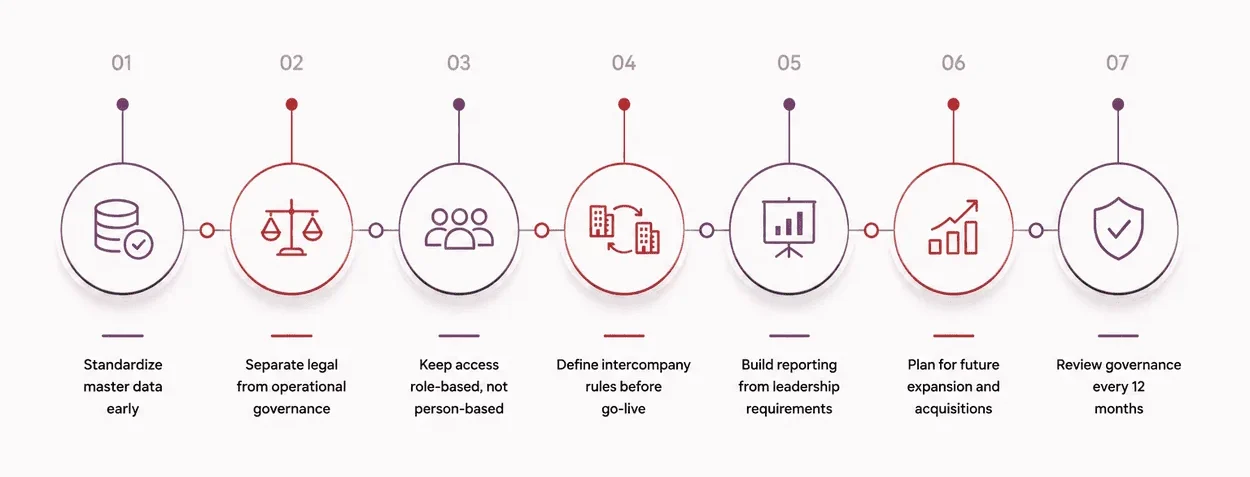
Here are the patterns that consistently work across large-scale implementations.
- Standardize master data early: Shared product catalogs, vendors, tax mapping, and accounting structures reduce downstream duplication.
- Separate legal governance from operational governance: Not every business process should follow legal entity boundaries.
- Keep access role-based, not person-based: Design for teams and roles. Not individuals.
- Define intercompany rules before go-live: Waiting until after launch creates reconciliation issues later.
- Build reporting backwards from leadership requirements: Start from the reports management wants to see. Then structure the ERP beneath that.
- Plan for future acquisitions or expansion: A scalable Odoo multi-company ERP model should accommodate growth without redesign.
- Review governance every 12 months: Enterprise structures evolve. Governance should too.
KPIs That Matter in Multi-Company Odoo Governance
Governance becomes stronger when it can be measured. Enterprise teams often spend significant time designing workflows, permissions, and entity structures. But long-term performance depends on what gets monitored after the system is active.
That is where KPIs become useful. In a multi-company ERP environment, performance metrics help leadership identify inefficiencies before they affect operations at scale.
The right KPIs vary by industry, but enterprise teams often track a mix of financial, operational, and cross-entity performance indicators. These commonly include:
Financial KPIs
|
Operational KPIs
|
Governance KPIs
|
Tracking these metrics creates operational visibility beyond standard ERP reporting. It allows leadership to identify where governance is working and where friction is building.
While the terms are often used interchangeably, they address different aspects of enterprise operations. Understanding the distinction helps businesses design governance models that support both compliance and operational efficiency.
| Area | Odoo Multi-Company | Odoo Multi-Entity Management |
|---|---|---|
| Primary Focus | Managing multiple legal entities within one ERP environment | Managing the broader operating structure across companies, brands, divisions, regions, or business units |
| Scope | Legal and financial separation | Operational and organizational coordination |
| Typical Structure | Parent company with subsidiaries | Multiple companies, brands, departments, business units, or regions |
| Key Objective | Maintain compliance, accounting separation, and entity-level control | Improve visibility, collaboration, and decision-making across the organization |
| Governance Focus | Access control, accounting, taxation, reporting, and intercompany transactions | Workflow alignment, shared services, data governance, and performance management |
| Reporting Needs | Entity-wise and consolidated financial reporting | Cross-functional operational and strategic reporting |
| Example | A group operating separate legal entities in India, UAE, and the US | The same group managing manufacturing, distribution, retail, and service divisions across those entities |
For most enterprise organizations, governance extends beyond legal company structures. While Odoo multi-company capabilities provide the foundation, effective governance requires visibility into how teams, processes, and business units interact across the wider enterprise landscape.
Common Mistakes Enterprise Teams Make in Odoo Multi-Company Projects
Even strong ERP projects struggle when governance is treated as secondary. The most common issues include:
- Copying one company setup into another without redesign
- Giving broad user access to solve temporary issues
- Creating duplicate products per company
- Not defining ownership for shared workflows
- Ignoring intercompany tax treatment early
- Building reports outside ERP instead of inside it
- Delaying governance documentation until after launch
These decisions usually feel faster initially. But they create operational debt over time.
Designing for Growth Beyond Current Structure
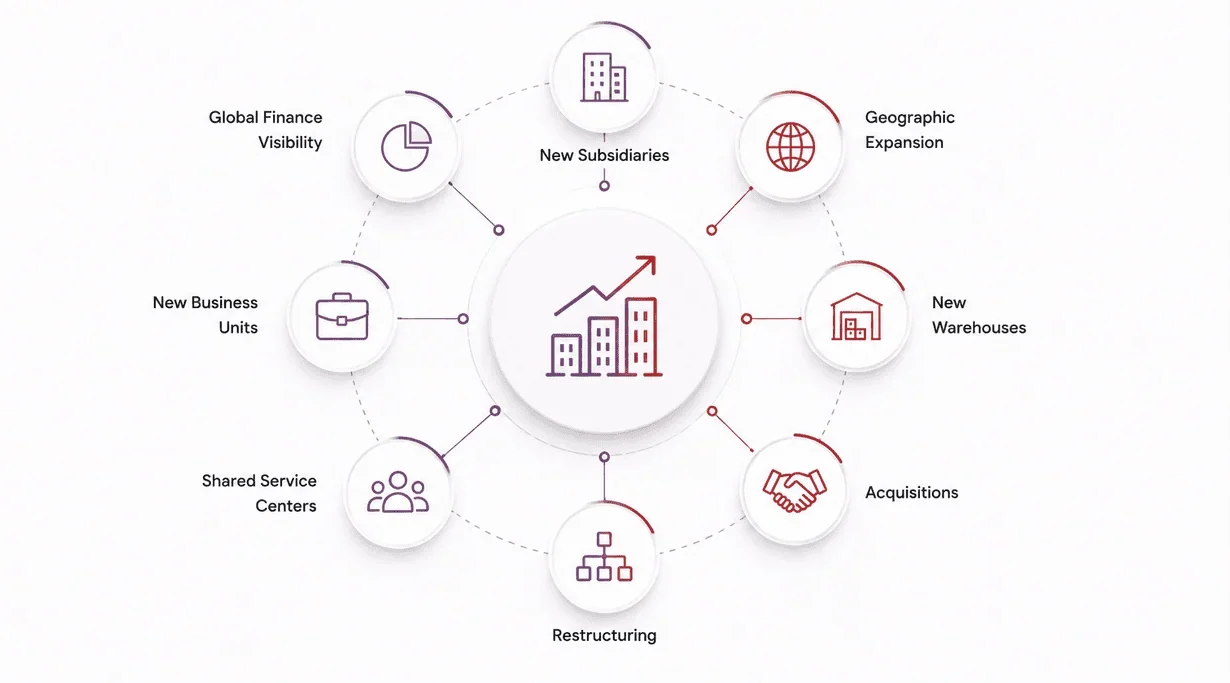
A good multi-company ERP setup should not only support the current business. It should support what the business may become in three years.
That means planning for:
- New subsidiaries
- Geographic expansion
- New warehouses
- Acquisitions
- Restructuring
- Shared service centers
- New business units
- Global finance visibility
This is where Odoo business unit management becomes part of enterprise planning. The ERP becomes infrastructure for growth. Not just software for operations.
Go-live is not the end of governance work. In many enterprise Odoo projects, it is the point where governance becomes real. Before launch, workflows are mapped carefully. Access is reviewed. Processes are approved. Teams align around the future state. Then the business starts operating inside the system. And real-world complexity begins shaping the environment.
New users join. Teams expand. Approvals shift. Departments request changes. New warehouses open. A new subsidiary enters the group. Regional processes evolve. Exceptions start appearing. Without review mechanisms, governance slowly drifts away from original design. That drift is common across enterprise ERP environments.
Strong organizations plan for it. Post-go-live governance usually includes structured review across:
- Quarterly access and permission audits
- Workflow approval reviews
- Intercompany reconciliation checks
- Master data cleanup cycles
- Reporting accuracy validation
- Policy and SOP updates
- New company onboarding governance
- ERP enhancement backlog review
This helps the ERP remain aligned with how the business operates now, not just how it operated during implementation. The strongest Odoo enterprise governance models are not static. They evolve with the organization.
How iProgrammer Streamlines Multi-Company Odoo Strategy
With 18+ years of product engineering experience, iProgrammer Solutions brings a systems-first perspective to ERP transformation. That experience helps enterprise teams design Odoo environments that are not only functional at go-live, but scalable as operations expand across business units, warehouses, and legal entities.
At iProgrammer, multi-company Odoo projects usually begin long before configuration.
They begin with
- Business structure, workflow mapping, and governance decisions.
- Understanding how operations move across teams, entities, finance, inventory, manufacturing, and leadership.
That matters because enterprise ERP success rarely depends on implementation alone. It depends on how well the platform reflects the business behind it. We work with enterprises to design scalable Odoo environments that support governance, visibility, and operational efficiency together.
If you’re planning a multi-company Odoo rollout or scaling an existing setup, connect with our team to explore the right architecture for your operations.
1. Can different companies in Odoo use different currencies?
2. Can one employee access multiple companies in Odoo with different permissions?
3. Does Odoo support consolidated reporting across subsidiaries?
4. How difficult is it to add a new company into an existing Odoo multi-company setup?
5. Is Odoo suitable for holding companies with multiple brands or divisions?