





Generative AI Staff Augmentation for Multi-Agent AI Development
- Why Enterprises Are Struggling to Build AI Teams
- What Generative AI Staff Augmentation Means in 2026
- Why Multi-Agent AI Development Needs Specialized Teams
- The Skills Required for Modern AI Projects
- How Staff Augmentation Accelerates AI Delivery
- How Enterprises Scale Generative AI Teams Faster
- Choosing the Right AI Implementation Partner
- Final Thoughts
- iProgrammer’s Generative AI Staff Augmentation
- FAQs
Nobody wants another reminder that AI is moving fast. They already know it. It’s all they hear at work, urgently if not literally. Because sales want answers, not five tools to find them. Product wants features that don’t fall behind. Operations want the manual work gone. Support wants agents that resolve, not escalate. Leadership wants numbers before the next planning cycle. The ambition is clear, but the hard part begins after approval.
Who will design the architecture? Who will connect the data? Who will test hallucination risk? Who will secure prompts, APIs, logs, and access? Who will keep the system useful after the first demo? This is where many AI programs lose speed.
The problem is usually the shortage of the right AI engineering team at the right time. Generative AI development needs software engineers, LLM specialists, data engineers, AI solution architects, security experts, and product thinkers working together. Multi-agent AI development adds another layer.
This is why Generative AI staff augmentation is becoming a serious delivery model. It helps enterprises add specialized AI talent without rebuilding their entire technology team. It gives them the speed, depth, and control needed to move from AI ideas to real delivery.
Why Enterprises Are Struggling to Build AI Teams
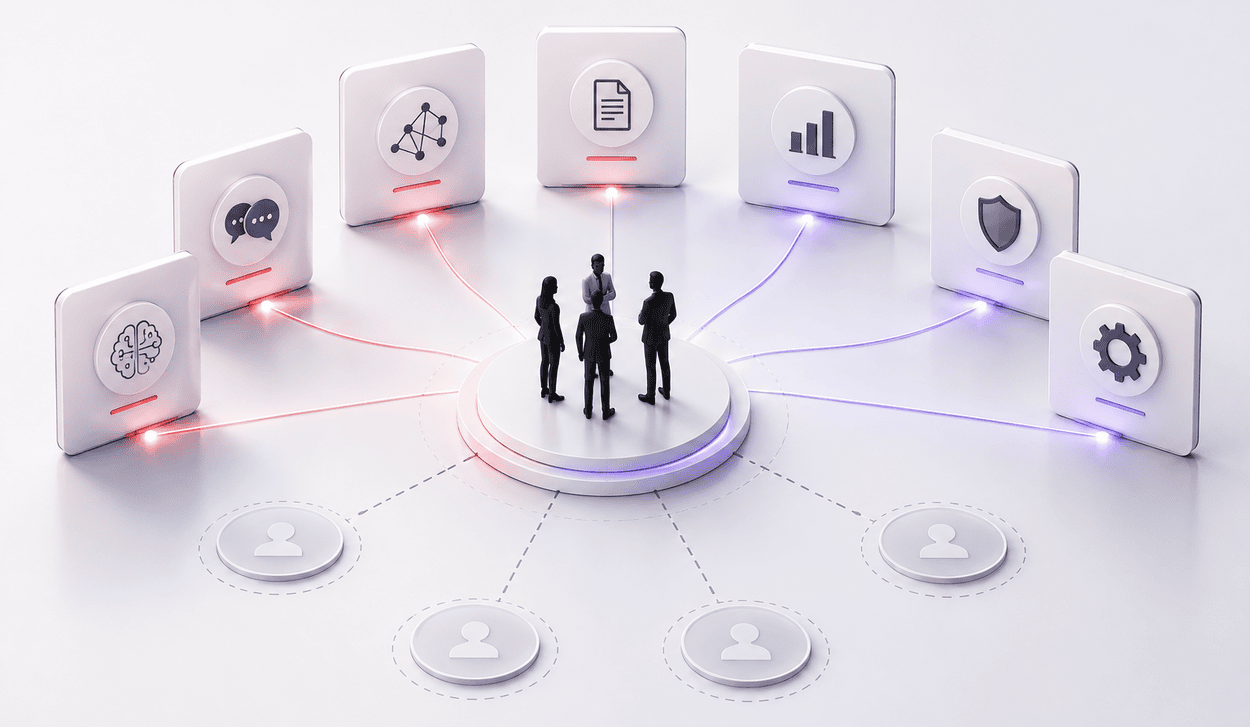
AI adoption has moved faster than enterprise hiring models. Many companies now have several AI use cases waiting for execution. Every team has a different ask and none of them can wait. The challenge is that each use case needs different technical depth.
A basic AI prototype may need one developer and a model API. A production AI system needs much more. It needs architecture, secure data access, model evaluation, observability, integration, and user adoption planning. These responsibilities rarely sit with one person.
Fact– Stanford’s 2025 AI Index reported that generative AI attracted $33.9 billion in global private investment in 2024, showing strong market momentum. The same report also tracks the rising use of AI across business functions.
This growth has created pressure on talent supply. Enterprises need AI solution architects, LLM engineers, data engineers, MLOps specialists, AI QA engineers, and security professionals. Hiring all these roles internally takes time. Many organizations also do not need every role permanently. That mismatch slows delivery.
Traditional hiring works best when demand is predictable. AI delivery is often uneven. An enterprise may need an architect at the start, a data engineer during ingestion, and an AI QA specialist before release. Permanent hiring struggles with that rhythm.
AI staff augmentation gives companies access to specialists when each project phase needs them. Internal teams keep business ownership. Augmented specialists bring execution depth. This structure helps enterprises avoid long hiring cycles while keeping control over the product direction.
What Generative AI Staff Augmentation Means in 2026
Generative AI staff augmentation is the practice of extending an internal technology team with specialized AI professionals. These professionals support AI architecture, LLM application development, RAG systems, AI agents, workflow automation, model evaluation, deployment, and enterprise integration.
It is different from traditional staff augmentation.
- Traditional augmentation usually adds developers to clear software tasks.
- AI developer augmentation often starts earlier. The team may need to assess feasibility, define architecture, test model options, prepare data, create evaluation methods, and set guardrails before full development begins.
This matters because generative AI projects can look simple from the outside. A chat interface may appear easy. The real complexity sits behind it. The system must understand user intent. It must retrieve the right context. It must respect permissions. It must return traceable answers. It must avoid unsafe actions. It must work inside existing business applications. It must be monitored after release.
Generative AI staff augmentation gives enterprises access to people who understand this full delivery path. The model can be used in many ways.
- A company can add one LLM engineer to an existing product team.
- It can hire an AI solution architect for roadmap and design support.
- It can create a dedicated AI engineering team for a larger enterprise AI development program.
This flexibility is important in 2026. Many companies are moving from AI pilots to production systems. McKinsey’s 2025 State of AI research found that organizations are starting to redesign workflows and assign senior leaders to AI governance as they seek business impact.
Why Multi-Agent AI Development Needs Specialized Teams
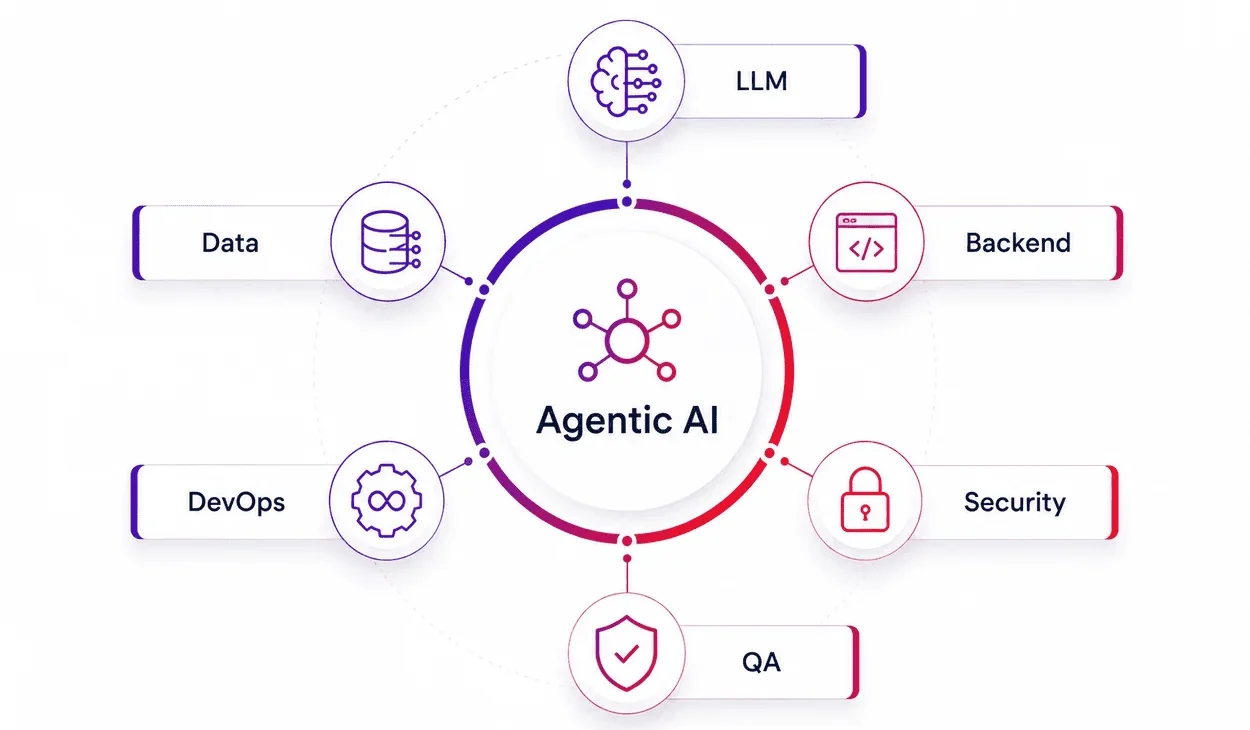
Multi-agent AI development changes the delivery challenge. A single AI assistant may answer questions from a knowledge base. A multi-agent system can plan work, assign tasks, retrieve data, call tools, check policies, escalate exceptions, and complete workflows across applications.
That power comes with responsibility. Each agent needs a clear role. One agent may classify the request. Another may retrieve documents. Another may validate business rules. Another may call an ERP or CRM system. Another may prepare a response for human approval.
This design needs careful orchestration. Agents must know when to act, when to wait, and when to stop. They must not expose sensitive data. They must not trigger business actions without permission. They must produce logs that teams can review.
Gartner predicted that 40% of enterprise applications will include task-specific AI agents by 2026, up from less than 5% in 2025. Gartner also predicted that over 40% of agentic AI projects may be canceled by the end of 2027 due to cost, unclear value, or weak risk controls.
This is why multi-agent systems need specialized teams. A strong AI engineering team brings the required mix. It includes LLM development services, backend engineering, data engineering, DevOps, AI testing, and security review. It also includes business analysis because agents must reflect real operational workflows.
Without this structure, agentic AI projects can become impressive demos that fail in production.
The Skills Required for Modern AI Projects
Modern AI projects need a balanced team. The exact size depends on scope, but each responsibility must be owned.
- An AI solution architect defines the technical direction. This role decides whether the project needs RAG, fine-tuning, agents, workflow automation, or simpler rules. The architect also connects business requirements with system design.
- LLM engineers work on model behavior. They design prompts, structured outputs, tool calling, model routing, and response controls. They also manage latency, accuracy, and cost trade-offs.
- Data engineers prepare the knowledge layer. They manage data pipelines, document ingestion, embeddings, metadata, vector stores, and access rules. Their work directly affects answer quality.
- Backend engineers connect AI features with enterprise systems. They build APIs, business logic, workflow services, and integrations with ERP, CRM, HRMS, ticketing tools, and data platforms.
- AI QA engineers test answer quality, retrieval accuracy, hallucination risk, unsafe prompts, edge cases, and regression. This testing is different from normal software QA because model behavior changes with context.
- DevOps and MLOps specialists handle deployment, monitoring, secrets, logs, scaling, and environment management. They help ensure the system remains reliable after launch.
- Security professionals review access control, prompt injection risks, data exposure, audit needs, and compliance requirements.
- Product owners and business analysts translate operational needs into clear workflows. They define user journeys, acceptance criteria, review points, and success metrics.
Together, these roles form the foundation of an AI development team that can deliver beyond prototypes.
| Role | Core Responsibility | Why It Matters |
|---|---|---|
| AI Solution Architect | Designs architecture, model strategy, governance, and integration flow | Keeps the AI system aligned with business and technology goals |
| LLM Engineer | Handles prompts, tool use, agents, model routing, and structured output | Converts model capability into controlled application behavior |
| Data Engineer | Builds ingestion, metadata, embeddings, and retrieval pipelines | Improves accuracy and context quality |
| Backend Engineer | Develops APIs, workflow logic, and enterprise integrations | Connects AI with real business systems |
| AI QA Engineer | Tests hallucination risk, retrieval quality, and edge cases | Protects reliability before and after release |
| DevOps or MLOps Engineer | Manages deployment, monitoring, scaling, and logs | Keeps AI applications stable in production |
| Security Specialist | Reviews access, data protection, prompt attacks, and compliance | Reduces business and regulatory risk |
| Product Owner | Defines workflows, users, success metrics, and adoption needs | Ensures the AI system solves a real business problem |
*This table does not mean every project needs a large team. It means every function needs ownership. Generative AI staff augmentation helps companies bring in these skills in the right mix.
How Staff Augmentation Accelerates AI Delivery
AI staff augmentation accelerates delivery by removing the wait for specialized hiring. It also improves execution quality when the partner brings practical AI experience.
can help enterprises avoid common mistakes. Many projects fail because teams select tools before clarifying use cases. Some use agents when a retrieval workflow is enough. Others build chat interfaces without evaluation, security, or adoption planning.
brings patterns from real delivery. It can help define architecture, select models, build reusable components, and create safer deployment paths.
also supports internal learning. External AI specialists work with internal developers, architects, and business users. This helps the enterprise build capability while delivering the current project.
This matters because AI cannot remain an isolated vendor activity. Enterprises need internal understanding of data, risk, operations, and long-term support. The best model is shared ownership.
AI developer augmentation also matches the changing needs of a project. Early phases may need AI solution architects and LLM engineers. Build phases may need backend and data engineers. Launch phases may need QA, DevOps, and security support. This flexibility keeps delivery practical.
It also helps companies manage cost. They can add the right specialists for the required duration instead of hiring every role permanently. For fast-moving AI programs, this can reduce delay without weakening control.
How Enterprises Scale Generative AI Teams Faster
Scaling AI teams requires a delivery model, not only more people.
- The first step is to create AI pods around business outcomes. A pod may include an AI architect, LLM engineer, backend developer, data engineer, QA engineer, and product owner. This team should own a use case from design to release.
- The second step is to build reusable AI assets. These may include document ingestion pipelines, prompt logging, model gateways, evaluation test sets, retrieval templates, and monitoring dashboards.
- The third step is to set governance early. Access rules, audit trails, human approval, data retention, and security checks should be part of the architecture. Late governance creates rework.
- The fourth step is to connect AI with existing systems. Enterprise AI becomes useful when it works inside ERP, CRM, HRMS, ticketing systems, document platforms, and analytics tools.
- The fifth step is to measure business impact. AI projects should be judged by operational metrics. These may include resolution time, manual effort reduction, user adoption, quality improvement, cost saving, or faster decision cycles.
- The sixth step is to improve continuously. AI systems need feedback loops, model reviews, prompt updates, data refreshes, and monitoring.
Insights Stack Overflow’s 2025 Developer Survey found that 84% of respondents use or plan to use AI tools in development. It also reported that 51% of professional developers use AI tools daily.
This shows that AI is also changing how engineering teams work. The best teams will not only build AI systems. They will use AI responsibly inside their own delivery process. Generative AI staff augmentation helps enterprises adopt this delivery discipline faster.
| Stage | Enterprise Situation | Team Need | What Progress Looks Like |
|---|---|---|---|
| 1: Exploration | Teams test use cases and AI tools | AI consultant, prototype engineer, product owner | Clear use case shortlist and feasibility view |
| 2: Pilot | One use case moves into development | LLM engineer, data engineer, backend developer | Working pilot with real data and success metrics |
| 3: Production | AI connects with enterprise systems | AI architect, DevOps, security, QA | Secure release with monitoring and user feedback |
| 4: Multi-Agent Expansion | Workflows need planning, tools, and approvals | Agent architect, orchestration engineer, AI QA | Governed agents with logs, fallback, and review |
| 5: AI Platform | Multiple teams build AI use cases | AI engineering pods and platform team | Reusable services, standards, and measurable impact |
This maturity model helps enterprises staff AI work more intelligently. A prototype does not need the same team as a production agent system. Generative AI staff augmentation allows companies to scale team depth as maturity grows.
Choosing the Right AI Implementation Partner
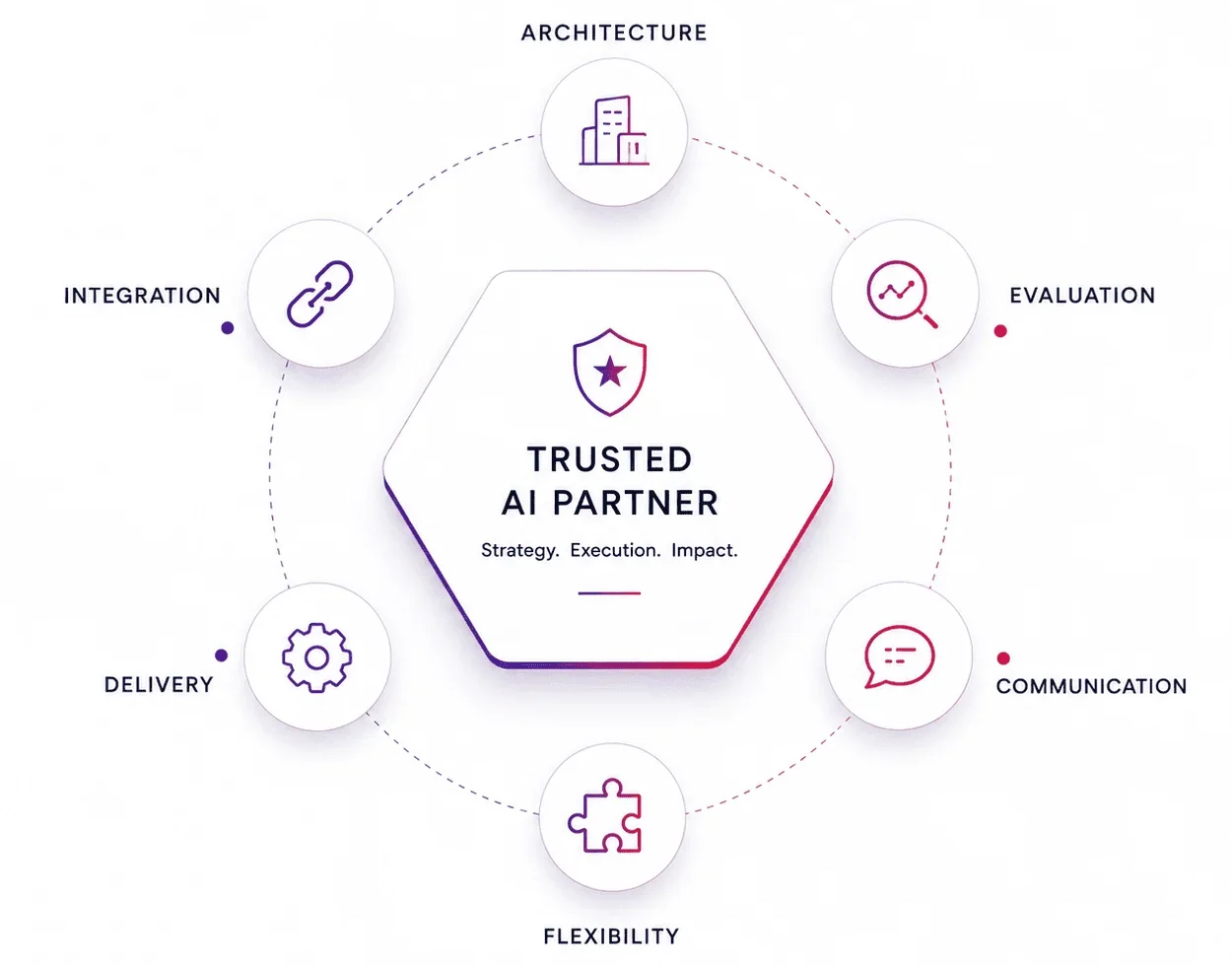
The right AI implementation partner should bring more than resumes. Enterprises should evaluate how the partner thinks about architecture, delivery, risk, and business fit.
- First, the partner should understand enterprise AI development. This includes LLM applications, RAG, AI agents, data engineering, cloud deployment, DevOps, and security.
- Second, the partner should know when not to overbuild. Some use cases need agents. Some need search. Some need classification. Some need workflow automation with human review.
- Third, the partner should have integration experience. Enterprise AI must connect with real systems, not remain inside a separate interface.
- Fourth, the partner should bring evaluation discipline. AI output quality must be tested with real user queries, edge cases, and regression checks.
- Fifth, the partner should support flexible engagement. Some companies need one AI specialist. Others need a full AI engineering team.
- Sixth, communication should be clear. AI projects need close coordination between business, technology, security, and operations teams.
A good partner helps the enterprise make better technical choices. It should reduce uncertainty, not add complexity.
Final Thoughts
Generative AI has changed what enterprises need from technology teams. AI projects now require software skill, data maturity, model understanding, governance, and product thinking.
Multi-agent AI development raises the bar further. These systems need orchestration, permissions, tool access, monitoring, fallback logic, and human review. They need teams that can design for both autonomy and control.
Generative AI staff augmentation gives enterprises a practical way to build that capability. It helps them add specialized skills, reduce hiring delays, scale delivery, and strengthen internal teams through real project work.
The companies that move ahead will not be the ones with the longest AI wish list. They will be the ones that build the right AI development team around the right business problems.
iProgrammer’s Generative AI Staff Augmentation
iProgrammer works with enterprises that need practical AI delivery. Our teams support AI product engineering, LLM development services, RAG systems, multi-agent AI development, workflow automation, cloud engineering, and enterprise software development.
For companies exploring Generative AI staff augmentation, the focus should be simple: build the right team around the business problem. Start with the workflow, the data, the users, and the expected outcome, not the tools. Some organizations need architects to shape the roadmap. Some need developers to support product teams. Some need an end-to-end engineering team to move from pilot to production.
iProgrammer supports these needs through flexible staffing and delivery models. Enterprises can extend their internal team with skilled AI engineers, architects, developers, and implementation specialists. This helps them move faster without losing ownership. It also helps them build AI systems that fit real operations.
If your organization is planning enterprise AI development, agentic workflows, or generative AI-enabled products, iProgrammer can support your team through IT staff augmentation services.
1. How is generative AI staff augmentation different from hiring freelance AI developers?
Generative AI staff augmentation is more structured. It gives enterprises access to vetted specialists, delivery oversight, and team continuity. Freelancers may support narrow tasks. Augmented AI teams can support architecture, development, integration, testing, and deployment.
2. Can AI staff augmentation work with our existing development team?
Yes. The augmented team works with internal developers, product owners, architects, and business users. Internal teams keep business knowledge. External specialists bring AI engineering depth.
3. What projects are best suited for AI developer augmentation?
It works well for RAG applications, AI copilots, enterprise search, AI agents, document intelligence, workflow automation, SaaS AI features, and multi-agent AI development.
4. How should enterprises prepare before starting an AI staff augmentation engagement?
They should prepare use case goals, sample data, system details, security needs, user groups, and success metrics. The partner can then refine architecture, team structure, and delivery phases.
5. Is staff augmentation suitable for long-term enterprise AI programs?
Yes. It can support both short-term delivery and long-term scaling. Enterprises can start with a small AI team, then expand into dedicated pods as use cases grow.